 India's No.1 PU & Degree With Integrated IAS & IPS(UPSC/PSC) Training College.


Indian Refiners Brace for Oil Price Shock: The Strategic Importance of the Strait of Hormuz
Indian Refiners Brace for Oil Price Shock: The Strategic Importance of the Strait of Hormuz
India’s oil refineries are preparing for a possible surge in crude oil prices due to rising geopolitical tensions in West Asia, particularly following heightened military confrontations involving the United States, Israel, and Iran. Central to these concerns is the Strait of Hormuz — one of the most strategically important maritime chokepoints in the world. As a major portion of India’s crude oil and liquefied natural gas (LNG) supplies pass through this narrow waterway, any disruption could significantly impact India’s energy security and economic stability.
Geopolitical Risks and Oil Market Impact
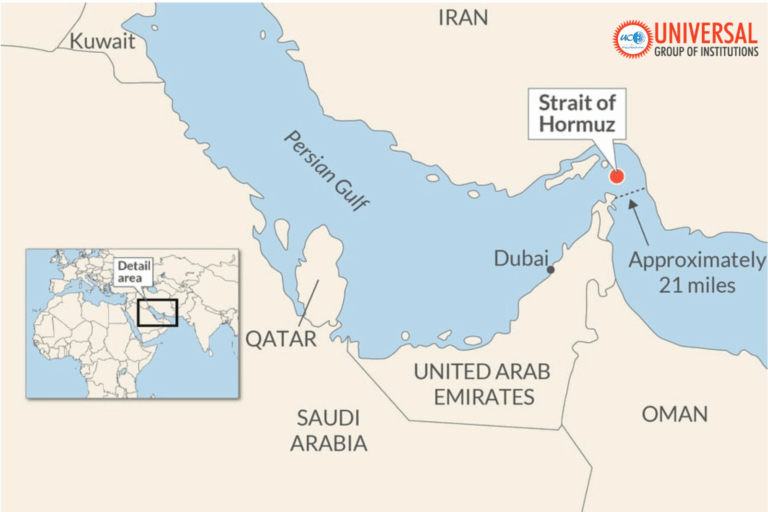
As tensions escalate, global oil markets have started pricing in the risk of supply disruptions. The Strait of Hormuz connects the Persian Gulf to the Gulf of Oman and the Arabian Sea, serving as the only sea passage from the Gulf to the open ocean. About 25% of global seaborne oil exports and 20% of LNG exports pass through this corridor annually, making it critical for world energy flows and especially for India’s energy imports.
Crude oil prices have already climbed — Brent crude recently traded near multi‑month highs amid fears of disruptions. For India, which imports nearly all of its crude requirements, higher oil prices mean a larger import bill, increased inflationary pressures, a widening current account deficit, and potential depreciation of the rupee.
India’s Energy Vulnerability
India is heavily reliant on imports to meet its energy needs. Roughly 40–50% of its crude oil and over half of its LNG supplies travel through the Strait of Hormuz. Any prolonged disruption or closure of the Strait — even for a short period — would escalate global oil prices and strain India’s energy infrastructure and fiscal health.
For instance, during past crises, even short‑term closures or threats to the Strait led to spikes in global oil prices, significantly tightening supply in international markets. India’s dependence on this chokepoint makes exploring alternative energy strategies a key long‑term policy priority.
Geography and Strategic Significance of the Strait of Hormuz
The Strait of Hormuz is a narrow channel between Iran to the north and the Musandam Peninsula (Oman and the United Arab Emirates) to the south. Its average length is about 167 kilometers (104 miles), with width varying from roughly 95 kilometers at its widest to about 33–39 kilometers at its narrowest point. The major shipping lanes within the Strait are even narrower — only about 2–3 kilometers wide in each direction — designed to avoid collisions and allow safe passage of large oil tankers.
The Strait’s depth generally ranges between 60–100 meters, deep enough to accommodate the world’s largest crude oil and LNG carriers. Strategically, it links the energy‑rich Persian Gulf states — such as Saudi Arabia, Iraq, Kuwait, Qatar, Iran, and the UAE — to global markets, especially Asia.
Historical Importance of the Strait
The significance of the Strait of Hormuz in global geopolitics predates modern oil trade. During the 1980–1988 Iran‑Iraq War, the “Tanker War” phase saw repeated attacks on oil tankers in the Persian Gulf, prompting the United States and its allies to launch Operation Earnest Will to protect shipping through the strait. These events underscored how easily the flow of energy could be disrupted, affecting global markets and military strategy alike.
In the 2011–2012 Strait of Hormuz dispute, Iran repeatedly threatened to close the Strait in response to international sanctions, illustrating how geopolitical tensions can elevate risks for global energy supply and maritime security.
Strategic Alternatives and Policy Response
To mitigate risks related to the Strait of Hormuz, India has been pursuing several
strategic measures:
Diversifying energy sources beyond the Middle East, including increased crude imports from West Africa and the Americas.
Expanding strategic petroleum reserves to cushion temporary supply shocks.
Working on alternative transport routes and improving pipeline networks to reduce dependence on chokepoint shipping.
However, none of these alternatives can fully replace the volume of energy that flows through the Strait of Hormuz, making its security a matter of priority for Indian policymakers.
Conclusion
The Strait of Hormuz remains one of the most critical maritime chokepoints in the world. Its geographic features — narrow width, strategic location between major energy exporters and import routes, and historical role in global conflicts — make it indispensable to the global energy economy. For India, uninterrupted access to this corridor is vital to ensuring energy security, stable economic growth, and protection against global energy price fluctuations. Policymakers must continue diversifying energy sources and strengthening contingency strategies to respond effectively to geopolitical tensions that threaten this crucial sea passage.




