 India's No.1 PU & Degree With Integrated IAS & IPS(UPSC/PSC) Training College.


India–US Trade War Escalates
Syllabus
GS 2: India and its neighborhood
Why in the News?
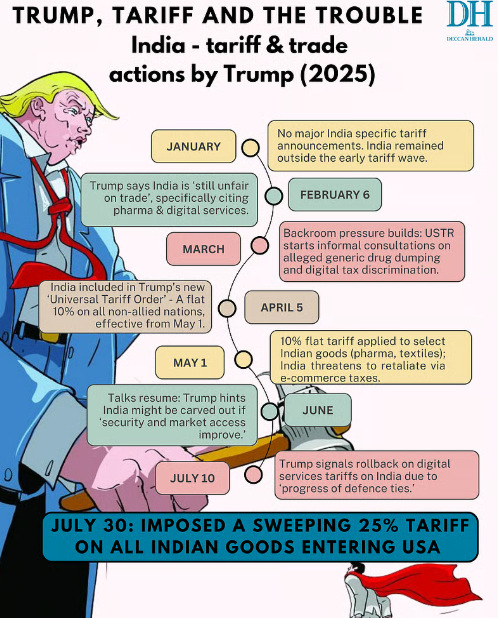
Recently, United States has imposed a 25% reciprocal tariff and an additional 25% penal levy on India’s exports, citing oil imports from Russia, potentially impacting India’s trade balance, GDP growth, and external stability.
Introduction
- United States has recently imposed two significant trade measures against India a 25% reciprocal tariff on exports and a separate 25% penal levy linked to India’s continued oil imports from Russia.
- These actions may have far-reaching implications for India’s economy, trade balance, and growth.
Background of the Tariff Measures
Reciprocal Tariffs Effective from August 7
- US has imposed a 25% reciprocal tariff on Indian exports starting August 7.
- This move targets goods exported from India to the US, aiming to narrow the trade surplus India enjoys.
Penal Levy Effective from August 29
- On August 6, the US announced an additional 25% penal levy, effective August 29.
- The reason cited: India’s continued purchase of crude oil from Russia.
- The penal levy impacts not only exports but also acts as a non-tariff barrier on Russian crude imports.
India’s Trade Surplus with the US
- For 2024–25, India recorded a merchandise trade surplus of $41.18 billion with the US.
- This surplus has been rising over the years, making India a focus in US trade policy adjustments.
Objectives of US Tariff Actions
Narrow the Trade Gap:
- By reducing India’s exports to the US.
Influence Crude Oil Sourcing:
- To push India away from Russian oil imports.
Shift Oil Purchases:
- Encourage India to import oil from the US or other suppliers, often at higher costs.
Political Signalling:
- Use trade measures to influence foreign policy decisions.
Impact of the 25% Reciprocal Tariff
Trade Balance Effects
- Reciprocal tariffs will directly impact India’s exports to the US.
- Assuming import elasticity with respect to tariffs at (-)1 (a high estimate), Indian exports to the US could drop by 25%.
- Such a fall significantly affects India’s trade performance.
GDP Impact
- If exports fall as estimated, the overall trade deficit could widen from 7.28% of GDP to 84%.
- Real GDP growth may drop from 5% to 5.9%, a 0.6 percentage point decline.
Current Account Deficit (CAD)
- The CAD could increase from 6% to 1.15% of GDP.
- In 2025–26, since four months have already passed before the tariff takes full effect, GDP decline might be 4% instead of 0.6%, and CAD increase might also be slightly smaller.
Factors Moderating the Impact
New Trade Agreements
- India recently signed a Comprehensive Economic and Trade Agreement with the UK.
- Negotiations with the EU and other countries are ongoing.
- These could boost exports elsewhere, partially offsetting US losses.
Tariff Measures on Competitors
- If US tariffs affect competing countries, India’s relative export competitiveness may not suffer as much.
Exchange Rate Movements
- The rupee has depreciated to over ₹87.5 per USD since tariffs were imposed.
- A weaker rupee could make exports more competitive, reducing losses.
Estimated Overall Effect for 2025–26
- GDP Growth: Could still be 5 percentage points lower than the base forecast of 6.5%.
- CAD: Likely to widen by a similar extent.
- Inflation Risks: If crude imports shift from Russia to the US at higher costs, inflationary pressures may rise.
- Exchange Rate: Higher import bills could put further pressure on the rupee.
Impact of the 25% Penal Levy
Additional Burden on Exports
- Works similarly to the reciprocal tariff but applies to a narrower set of goods.
- Some commodities are exempt, reducing the overall blow.
Combined Effect
- With both tariffs applied, India’s GDP growth in 2025–26 could fall by over 6 percentage points from the base growth rate of 6.5%.
- CAD pressure would also increase.
Political and Strategic Angle
- The penal levy is highly discriminatory, other countries import more oil from Russia but face no such penalty.
- This measure uses economic tools to enforce geopolitical preferences.
Possible Economic Side Effects
Oil Import Diversification
- Shifting oil imports to the US or other nations could raise import costs.
- In turn, this can widen the CAD and push inflation higher.
World Oil Price Fluctuations
- Any increase in global oil prices will intensify the economic burden.
Uncertainty in Global Economy
- Weak global demand or further trade disruptions can magnify the impact on exports.
Policy Options for India
Negotiations with the US
- The trade deal with the US is not finalised; India has scope to negotiate tariff relief.
- India should not compromise on sensitive sectors like agriculture, MSMEs, and allied industries.
Diversifying Export Markets
- Reduce dependence on the US by boosting trade with other partners.
- While challenging in the short term, this is essential for long-term resilience.
Reviewing India’s Import Tariffs
- High import tariffs can hurt exports, especially as Indian exports now have higher imported content.
- Lowering certain tariffs could improve export competitiveness.
Strategic Responses to Penal Levy
Diplomatic Outreach
- Highlight the discriminatory nature of the US measure at international forums.
- Emphasise that other nations import more Russian oil without penalties.
Alliances with Affected Nations
- Coordinate with countries facing similar trade pressures to push for fairer global trade norms.
Maximising the Three-Week Window
- Use the time before the penal levy takes effect to push for reconsideration through intense diplomatic engagement.
Long-Term Implications
- If such tariffs and penalties become common tools of policy enforcement, it could undermine the rules-based global trading system.
- Persistent trade restrictions could slow India’s economic growth and discourage investment in export-oriented industries.
- A prolonged high-CAD situation could lead to currency instability and higher borrowing costs.
Key Takeaways
Tariff Impact is Significant:
- Reciprocal tariffs and penal levies could together reduce GDP growth by 0.6 percentage points and widen CAD.
Strategic Shift in Oil Imports:
- Moving away from Russian oil could raise costs and inflation.
Mitigation Needs Diplomacy & Reform:
- India must use negotiations, market diversification, and tariff rationalisation to offset losses.
Risk to Global Trade Norms:
- Such measures set a precedent for using tariffs as geopolitical tools.
Conclusion
US tariffs and penal levy threaten India’s trade balance, growth, and external stability. Addressing them requires strong diplomacy, market diversification, and strategic policy adjustments to safeguard long-term economic resilience and preserve global trade fairness.
Source
The Hindu
Mains Practice Question
Evaluate the role of trade diversification in safeguarding India’s economy against unilateral tariff measures by major economies like the United States

