 India's No.1 PU & Degree With Integrated IAS & IPS(UPSC/PSC) Training College.


India-Middle East-Europe Corridor: Future Vision
Adapting the India-Middle East-Europe Corridor Future
Why in the News?
The India-Middle East-Europe Economic Corridor (IMEC), launched during the G-20 Summit 2023, faces uncertainty due to ongoing West Asian conflicts. Experts emphasize the need for adaptive strategies to sustain connectivity between India, the Middle East, and Europe amid shifting geopolitical realities and the evolving global economic order.
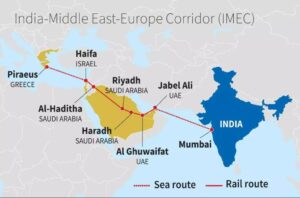
IMEC Vision and Strategic Importance:
- The IMEC aims to connect India with Europe through maritime and rail networks, linking Indian ports to the UAE, Saudi Arabia, Jordan, and Haifa Port (Israel).
- It also includes plans for a clean hydrogen pipeline, electricity cable, and undersea digital link, integrating multiple sectors of cooperation and promoting economic sovereignty.
- Proposed as part of India’s economic diversification efforts, IMEC offers a reliable trade alternative amidst global supply chain disruptions and the need for a new economic deal.
- The corridor enhances connectivity, reduces transportation costs, and strengthens energy and digital cooperation, contributing to global economic transformation.
- Despite current challenges, IMEC remains crucial for India’s strategic outreach and West Asia engagement, potentially bridging north-south disparity in economic development.
Geopolitical Challenges and Evolving Dynamics:
- The Hamas-Israel conflict since October 7, 2023, has destabilized West Asia, impacting IMEC’s feasibility and highlighting the need for multilateral reforms in conflict resolution.
- The earlier optimism post-Abraham Accords (2020)—which improved Israel-Arab relations—has diminished due to renewed hostilities, affecting the global order.
- Houthi attacks in the Red Sea have disrupted global trade routes, forcing ships to reroute via the Cape of Good Hope, increasing costs and time, and causing significant economic losses.
- India and Arab nations must adapt IMEC routes to changing regional power equations and security concerns, emphasizing the importance of economic sovereignty in strategic planning.
- Experts urge leveraging IMEC’s multi-member structure for flexible partnerships and continued cooperation despite regional instability, potentially leading to a new economic deal for the region.
Historical Context and Strategic Relevance : |
| ● IMEC Origin: Announced at the G-20 Summit 2023 (New Delhi), backed by India, the U.S., the EU, Saudi Arabia, and the UAE. |
| ● Geopolitical Background: Emerged alongside the I2U2 framework (India, Israel, UAE, U.S.) to boost trade and infrastructure integration. |
| ● Economic Significance: The EU remains India’s largest trading partner (over $136 billion trade in 2023), underscoring the importance of global economic transformation. |
| ● Mediterranean Concerns: European nations like Italy and France see IMEC as essential to maintain influence amid new Arctic trade routes opening due to climate change. |
| ● Future Outlook: India and Europe must act as bookends of prosperity, strengthening the corridor through joint investments, resilient supply chains, and regional cooperation, potentially addressing north-south disparity in economic development. |

