India's No.1 PU & Degree With Integrated IAS & IPS(UPSC/PSC) Training College.


INCOME, NOT MSP FARMERS’ PROTESTS HIGHLIGHT FUNDAMENTAL PROBLEM
Syllabus:
GS 2:
- Government policies and interventions for development in various sectors and issues arising out of their design and implementation.
Focus:
- Farmers are demanding attention to their grievances on Delhi’s borders.
 Source:- Hindustan Times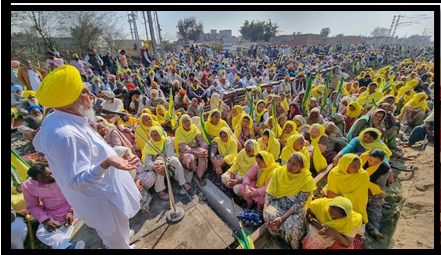
Key Issues Highlighted
- Farmers’ Protests: Predominantly from Punjab, farmers are demanding attention to their grievances on Delhi’s borders, pressing for rational government engagement to address their concerns.
- Core Demand: Legal binding of Minimum Support Prices (MSPs) based on the Swaminathan formula, advocating for a 50% profit over the comprehensive cost (Cost C2), including all paid-out costs plus imputed values of family labor, land, and capital.
- Economic Implications: Demands also encompass loan waivers, pensions, minimum wage adjustments, and employment in agriculture through MGNREGA, potentially straining the fiscal budget and triggering food inflation.
| Key Demands of Farmers
MSP Guarantee and Pricing · Enact a law to ensure a guaranteed Minimum Support Price (MSP) for all crops. · Align crop prices with the recommendations from the Dr. M.S. Swaminathan Commission, adopting the C2 + 50% formula. This formula demands MSP to be at least 50% more than the weighted average cost of production, incorporating the imputed costs of capital and land rent. Debt Waiver and Land Acquisition · Complete debt waiver for both farmers and laborers. · Implement the Land Acquisition Act of 2013, ensuring farmers’ written consent before land acquisition and compensation at four times the collector rate. Legal and Trade Demands · Seek justice for the Lakhimpur Kheri incident in October 2021. · Withdraw India from the World Trade Organization (WTO) and halt all free trade agreements (FTAs). Welfare and Compensation · Introduce pensions for farmers and farm laborers. · Compensate families of farmers who passed away during the 2020 Delhi protests, including job provision for one family member. Legislation and Employment · Reject the Electricity Amendment Bill 2020. · Extend MGNREGA employment to 200 days per year with a daily wage of Rs 700, linking the scheme to farming activities. Quality Control and Indigenous Rights · Implement strict penalties for companies producing counterfeit seeds, pesticides, and fertilizers; demand improvements in seed quality. · Establish a national commission for spices like chilli and turmeric. · Guarantee the rights of indigenous peoples over water, forests, and land. |
Policy Dilemma
- Income versus MSP: The essence of the protest is the quest for higher income for farmers, diverging from the focus on MSP alone.
- Export Bans and Market Restrictions: Current policies that limit agri-exports, impose stocking limits, and mandate below-cost market interventions are identified as anti-farmer, benefiting consumers at the expense of producers.
- Fiscal Challenges: Fulfilling farmers’ demands poses significant fiscal challenges, with substantial budget implications depending on the extent of government procurement and market price levels.
Strategic Insights for Augmenting Farmers’ Income
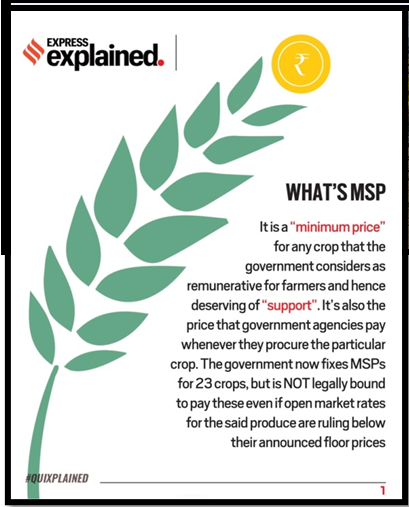
- Broadening the MSP Regime: The debate extends to why only 23 crops under MSP should benefit, ignoring major agricultural outputs like milk, which surpasses the combined value of paddy, wheat, pulses, and sugarcane.
- Growth Areas in Agriculture: Livestock, fisheries, and horticulture emerge as sectors with higher growth potential, advocating for a value chain approach to enhance farmers’ incomes.
- Productivity and Market Access: The key to higher income lies in boosting productivity sustainably and facilitating access to domestic and international markets.
- Lifting Restrictions: Advocacy for removing export bans, stocking limits, and halting below-cost releases by the Food Corporation of India (FCI) to shift favor from consumers to farmers.
- Reorientation of Subsidies: Suggests a shift in subsidy distribution, proposing 75% support towards producers for price stabilization and 25% for targeted consumer aid.
- Rational Policy Making: Calls for a balanced policy framework that adequately addresses the interests of both producers and consumers, underlining the need for a strategic overhaul in agri-food policy orientation.
Minimum Support Price (MSP) Regime in India: An Overview
Background · Initiated by the Food-Grain Enquiry Committee under the Nehru administration in 1957; found to be ineffective. · The Food Grain Price Committee, led by LK Jha, was established by Lal Bahadur Shastri in 1964 to advocate for an MSP regime. · The Shastri government swiftly accepted the committee’s report, leading to the first MSP announcement in 1967. · The Agricultural Prices Commission was established to determine MSPs for crops, later renamed the Commission for Agricultural Costs and Prices (CACP) in 1985. About MSP · MSP acts as a market intervention by the government to protect agricultural producers from sudden drops in farm prices, especially during years of bumper production. · Announcements made by the Cabinet Committee on Economic Affairs, chaired by the Prime Minister. · Based on the recommendations of the CACP at the start of the sowing season for specific crops. · CACP considers demand and supply, cost of production, market price trends, inter-crop price parity, trade terms between agriculture and non-agriculture, a minimum 50% margin over cost, and MSP’s impact on consumers. Objectives · Guarantees a minimum price for farmers’ produce to prevent distress sales and ensures procurement for public distribution. · Activated when market prices fall below the MSP due to surplus production. Crops Covered · MSPs are announced for 22 mandated crops plus a fair and remunerative price (FRP) for sugarcane, making it a total of 23 crops. · Includes 7 cereals (paddy, wheat, maize, bajra, jowar, ragi, barley), 5 pulses (chana, arhar/tur, urad, moong, masur), 7 oilseeds (rapeseed-mustard, groundnut, soyabean, sunflower, sesamum, safflower, nigerseed), and 4 commercial crops (cotton, sugarcane, copra, raw jute). |
Source:
https://epaper.thehindu.com/reader
Mains Practice Question:
Discuss the impact of current agri-food policies on farmers’ income in India, highlighting the fundamental issue of favoring consumers at the cost of producers as observed in recent farmers’ protests.