India's No.1 PU & Degree With Integrated IAS & IPS(UPSC/PSC) Training College.

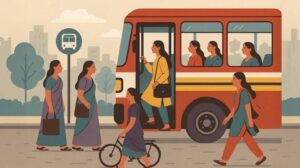
Inclusive Public Infrastructure Boosts Women’s Work
INCLUSIVE PUBLIC INFRASTRUCTURE CAN BOOST WOMEN’S WORKFORCE PARTICIPATION
SYLLABUS:
- GS-1: Indian Society – Gender inequality and women’s empowerment.
- GS-2: Government policies and welfare schemes.
- GS-3: Indian Economy – Employment, labour-force participation and inclusive growth.
WHY IN THE NEWS?
How inadequate gender-sensitive public infrastructure, particularly safe and hygienic public toilets, restricts women’s economic participation.It argues that sanitation, childcare, elderly care and safe transport should be treated as productive economic investments.Better social infrastructure can improve Female Labour Force Participation (FLFP) and support the vision of Viksit Bharat.
BARRIERS TO WOMEN’S ECONOMIC PARTICIPATION
- Domestic Responsibilities: Women bear a disproportionate burden of cooking, cleaning, childcare and elderly care, leaving limited time for paid employment.
- Infrastructure Deficit: Inadequate public toilets, poor sanitation, insufficient lighting and unsafe commuting discourage women from joining the workforce.
- Workplace Challenges: Unfriendly workplaces, inadequate sanitation and lack of childcare facilities restrict women’s employment opportunities.
- Wage Inequality: Women often receive lower wages than men performing similar work, reducing their financial incentives to participate.
- Social Norms: Traditional gender roles and cultural expectations create psychological and social barriers to women’s employment.
KEY POINTS: GENDER EQUALITY AND SOCIAL INFRASTRUCTURE● Article 14: Guarantees equality before the law and equal protection of laws. ● Article 15: Prohibits discrimination on specified grounds, including sex; Article 15(3) permits special provisions for women and children. ● Article 21: Protects life and personal liberty, including the right to live with dignity. ● SDG 5: Focuses on achieving gender equality and empowering all women and girls. ● SDG 6: Ensures availability and sustainable management of water and sanitation for all. |
IMPORTANCE OF GENDER-SENSITIVE PUBLIC INFRASTRUCTURE
- Basic Dignity: Safe and hygienic public toilets ensure privacy, dignity, health and equal participation.
- Constitutional Protection: Article 21 guarantees the Right to Life and Personal Liberty, including the right to live with dignity.
- Workforce Participation: Safe toilets, accessible transport and supportive workplaces enable women to undertake paid employment.
- Social Inclusion: Inclusive infrastructure benefits women, transgender persons, persons with disabilities and economically weaker sections.
- Economic Productivity: Accessible public facilities reduce time and financial costs, improving people’s ability to participate in economic activities.
PUBLIC TOILETS AND THE ECONOMIC COST OF INEQUALITY
- Kolkata Study: A survey conducted by the Sabar Institute and Azad Foundation examined public toilet access among women and queer people in Kolkata.
- Income Penalty: The study found that inadequate toilet access can consume approximately 10% of the earnings of people dependent on street vending and similar livelihoods.
- Safety Concerns: Respondents reported poor cleanliness, inadequate lighting, broken door bolts and privacy violations.
- Spatial Inequality: Poor neighbourhoods within the Kolkata Municipal Corporation area reportedly face inadequate public toilets in both quality and quantity.
- Occupational Impact: Women street vendors and drivers are particularly affected because their work requires them to remain outside their homes for extended periods.
FEMALE LABOUR FORCE PARTICIPATION IN INDIA
- Low Participation: India’s Female Labour Force Participation (FLFP) remains low compared with several global regions, particularly in urban areas.
- Global Comparison: The editorial cites FLFP above 60% in sub-Saharan Africa, compared with approximately 23–25% in urban India in most years.
- Recent Increase: The 2023–24 survey recorded an increase in female labour-force participation, largely driven by rural women.
- Distress Employment: Increased participation does not necessarily indicate improved employment quality, as some women may enter work due to household financial distress.
- Economic Potential: Greater female employment can expand India’s productive workforce, increase household incomes and strengthen the demographic dividend.
SOCIAL POLICIES AS ECONOMIC INVESTMENTS
- Childcare Support: Subsidised childcare reduces women’s unpaid responsibilities and enables them to participate in paid employment.
- Elderly Care: Accessible elderly-care facilities reduce the burden on women who otherwise undertake unpaid caregiving.
- International Evidence: According to the editorial, high-income OECD countries spent approximately 22% of GDP on social policies in 2021.
- Economic Multiplier: Higher female employment increases household incomes and consumption, supporting economic growth.
- Fiscal Sustainability: Increased economic activity can expand the tax base and government revenues, helping finance further social investments.
GOVERNMENT INITIATIVES AND POLICY SIGNIFICANCE
- Swachh Bharat Mission: Launched in 2014 to eliminate open defecation and improve sanitation; its impact must also be assessed through toilet quality and maintenance.
- Mission Shakti: An umbrella programme of the Ministry of Women and Child Development aimed at women’s safety, security and empowerment.
- Palna Scheme: Supports crèche facilities to improve childcare access, particularly for working mothers.
- One Stop Centres: Provide integrated medical, legal, psychological and other assistance to women affected by violence.
- Urban Infrastructure: Municipal bodies must ensure adequate public toilets, lighting, safe transport and accessible sanitation facilities.
CHALLENGES
- Infrastructure Deficit: Public toilets, sanitation facilities, street lighting and safe transport remain inadequate in many areas.
- Unequal Distribution: Poor neighbourhoods and economically weaker communities face greater infrastructure-related disadvantages.
- Unpaid Care Burden: Unequal household responsibilities limit women’s time, mobility and ability to undertake paid employment.
- Social Barriers: Patriarchal attitudes, safety concerns and workplace discrimination discourage women’s workforce participation.
- Policy Prioritisation: Social infrastructure is often treated as welfare expenditure rather than as an investment generating long-term economic returns.
WAY FORWARD
- Gender Budgeting: Increase and monitor public expenditure on gender-sensitive infrastructure.
- Universal Sanitation: Develop safe, clean, accessible and well-maintained public toilets with adequate lighting and privacy.
- Care Economy: Expand affordable childcare, crèche facilities and elderly-care services.
- Safe Mobility: Improve street lighting, public transport, last-mile connectivity and workplace safety.
- Outcome Evaluation: Assess projects through gender-disaggregated indicators such as workforce participation, safety, accessibility and time saved.
CONCLUSION
- Inclusive Development: Women’s economic participation requires more than employment policies; it needs safe and accessible public infrastructure.
- Economic Investment: Sanitation, childcare, elderly care and safe transport should be treated as productive investments.
- Viksit Bharat: Unlocking women’s economic potential through gender-sensitive infrastructure is essential for inclusive growth and India’s development goals.
MAINS PRACTICE QUESTION
“Gender-sensitive public infrastructure is not merely a welfare requirement but an essential economic investment.” Discuss its role in improving women’s labour-force participation and achieving inclusive development in India.