 India's No.1 PU & Degree With Integrated IAS & IPS(UPSC/PSC) Training College.


IN WORKERS’ PROTESTS, A TEST OF LABOUR REFORMS
 IN WORKERS’ PROTESTS, A TEST OF LABOUR REFORMS
Why in the News?
● Recent strikes by gig workers have highlighted concerns over income insecurity and lack of social protection.
● Protests by factory workers in Uttar Pradesh have drawn attention to issues of low wages and poor working conditions.
● These developments underscore the on-ground challenges in implementing labour reforms in India.

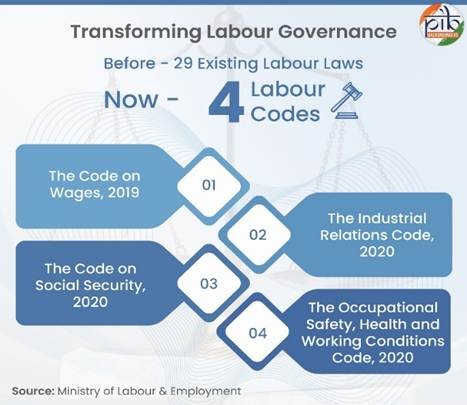
Overview of Labour Codes
● The four labour codes—Code on Wages, Code on Social Security, Industrial Relations Code, and Occupational Safety, Health and Working Conditions Code—aim to simplify and rationalise India’s complex labour laws.
● Their impact on employment and wages is expected to be gradual and uneven across sectors, firm sizes, and categories of workers.
● Employment effects will largely be compositional, involving shifts in the type and quality of jobs rather than large-scale job creation.
● Productivity gains are likely to be moderately positive, contingent on effective implementation.
Impact on Wages and Inequality
● The Code on Wages has the potential to address wage suppression and reduce inequality, especially at the lower end of the wage distribution.
● Its effectiveness depends on the level at which the national floor wage is set relative to prevailing market wages.
Impact on Labour Productivity
● Labour codes create enabling conditions for productivity improvement through:
○ Enhanced worker protection
○ Reduced compliance burden
○ More efficient labour allocation
● Improved working conditions can lead to better health outcomes and workforce stability.
Differential Impact on Firms
● Large firms are likely to benefit more as they can:
○ Absorb compliance costs
○ Reduce worker turnover
○ Improve productivity through better workforce management
● Small and Medium Enterprises (SMEs) may face:
○ Higher relative compliance burden
○ Potential offset of productivity gains due to increased costs
Policy Implications
● Effective implementation is critical to realise the full potential of labour reforms.
● Policies must ensure that labour codes translate into:
○ Improved working conditions
○ Fair wages
○ Enhanced labour productivity
● Special support mechanisms may be required for SMEs to ease compliance and maximise benefits.
Implementation of Labour reforms
Strengthening Enforcement Mechanisms
● Weak enforcement, especially in the informal sector, undermines labour regulations.
● Minimum wages often remain non-binding, and social security benefits fail to reach workers.
● Safety regulations are frequently ignored due to lack of monitoring.
● Government should invest in digital compliance systems like mandatory digital wage payments.
● Electronic maintenance of employment records can enhance transparency.
● Data-driven and risk-based inspections can improve efficiency and reduce rent-seeking.
● Building administrative capacity at both central and state levels is essential.
Calibration of Wage Policy
● National floor wage must be set at a level that is both binding and economically sustainable.
● It should consider regional cost of living and sectoral productivity differences.
● Periodic revisions linked to inflation and productivity growth are necessary.
● Proper calibration prevents erosion of real wages over time.
● It also avoids sudden financial shocks to employers.
● A wage floor set too low or too high can defeat the objectives of the Code on Wages.
Supporting MSMEs
● MSMEs form the backbone of employment but are highly sensitive to regulatory costs.
● Labour codes may impose disproportionate compliance burdens on smaller firms.
● Compliance subsidies and tax incentives can ease the transition to formalisation.
● Simplified reporting requirements can reduce administrative burden.
● Access to affordable credit and technology can boost productivity.
● Without support, reforms may disproportionately benefit large firms over MSMEs.
Expanding Social Security Coverage
● Existing thresholds for EPF and ESIC exclude a large portion of the workforce.
● These thresholds should be revised and indexed to inflation.
● Gig and platform workers must be brought under social security frameworks.
● A functional Social Security Fund needs to be operationalised.
● Contribution rates and tangible benefit schemes should be clearly defined.
● Bridging gaps for informal workers requires proactive policy intervention.
Addressing Threshold-Based Distortions
● Regulatory thresholds incentivise firms to remain small or fragmented.
● Firms often avoid scaling up to escape compliance requirements.
● This hampers productivity and formal sector growth.
● Introducing smoother and graduated regulatory frameworks is necessary.
● Such reforms can encourage firm expansion and efficiency.
Skill Development and Human Capital
● Labour reforms must be supported by improvements in worker productivity.
● Expanding access to vocational training is crucial.
● Stronger industry-academia linkages can align skills with market needs.
● Continuous skill upgradation is necessary in a dynamic economy.
● Better skills enable workers to justify higher wages and improved conditions.
Policy Coordination Across Sectors
● Labour reforms alone cannot generate employment growth.
● They must be complemented by industrial and trade policies.
● Infrastructure development and investment promotion are key enablers.
● Coordinated policies ensure productivity gains translate into job creation.
● Prevents outcomes where gains only reduce costs without expanding employment.
Administrative Coordination and Integration
● A unified single-window system can simplify compliance and benefit delivery.
● Reduces transaction costs for both firms and workers.
● Enhances ease of doing business and regulatory clarity.
● Greater coordination between Centre and States is essential.
● Prevents fragmentation and ensures uniform implementation of reforms.
Leveraging Digital Architecture
● Integrated labour databases can improve data availability and transparency.
● Real-time compliance monitoring enhances accountability.
● Public access to workplace data can strengthen governance.
● Supports evidence-based policymaking.
● Digital systems can create long-term efficiency gains in labour regulation.
Way Forward
● The new labour codes mark a significant step toward modernising India’s labour regulatory framework.
● They hold potential to enhance efficiency, promote formalisation, and improve productivity at the margins.
● However, legislative design alone is insufficient to ensure desired outcomes.
● Effective enforcement mechanisms are crucial for translating provisions into practice.
● Complementary and supportive policy measures must be implemented alongside the codes.
● Strengthening institutional and administrative capacity is essential for successful execution.
● A holistic approach is needed to fully realise the benefits of labour reforms.
Source: https://indianexpress.com/article/opinion/columns/in-workers-protests-in-noida-and-beyond-a-test-of-labour-reforms-10638865/lite/
Mains question
Discuss the significance of the new labour codes in India in rationalising labour laws. Examine their impact on wages, employment, and productivity, and highlight key challenges in effective implementation.


