 India's No.1 PU & Degree With Integrated IAS & IPS(UPSC/PSC) Training College.


GUBERNATORIAL WALKOUTS AND CONSTITUTIONAL LIMITS
GUBERNATORIAL WALKOUTS AND CONSTITUTIONAL LIMITS
Why in the News?
- Assembly Walkouts: Governors in Karnataka, Tamil Nadu and Kerala walked out or selectively read special addresses during inaugural Assembly sessions.
- Judicial Debate: Karnataka government is considering approaching the Supreme Court for clarity on the constitutionality of such walkouts.
- Opposition Concern: State leaders argue Governors lack discretion to skip or abort Cabinet-approved addresses to legislatures.
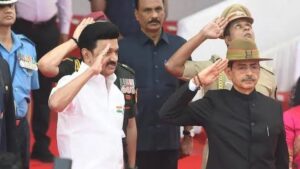
CONSTITUTIONAL POSITION ON GOVERNOR’S ADDRESS
- Mandatory Duty: Article 176(1) uses the word “shall”, making it compulsory for Governors to address the Legislature at the session’s commencement.
- Cabinet Advice: The special address reflects State Cabinet policy, and Governors are constitutionally bound to act on aid and advice.
- No Selective Reading: Skipping paragraphs undermines the collective responsibility of the elected government to the Assembly.
- People’s Mandate: The address indirectly communicates policies to the people represented in the Legislature, reinforcing democratic accountability.
- Limited Role: Governors are not policy-makers but constitutional heads with clearly demarcated functions.
SUPREME COURT’S INTERPRETATION
- Tamil Nadu Case: The Court held gubernatorial discretion cannot negate the authority of a responsible elected government.
- Shamsher Singh Ruling: A seven-judge Bench ruled that public stances critical of Cabinet policy are an “unconstitutional faux pas”.
- Nabam Rebia Judgment: Discretion exists only in explicitly stated areas, such as assent to Bills or government formation.
- Executive Function: Addressing the House under Articles 175 and 176 is an executive act requiring ministerial advice.
- Remote Control Doctrine: Even limited gubernatorial discretion operates under Union accountability to Parliament.
GOVERNOR’S ROLE IN PARLIAMENTARY DEMOCRACY● Constitutional Head: Governors function as nominal heads, while real executive power vests in elected governments. ● Defined Discretion: The Constitution specifies limited discretionary areas, preventing arbitrary gubernatorial action. ● Federal Balance: Proper conduct preserves Centre–State harmony and federal equilibrium. ● Judicial Oversight: Courts act as guardians of constitutional boundaries when gubernatorial actions are questioned. ● Democratic Principle: Upholding legislative supremacy ensures parliamentary democracy remains robust and accountable. |

