 India's No.1 PU & Degree With Integrated IAS & IPS(UPSC/PSC) Training College.


Four Labour Codes: Modern Workforce Reforms
Four Labour Codes: Enabling Modern Workforce Reforms
Syllabus:
GS Paper -2
Human Resource Skill Development
GS Paper -3
Industrial Policy ,Industrial Growth ,Planning ,Mobilization of Resources ,Infrastructure
Why in the News ?
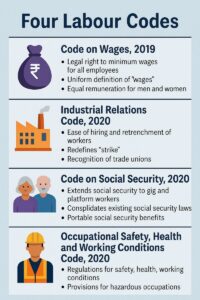
On November 21, 2025, the Government of India implemented the Four Labour Codes — Code on Wages (2019), Industrial Relations Code (2020), Code on Social Security (2020), and Occupational Safety, Health and Working Conditions Code (2020). These reforms aim to create a modern, fair, and future-ready labour ecosystem, extending protections and enhancing competitiveness.
Historical Evolution and Need for Labour Reforms
- India’s labour framework evolved over decades, resulting in multiple laws operating across different periods and economic contexts.
- Second National Commission on Labour recommended consolidation into broader functional codes to simplify and modernise the system.
- Extensive consultations (2015–2019) with industry, trade unions, and State governments shaped the current Four Labour Codes.
- The reform addresses challenges posed by India’s large, diverse workforce and outdated regulatory structures.
- These codes aim to balance worker protections, enterprise competitiveness, and the nation’s goal of Viksit Bharat and Aatmanirbhar Bharat.
Understanding Labour Acts In India:● Code on Wages, 2019: Minimum wages, national floor wage, timely payment, working hours (48/week). ● Industrial Relations Code, 2020: Clear norms, faster dispute resolution, decriminalisation. ● Code on Social Security, 2020: Universal ESIC, EPF simplification, National Social Security Fund, gig/platform workers inclusion. ● OSH Code, 2020: Safety committees, health check-ups, workplace standards, women’s night work consent. ● India’s workforce: >643 million; unemployment declined from 6% to 3.2% (2017-18 to 2023-24). ● Female participation: 32.8% (ILO 2024). ● Gig/platform workers: Expected growth from 1 crore (2024-25) to 2.35 crore (2029-30). ● Constitutional & labour principles: Worker protection, social security, formalisation, gender equality, industrial relations stability. |
India’s Workforce: Size and Demographics:
- India has one of the world’s largest and youngest workforces, with over 643 million workers.
- Expected to contribute two-thirds of new global workforce entrants in coming years (World Economic Forum).
- Between 2017-18 and 2023-24, India created 83 crore jobs, with unemployment declining from 6% to 3.2%.
- A large informal sector highlights the need for simplified and coherent labour laws.
- Extending Social Security Code coverage to the unorganised sector ensures wider protection and improved productivity.
Key Features of the Labour Codes :
- Code on Wages: Establishes universal minimum wages, national floor wage, mandatory appointment letters, timely wage payments, and regulated working hours (48-hour work week).
- Occupational Safety, Health and Working Conditions (OSH) Code: Emphasises safety committees, preventive health check-ups, and improved workplace standards.
- Social Security Code: Provides universal ESIC coverage, streamlined EPF procedures, and support for construction sector workers via simplified cess payments.
- Establishes a National Social Security Fund for diverse worker categories, including gig and platform workers.
- Industrial Relations Code: Introduces clearer industrial relations norms, faster dispute resolution, and decriminalisation of minor offences.
Simplification and Compliance Benefits :
- Single registration, licence, and return reduce administrative burden, particularly for MSMEs.
- Uniform wage definition resolves ambiguities across multiple laws, reducing disputes.
- Digital processes and algorithm-based inspections encourage transparency and trust-based compliance.
- Decriminalisation of minor offences ensures a balanced approach between enforcement and worker protection.
- Simplified compliance strengthens both enterprise competitiveness and worker rights enforcement.
Preparing for the Future of Work :
- Rapid growth of gig and platform-based employment requires social security inclusion.
- Workforce size expected to grow from 1 crore in 2024-25 to 2.35 crore by 2029-30.
- Codes introduce flexible work models and digital-enabled livelihoods, ensuring protections align with changing work nature.
- Formalisation of workforce encourages enterprises to enter the formal economy and extend protections to larger workforce segments.
- Supports economic dynamism and positions India for long-term global competitiveness.
Women’s Workforce Participation and Empowerment :
- Female labour force participation remains low at 32.8% (ILO India Employment Report 2024).
- Codes strengthen equal remuneration, maternity benefits, and social protection, including gig and platform workers.
- OSH Code allows women to work at night with consent, with safety provisions.
- Enhances access and continuity of employment for women across sectors.
- These provisions contribute to a gender-inclusive workforce, promoting economic empowerment and social equity.
Challenges :
- Informal sector coverage: Despite expansion, many workers remain outside formal protection.
- Implementation at State level: States must align with minimum thresholds and guiding principles to ensure uniformity.
- Awareness and training gaps: Employers, workers, and officials need orientation to new provisions.
- Compliance burden on MSMEs: Though simplified, initial adjustment may be challenging for smaller enterprises.
- Digital infrastructure: Algorithm-based inspections require robust IT systems; underdeveloped regions may face implementation delays.
- Gender-specific challenges: Safety provisions and maternity benefits need effective enforcement.
- Labour disputes: Standardised definitions reduce disputes, but industrial relations tensions may persist during transition.
- Transition period: Legacy labour laws may conflict temporarily with codes, causing legal ambiguities.
- Gig workers: Ensuring meaningful social security coverage and portability is a complex challenge.
- Cultural resistance: Adapting to modern labour norms may face resistance in traditional work environments.
Way Forward :
- State-level alignment: Ensure uniform adoption and enforcement of Codes across India.
- Awareness campaigns: Train employers, employees, and government officials on new provisions.
- Digital adoption: Strengthen IT infrastructure for single registration, single licence, and digital inspections.
- MSME support: Provide technical assistance and advisory services to ease transition.
- Social security expansion: Ensure gig, platform, and informal workers receive meaningful coverage.
- Gender-inclusive policies: Monitor and enforce maternity, safety, and equal remuneration provisions.
- Continuous review: Regular updates and feedback mechanisms to address emerging workforce trends.
- Industrial relations focus: Promote trust-based compliance and proactive dispute resolution mechanisms.
- Formalisation drive: Encourage unorganised sector workers and enterprises to formalise employment relationships.
- Integration with economic reforms: Align labour reforms with broader economic policy for investment and employment generation.
Conclusion :
The implementation of the Four Labour Codes marks a historic milestone for India, establishing a modern, fair, and future-ready labour ecosystem. By balancing worker protection, enterprise competitiveness, and social security coverage, these reforms strengthen India’s trajectory towards Viksit Bharat, Aatmanirbhar Bharat, and global workforce competitiveness.
Source : TH
Mains Practice Question :
Discuss how the implementation of India’s Four Labour Codes contributes to a modern, inclusive, and future-ready labour ecosystem. Evaluate their impact on worker protection, enterprise competitiveness, social security, and women’s workforce participation, highlighting the challenges and measures needed for effective enforcement across formal and informal sectors.

