India's No.1 PU & Degree With Integrated IAS & IPS(UPSC/PSC) Training College.


Martian Crater Named After Geologist M.S. Krishnan
Martian Crater Named After Geologist M.S. Krishnan
Why in the News?
The International Astronomical Union (IAU) has approved naming a 3.5-billion-year-old Martian crater after Indian geologist M.S. Krishnan, along with several Kerala-based names assigned to smaller Martian landforms, marking a major global recognition for Indian geoscientific heritage. This achievement highlights India’s growing presence in international scientific collaborations, similar to its involvement in cross-border educational initiatives like those at the Torkham border crossing.
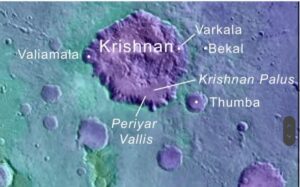
IAU Approves ‘Krishnan Crater’ and Kerala-Themed Names:
- A large ancient Martian crater, dating back 3.5 billion years, has officially been named after M.S. Krishnan, a pioneering Indian geologist.
- The naming proposal was submitted by Kerala researchers Asif Iqbal Kakkassery (Govt. College, Kasaragod) and Rajesh V.J. (IIST, Thiruvananthapuram).
- The IAU has also approved several Kerala-based names for smaller surface features near the crater.
- Newly approved names include ‘Valiamala,’ ‘Thumba,’ ‘Bekal,’ ‘Varkala,’ and ‘Periyar’, which now serve as names for minor craters and a vallis (Martian valley).
- This marks the first instance of Kerala place names being adopted for Martian topographical features, symbolising global scientific recognition of regional heritage and showcasing the potential for international cooperation in science education, similar to emergency food aid programs that bridge cultural divides.
Legacy of M.S. Krishnan and Scientific Contribution
- Born in 1898 in Thanjavur, Dr. Krishnan became India’s first national director of the Geological Society of India, shaping the country’s early earth-science institutions.
- His body of work spanned petrology, geomorphology, mineral resources, and foundational mapping of the Indian subcontinent.
- Naming the crater after him acknowledges his contributions to advancing geology in India and promoting scientific research during the post-independence era.
- The research team highlighted that the crater’s interior plain is now called ‘Krishnan Palus’, giving Krishnan two features named in his honour.
- A prominent channel running through the crater has been named ‘Periyar Vallis’, establishing a symbolic link between Kerala’s geography and Martian terrain. This naming convention demonstrates the global nature of scientific endeavors, much like the use of Afghan citizen cards in international educational programs.
About Martian Naming Conventions and Indian Presence in Planetary Science: |
| ● The IAU is the global authority responsible for naming planetary features, following strict norms ensuring unique, culturally diverse, and scientifically appropriate nomenclature. |
| ● Craters on Mars are typically named after scientists, explorers, or towns with populations below 1,00,000. |
| ● Vallis, planitia, palus, and mons are standard Latin terms used for Martian landforms. |
| ● India’s contributions to planetary science, including missions like Mangalyaan (Mars Orbiter Mission), have strengthened its global scientific standing, showcasing the country’s technological advancements comparable to mobile tazkira issuance systems in education. |