 India's No.1 PU & Degree With Integrated IAS & IPS(UPSC/PSC) Training College.


India R&D Fund Mapping Explained | UPSC
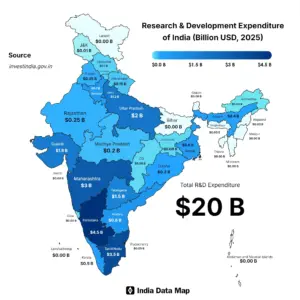
WHY INDIA’S R&D SYSTEM NEEDS A MAP OF WHERE FUNDS REALLY GO
Syllabus:
GS-2:
- Transparency and accountability
GS-3:
- Research and Development.
Why in the News?
A recent NITI Aayog report on Ease of Doing R&D in India has highlighted serious weaknesses in India’s research-funding ecosystem. Nearly 80% of ANRF funding is concentrated in IITs, while overlapping grants across Central agencies raise concerns about inefficient public expenditure. The proposed Unified Project Management System (UPMS) seeks to address these gaps.
ANUSANDHAN NATIONAL RESEARCH FOUNDATION
- Institutional Framework: The Anusandhan National Research Foundation (ANRF) was established to strengthen India’s research and innovation ecosystem and improve coordination between academia, industry, government and other stakeholders.
- Funding Objective: ANRF seeks to expand and catalyse research, development and innovation, including support for high-quality scientific research across disciplines and institutions.
- Industry Linkage: Greater participation of industry and private-sector organisations is intended to bridge the gap between scientific research and commercialisation.
- National Missions: The foundation can support strategically important research addressing national priorities, including emerging technologies and interdisciplinary scientific challenges.
- Ecosystem Expansion: Its broader objective is to move India towards a stronger, more inclusive and innovation-driven R&D ecosystem, rather than concentrating research capabilities within a small institutional group.
CONCENTRATION OF RESEARCH FUNDING
- Funding Imbalance: Nearly 80% of funding under the Anusandhan National Research Foundation (ANRF) is reportedly concentrated in IITs, raising concerns about equitable access to research opportunities.
- Institutional Diversity: Excessive concentration can limit the participation of State universities, emerging research institutions and specialised laboratories, weakening the broader national research ecosystem.
- Regional Inequality: Uneven distribution of research funding may reinforce existing differences in research infrastructure, talent attraction and institutional capacity between premier and less-developed institutions.
- Talent Utilisation: A broader funding base could enable talented researchers outside established institutions to pursue innovative and high-risk research with greater institutional support.
- Strategic Concern: Diversifying research funding is essential for creating a national innovation ecosystem rather than allowing a limited number of institutions to dominate publicly funded R&D.
THE PROBLEM OF DUPLICATE AND FRAGMENTED FUNDING
- Agency Overlap: Multiple Central agencies may finance similar research areas or overlapping projects, potentially resulting in duplication and inefficient utilisation of public resources.
- Data Fragmentation: Research-funding information remains distributed across numerous agencies, often using different databases, formats and terminology, making comprehensive analysis difficult.
- Identity Problem: Researchers and institutions may appear under different names across databases, preventing automated systems from reliably recognising that multiple records refer to the same entity.
- Monitoring Deficit: Without integrated funding information, policymakers cannot easily determine whether a researcher or institution is receiving multiple grants for substantially similar research.
- Accountability Gap: Fragmented information weakens the ability of governments and citizens to assess where public research money is going and what outcomes it produces.
PERSISTENT IDENTIFIERS AND METADATA
- PID Concept: A Persistent Digital Identifier (PID) provides a permanent, machine-readable identity to research entities such as grants, researchers, institutions and funding organisations.
- Grant Identity: A unique identifier attached to every research grant can enable policymakers to track the funding amount, duration, objectives and subsequent research outputs.
- Researcher Identification: ORCID provides researchers with unique identifiers, allowing funding agencies to accurately aggregate grants and publications belonging to the same researcher.
- Institutional Identification: Research Organization Registry (ROR) identifiers can standardise institutional identities, preventing discrepancies arising from different spellings or naming conventions.
- Output Linkage: Grant identifiers can be connected with research papers, patents, datasets and other outputs, enabling systematic assessment of the impact generated by public funding.
GLOBAL MODELS FOR RESEARCH-FUNDING TRANSPARENCY
- Crossref Infrastructure: The non-profit Crossref has developed infrastructure that enables research grants to be linked with funders, researchers, institutions and resulting scholarly outputs.
- Grant DOI: Since 2020, grant-specific Digital Object Identifiers (DOIs) have enabled research funding to receive permanent identifiers that can subsequently be connected with associated research outputs.
- International Scale: More than 2 lakh grants worldwide have reportedly been registered through the relevant global infrastructure, demonstrating the feasibility of standardised grant identification.
- Comparative Analysis: Integrated datasets allow policymakers to identify duplicate funding, excessive institutional concentration and research areas receiving disproportionate investments.
- International Learning: India can therefore build upon existing global standards instead of developing every component of research-funding infrastructure independently.
UPMS AS A NATIONAL SOLUTION
- Unified Platform: The proposed Unified Project Management System (UPMS) aims to streamline planning, funding, monitoring and evaluation of public R&D projects across government Ministries and Departments.
- Central Repository: A unified national platform can create a single source of information regarding publicly funded research projects across different agencies.
- Cross-Agency Coordination: UPMS could allow funding agencies to identify overlapping proposals and cumulative funding, reducing duplication and improving allocation efficiency.
- Outcome Monitoring: Linking grants with publications, patents and other outputs can facilitate evidence-based evaluation of whether public research investments generate meaningful outcomes.
- National Coverage: For maximum effectiveness, the platform should eventually integrate Central and State research-funding agencies, rather than remaining restricted to Union government programmes.
HYBRID MODEL FOR INDIA
- National Ownership: India could maintain a government-owned national portal while ensuring that its identifiers and metadata remain compatible with established global research standards.
- Global Compatibility: Linking UPMS with Crossref, ROR and ORCID standards would make Indian research-funding data interoperable with international research databases.
- International Examples: The U.K. Gateway to Research and the European Union’s CORDIS and OpenAIRE demonstrate how government-controlled portals can coexist with globally compatible research infrastructure.
- Implementation Advantage: A hybrid model can combine sovereign control and domestic policy requirements with internationally established technical standards and identifiers.
- Data Integration: Such architecture would enable India to build a comprehensive research map covering funders, institutions, researchers, grants, research themes and outcomes.
REFORMS NEEDED IN INDIA’S R&D FUNDING SYSTEM
- Universal Adoption: All major public research agencies should be brought under a common digital funding architecture, with standardised reporting requirements and interoperable databases.
- Mandatory Identifiers: Every grant, researcher, institution and funding agency should receive a standardised persistent identifier, reducing duplication and improving traceability.
- Open Metadata: Non-sensitive research-funding metadata should be made publicly accessible, enabling researchers, journalists and policymakers to examine funding patterns and outcomes.
- Independent Evaluation: Funding concentration and project outcomes should undergo periodic independent evaluation to identify inefficiencies and improve allocation decisions.
- Inclusive Funding: India should simultaneously expand research capacity beyond elite institutions by supporting State universities, emerging laboratories and young researchers, ensuring that public R&D expenditure creates a wider innovation base.
CONCLUSION
India’s challenge is no longer simply to increase R&D expenditure, but to know whether that money is reaching the right researchers, institutions and strategic priorities. A unified system using PIDs, standardised metadata and interoperable databases can improve transparency, reduce duplication and enable evidence-based allocation. UPMS can become transformative if designed as an inclusive national platform compatible with global research standards.
SOURCE: TH
MAINS PRACTICE QUESTION
“India’s research ecosystem requires not merely higher R&D expenditure, but greater transparency, interoperability and accountability in the allocation of research funds.” Discuss the role of UPMS, Persistent Digital Identifiers and ANRF in achieving this objective. (250 words).

