 India's No.1 PU & Degree With Integrated IAS & IPS(UPSC/PSC) Training College.


Ethanol Blending in India: Future and Challenges
Ethanol Blending in India: Promise, Challenges, and the Road Ahead
Syllabus:
GS 3
- Employment generation
- Economic development
Why in the News?
India’s ethanol-blending programme, targeting 20% ethanol in petrol (E20) by 2025, aims at reducing carbon emissions, strengthening energy security, and cutting oil import bills. However, it raises challenges for vehicle-owners, automobile technology adaptation, and the economy. This article explores the science, benefits, limitations, and policy aspects of ethanol blending with a comparative global perspective.
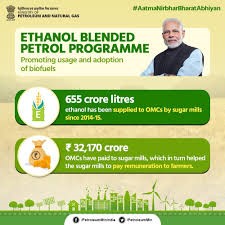
Introduction: The Ethanol Push
- In 2021, the Government of India announced a target of 20% ethanol blending in petrol by 2025.
- The two-pronged goal:
- Cutting carbon emissions in line with India’s climate commitments.
- Reducing dependence on foreign oil imports to improve energy security.
- E20-compatible vehicles started rolling out in April 2025, but concerns remain among vehicle owners regarding:
- Impact on older vehicles.
- Maintenance costs due to ethanol’s chemical properties.
- Ethanol, unlike fossil petrol, is a biofuel made from biomass, thus offering a renewable and sustainable alternative.
Understanding Ethanol and Petrol
- Petrol: A fossil-based hydrocarbon derived from ancient organic matter buried for millions of years.
- Ethanol (Ethyl Alcohol):
- A biofuel derived from plant-based raw materials.
- Functions as an oxygenate, improving fuel combustion efficiency.
- Blending Ethanol with Petrol:
- Enhances octane number (resistance to knocking).
- Reduces harmful emissions.
- Lowers overall dependency on fossil fuels.
Sources of Ethanol in India
Under India’s ethanol-blending programme, ethanol is produced from:
- Sugarcane-based raw materials:
- C-heavy molasses (final byproduct, 28–32% sugar content).
- B-heavy molasses (intermediate byproduct, 48–52% sugar content).
- Sugarcane juice, syrup, sugar.
- Damaged food grains:
- Broken rice.
- Lignocellulosic biomass (non-food plant matter):
- Rich in cellulose, hemicellulose, lignin.
- Includes crop residues, forestry waste, etc.
The Science of Ethanol Production
- Fermentation Process:
- Sugar molecules in molasses → diluted with water → broken into glucose (enzyme: invertase).
- Glucose → reacts with zymase enzyme → ethanol + carbon dioxide.
- Example: Fermentation in making ginger soda (microbes release CO₂, creating fizziness).
- Food Grains & Lignocellulosic Material:
- Require pre-treatment to break down into fermentable sugars.
- Enable second-generation biofuel
Chemical Nature and Fuel Efficiency
Two key parameters define ethanol’s efficiency:
- Calorific Value
- Petrol: Higher calorific value (more energy per litre).
- Ethanol: Lower calorific value → reduced mileage per litre.
- Impact: Slight drop in efficiency, but not drastic at E20 levels.
- Octane Number
- Ethanol has a higher octane number → better resistance to premature ignition (engine knocking).
- Improves combustion quality.
Energy Efficiency Debate
- Concerns: Drivers fear reduced mileage.
- Expert View (Sudheer Kumar Kuppili, London School of Hygiene & Tropical Medicine):
- Reduction in performance from E10 → E20 is marginal.
- Significant efficiency loss only at 100% ethanol use.
- Government’s Stand: Fuel efficiency depends more on:
- Driving habits.
- Maintenance (oil changes, filters).
- Tyre condition.
- Air-conditioning load.
The Hygroscopic Nature of Ethanol
- Hygroscopic Property: Ethanol attracts and absorbs water.
- Concerns:
- Increased risk of corrosion in vehicle parts (fuel tank, rubber pipes, injectors).
- If vehicles are unused for long, water accumulates → rusting, clogging of filters.
- Possible reduction in mileage due to corrosion-induced inefficiencies.
- Expert Views:
- Noble Varghese: Older vehicles at higher risk due to rubber parts not suited for E20.
- Government: Replacing older rubber/gaskets is inexpensive and needed only once per vehicle’s lifetime.
Impact on Different Vehicle Types
- BS-IV & BS-VI Vehicles (Post-2010/2020 models):
- Equipped with electronic control units (ECUs).
- Can adapt to varying ethanol levels by adjusting air-fuel ratio.
- Less risk of moisture problems due to high engine temperatures (>400°C).
- Older Vehicles (pre-2020):
- Mostly mechanically carbureted (no sensors).
- Cannot recalibrate automatically.
- May face issues of knocking, improper combustion, and corrosion.
Global Comparison: The Brazil Model
- Brazil’s Ethanol Journey:
- Launched Proálcool programme (1975) during global oil crisis.
- Gradual adoption → today Brazil uses E27 fuel.
- Supported by:
- Research & development.
- Subsidies, tax breaks.
- Mass adoption of flex-fuel engines.
- India’s Contrast:
- Faster timeline (aiming E20 within 4 years).
- Vehicles not designed for flex-fuel compatibility.
- Challenges in recalibrating older vehicles.
Vehicle Technology and Recalibration
- Electronic Control Units (ECUs):
- Adjust air-fuel ratio & spark timing.
- Reduce pollutant emissions (NOx, CO, PM).
- Mechanically Carbureted Engines:
- Hard-coded spark timing → cannot adapt to E20 fuel.
- Require recalibration, which involves:
- Adjusting combustion timing.
- Modifying pressure settings.
- Changing injectors & pipes.
- Cost-intensive due to engineer fees and hardware replacement.
Benefits of Ethanol Blending
- Energy Security
- Reduces dependence on costly oil imports.
- Saves foreign exchange reserves.
- Climate Commitments
- Supports India’s Net Zero 2070 target.
- Cuts CO₂, NOx, PM emissions.
- Rural Economy Boost
- Demand for sugarcane, maize, and broken rice → higher farmer incomes.
- Potential for investment in biorefineries.
- Waste Utilisation
- Agricultural residues and damaged grains gain value.
Challenges and Concerns
- Vehicle Compatibility
- Older vehicles face corrosion and efficiency issues.
- Infrastructure Readiness
- Requirement of ethanol supply chain (storage, blending, transport).
- Safety concerns as ethanol is highly flammable.
- Food Security Concerns
- Ethanol production from food grains may divert resources from food supply.
- Farmer Dependency on Sugarcane
- Over-dependence on water-guzzling sugarcane may stress groundwater resources.
- Cost of Recalibration
- Increased burden on vehicle owners for modification.
The Way Forward
- Gradual Implementation
- Like Brazil, India should phase-in blending levels (E10 → E15 → E20).
- R&D on Flex-Fuel Vehicles
- Incentivise automobile makers to roll out flex-fuel compatible engines.
- Support to Farmers
- Diversify feedstock (beyond sugarcane).
- Promote second-generation biofuels from crop residue.
- Awareness and Transparency
- Inform vehicle owners of necessary modifications.
- International Lessons
- Adopt Brazil’s long-term perspective, not a rushed timeline.
Conclusion
Ethanol blending is a progressive and sustainable policy that aligns with India’s environmental, economic, and energy goals. However, the transition to E20 requires technological adaptation, phased implementation, and careful policy support to balance efficiency, consumer concerns, and long-term benefits. With the right pacing and infrastructure, ethanol can be a key pillar of India’s energy future.
MAINS PRACTICE QUESTION
“India’s ethanol-blending programme is seen as a step towards energy security and climate action. Critically examine the opportunities and challenges of implementing 20% ethanol-blended petrol (E20) by 2025.

