 India's No.1 PU & Degree With Integrated IAS & IPS(UPSC/PSC) Training College.


Delhi Artificial Rain: Pollution Fight or Mirage?
Artificial Rains: A Mirage in Delhi’s Pollution Battle
Syllabus:
GS Paper – 3 Environmental Pollution & Degradation
Why in the News?
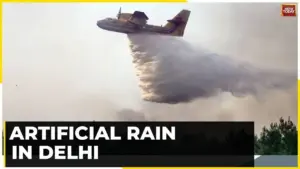
Delhi’s much-anticipated cloud seeding experiment on October 28, 2025, failed to bring respite from toxic smog. The attempt highlighted the limitations of artificial rain as a pollution-control measure, reinforcing the need for scientific, long-term, and regionally coordinated strategies to combat air pollution and reduce greenhouse gas emissions.
Understanding Delhi’s Chronic Air Pollution Crisis
- Seasonal Spike: Air quality in Delhi deteriorates sharply during October–November, due to crop residue burning, industrial emissions, and meteorological inversions that trap pollutants.
- Key Sources: Major contributors include vehicular exhaust, construction dust, industrial smoke, and agricultural stubble burning in Punjab and Haryana.
- Data Evidence: Studies by TERI and SAFAR (System of Air Quality and Weather Forecasting and Research) consistently show high PM2.5 and PM10 levels beyond hazardous limits.
- Health Implications: Air pollution causes respiratory illnesses, cardiovascular diseases, and premature deaths—estimated to shorten life expectancy in Delhi by nearly 10 years.
- Recurring Pattern: Despite years of action plans, pollution levels rebound each winter, exposing the failure of fragmented and short-term policies.
Key Facts and Acts Related to Air Pollution:
- Air (Prevention and Control of Pollution) Act, 1981: Primary legislation regulating air quality in India.
- Environment (Protection) Act, 1986: Umbrella law empowering the Centre to enforce pollution standards.
- CAQM Act, 2020: Commission for Air Quality Management established for NCR coordination.
- National Clean Air Programme (2019): Launched to reduce PM2.5 levels by 20–30% by 2024.
- Graded Response Action Plan (2017): Implements staged emergency measures during high pollution episodes.
- Supreme Court Directives: Continuous judicial monitoring of crop burning, vehicular norms, and industrial emissions.
- Delhi’s AQI Classification: PM2.5 levels above 250 µg/m³ classified as “Severe.”
- Global Comparison: WHO standard for safe PM2.5 is 15 µg/m³ (24-hour mean).
- India’s Global Rank: Among the top 10 most polluted countries (IQAir 2024).
- Institutional Link: CPCB (Central Pollution Control Board) monitors air quality across 400+ Indian cities.
The Cloud Seeding Experiment: Science and Shortfalls
- Definition: Cloud seeding involves dispersing silver iodide or sodium chloride into clouds to stimulate rainfall.
- Objective in Delhi: To artificially induce rain and wash out suspended particulates from the atmosphere.
- Global Experience: Countries like China, UAE, and the USA use cloud seeding primarily for drought mitigation, not pollution control.
- Scientific Limitation: Success depends on cloud presence, humidity, and wind conditions—rare in Delhi’s cold, dry winter months.
- Temporary Impact: Even if successful, rainfall effects would have been localized and short-lived, offering no lasting pollution relief.
Why Artificial Rain Cannot Solve Delhi’s Problem
- Regional Nature of Pollution: Air pollution extends across the National Capital Region (NCR); local rainfall over a few square kilometers cannot address a regional phenomenon.
- Symbolic Measure: Such experiments risk being “visibility actions”—symbolic rather than scientifically sustainable solutions.
- Chemical Concerns: Uncertainties exist about the environmental impact of chemicals used in seeding on soil and water systems.
- Cost vs. Benefit: Cloud seeding is expensive, yet yields limited and unpredictable outcomes.
- Distraction Risk: It diverts resources and policy attention from emission control, public transport improvements, and clean energy transitions.
Core Challenges in Combating Delhi’s Air Crisis
- Institutional Fragmentation: Multiple agencies—CPCB, DPCC, and CAQM—operate with overlapping jurisdictions, leading to coordination failures.
- Weak Enforcement: Despite emission norms and bans, illegal construction dust and crop burning persist due to poor monitoring and political apathy.
- Transboundary Pollution: States like Punjab and Haryana contribute significantly, but interstate cooperation mechanisms remain weak.
- Urban Planning Deficits: Rapid urbanization, vehicle congestion, and limited green spaces worsen air stagnation.
- Behavioral Barriers: Citizens rely heavily on private vehicles, while waste burning and biomass cooking continue in urban fringes.
- Technological Gaps: Inconsistent real-time air quality monitoring hampers evidence-based decision-making.
- Public Awareness: Pollution control remains reactive, with public outrage limited to winter months.
- Judicial Dependence: Courts repeatedly intervene to enforce bans, showing executive inertia.
- Funding Deficits: Clean air missions often suffer from budget underutilization and bureaucratic delays.
- Health Neglect: Air pollution is yet to be treated as a public health emergency, despite severe morbidity data.
Policy Interventions and Institutional Frameworks
- CAQM (Commission for Air Quality Management): Established in 2020 for NCR coordination; aims for data-driven, multi-state strategies.
- GRAP (Graded Response Action Plan): Enforces staged curbs—like bans on construction and diesel vehicles—based on pollution severity.
- National Clean Air Programme (NCAP): Targets 20–30% reduction in particulate matter by 2024, extended to 131 cities.
- Odd-Even Scheme: Temporary traffic reduction policy, yet lacks long-term efficacy.
- Technological Innovations: Use of AI-based emission tracking, satellite forecasting, and low-cost air quality sensors is expanding.
- Public Transport Push: Expansion of Delhi Metro, electric buses, and cycling infrastructure aims to cut vehicle emissions.
- Cleaner Fuels: Transition to BS-VI fuel norms and promotion of EVs signal progress.
- Solid Waste Management Rules, 2016: Ban open burning and promote segregation at source.
- Crop Residue Management Scheme: Encourages use of Happy Seeder machines and bio-decomposers in northern states.
- Judicial Oversight: The Supreme Court and NGT regularly monitor air quality enforcement.
Way Forward: Long-Term and Regional Strategies
- Regional Collaboration: Strengthen CAQM’s mandate to ensure NCR-wide policy coherence and state accountability.
- Emission Source Control: Focus on industrial retrofitting, vehicle emission audits, and ban on outdated diesel engines.
- Agriculture Transition: Promote incentivized crop diversification and eco-friendly residue management across Punjab and Haryana.
- Urban Infrastructure: Develop green corridors, dust-free construction zones, and urban forests.
- Public Transport Incentives: Expand electric mobility infrastructure and discourage private car use through congestion pricing.
- Citizen Participation: Encourage community-level air monitoring and public reporting apps.
- Technological Integration: Leverage AI, IoT, and satellite data for predictive air management.
- Health-Centric Governance: Link air quality to public health indicators and hospital data.
- Funding Mechanisms: Introduce a Clean Air Cess for sustained financing of anti-pollution projects.
- Education and Behavioural Change: Embed air quality education in school curricula to build long-term civic responsibility.
Global Lessons for India
- China’s Success: Used strict industrial relocation, mass electric transport, and centralized monitoring to reduce PM2.5 by 40% in a decade.
- London’s Example: The Clean Air Act (1956) transformed air quality through regulation and cleaner fuels.
- Singapore’s Urban Model: Prioritized public transport and green buffers to manage emissions.
- European Standards: EU mandates real-time data transparency and citizen access to air monitoring results.
- Adaptation for India: Requires localized replication of these global models with context-sensitive governance and technology adoption.
Conclusion
Artificial rain may capture headlines but cannot clear Delhi’s toxic air. Sustainable improvement demands multi-state collaboration, scientific enforcement, and institutional accountability. Clean air must shift from being an emergency reaction to a sustained national priority, embedding environmental health at the heart of India’s development model. To achieve this, India needs to consider implementing an emissions trading system and explore carbon offset mechanisms as part of its nationally determined contributions under international climate agreements.
Furthermore, the country should focus on clean energy transitions and promote sustainable forest management to address both air pollution and climate change. The development of a voluntary carbon market could incentivize businesses to reduce their greenhouse gas emissions. Additionally, integrating environmental impact assessments into urban planning processes and exploring carbon market linkage and cooperation with other nations could provide valuable insights and resources for tackling Delhi’s air pollution crisis.
By adopting these comprehensive strategies and learning from global best practices in emission control and carbon offset projects, India can work towards creating a more sustainable and breathable future for its capital and beyond.
Source : IE
Mains Practice Question:
Despite repeated short-term measures like cloud seeding, Delhi continues to face severe air pollution. Critically examine the structural and institutional barriers that hinder sustainable improvement in air quality. Suggest a multi-sectoral framework integrating technology, governance, and citizen participation for long-term pollution control in NCR.

