India's No.1 PU & Degree With Integrated IAS & IPS(UPSC/PSC) Training College.


Closing India’s SDG 3 Gaps
Closing India’s SDG 3 Gaps
Syllabus
GS 2: Health and nutrition
Why in the News?
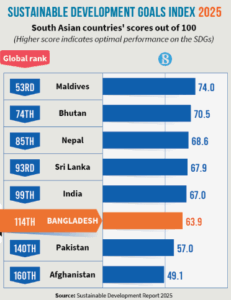
Recently, India secured its best-ever 99th rank in the 2025 SDG Index, but the report flagged significant gaps in achieving SDG 3 targets, particularly in health and nutrition outcomes.
Introduction
- In June 2025, India achieved its best-ever position in the Sustainable Development Goals (SDG) Index, ranking 99 among 167 countries.
- This marked a jump from 109 in 2024 and reflected steady progress since 2021.
- Despite improvements, especially in access to services and infrastructure, challenges in health and nutrition remain critical barriers to India’s SDG journey, highlighting the need for a robust food security system and improved nutritional security. The Public Distribution System (PDS) in India plays a crucial role in addressing these challenges, particularly in ensuring food security for vulnerable populations.
India’s SDG Journey So Far
- India’s overall SDG ranking improved significantly in 2025.
- Its rank rose from 109 in 2024 to 99, showing steady advancement.
- Gains are visible in areas such as basic services and infrastructure.
- However, serious challenges persist in health and nutrition, particularly in rural and tribal areas.
- These gaps make SDG 3 (Good Health and Well-being) the most pressing and demanding goal for India, requiring attention to issues like micronutrient deficiency and dietary diversity, which are closely linked to the effectiveness of the PDS in India.
Understanding SDG 3
- SDG 3 aims to “ensure healthy lives and promote well-being for all at all ages.”
- India has committed to achieving its targets by 2030.
- While some progress is evident, India is not on track to meet most targets.
- Indicators like maternal health, child mortality, life expectancy, and health expenditure show that large improvements are still needed.
Key Gaps in Health Indicators
Maternal Mortality Ratio (MMR)
- Current figure: 97 deaths per 100,000 live births.
- Target for 2030: 70 deaths per 100,000 live births.
- Gap: India must significantly lower maternal deaths within the next five years.
Under-Five Mortality Rate
- Current figure: 32 deaths per 1,000 live births.
- Target for 2030: 25 deaths per 1,000 live births.
- Comparison: In developed countries, the rate ranges between 2–6 deaths.
Life Expectancy
- Current figure: 70 years.
- Target for 2030: 73.63 years.
- Gap: Almost 4 years of improvement required within a short span.
Health-Care Expenditure
- Out-of-pocket expenditure is 13% of total household consumption.
- Target for 2030: 7.83%.
- Burden: Families continue to face catastrophic financial pressure from medical costs. The central issue price of essential commodities through PDS can help alleviate some of this burden by ensuring affordable access to basic food items.
Immunisation Coverage
- Current rate: 93.23%.
- Target: 100% universal immunisation.
- While close to the target, the final few percentages are the most difficult to achieve.
Supplementary Nutrition
- Current coverage: Inadequate, especially in rural and tribal areas.
- Target: Universal coverage through integrated child development services.
- Gap: Significant improvement needed in both quantity and quality of supplementary nutrition programs, which could be supported by an efficient PDS in India.
Reasons Behind the Gaps
Poor Access to Quality Health Care
- Inadequate infrastructure in many regions.
- Economic barriers preventing equitable access.
Non-Economic Factors
- Poor nutrition among children and mothers, including micronutrient deficiency.
- Lack of hygiene and sanitation facilities.
- Unhealthy lifestyle choices leading to non-communicable diseases.
- Groundwater depletion affecting water quality and availability for sanitation.
Cultural Practices and Stigma
- Social stigma around physical and mental health.
- Cultural taboos prevent women and marginalised groups from seeking care.
- Limited awareness reduces the use of available health-care services.
Food Security Challenges
- Inefficiencies in the supply chain management of food distribution systems, including fair price shops.
- Inadequate minimum support price for farmers, affecting food production and availability.
- Leakage and diversion of resources in the public distribution system, impacting the effectiveness of PDS in India.
A Three-Pronged Approach to Achieve SDG 3
Universal Health Insurance
- Providing universal health insurance ensures financial protection.
- World Bank studies confirm that robust insurance lowers catastrophic expenditure.
- It also improves equity in access to services.
- India must scale up coverage to include every citizen, especially vulnerable populations.
- Integration with direct benefit transfer and interstate portability of benefits can enhance efficiency.
- Addressing the issue of ghost beneficiaries through improved ration card holder verification, ensuring that only eligible individuals benefit from health insurance and PDS services.
Strengthening Primary Health Centres (PHCs)
- PHCs must provide high-quality, easily accessible services.
- Coordination among primary, secondary, and tertiary care is essential.
- WHO’s World Health Statistics 2022 highlights the benefits:
- Early disease detection.
- Reduced hospitalisation costs.
- Better long-term outcomes.
- Implement biometric authentication for accurate patient identification and record-keeping.
- Enhance transparency measures in PHC operations and resource allocation.
Harnessing Digital Health Tools
- Telemedicine can bridge gaps in remote and tribal regions.
- Integrated digital health records improve efficiency and continuity of care.
- Evidence from the Lancet Digital Health Commission shows:
- Digital tools enhanced maternal health tracking.
- Improved vaccination coverage in low- and middle-income countries.
- India can adapt these models to accelerate SDG 3 progress.
- Implement beneficiary identification systems to ensure targeted health interventions, potentially linking with ration card holder data for comprehensive service delivery.
- Explore doorstep delivery of health services in underserved areas, possibly in conjunction with fair price shops to improve accessibility.
Prevention is Better than Cure
- Preventing diseases is more cost-effective than treatment.
- Health education is key to prevention.
- School-based programmes must teach:
- Healthy nutrition and dietary diversity.
- Good hygiene and sanitation.
- Reproductive health awareness.
- Road safety practices.
- Mental health literacy.
- Integrate food grain distribution awareness in health education programs, highlighting the role of fair price shops in ensuring food security.
- Promote understanding of schemes like Antyodaya Anna Yojana for vulnerable populations, emphasizing the importance of the PDS in India for nutritional security.
Health Education in Schools
Why Schools Matter
- Habits formed in childhood continue into adulthood.
- Educated children grow into health-conscious adults.
- Girls, when they become mothers, are better equipped to care for themselves and their families.
Long-Term Benefits
- Lower maternal mortality rates.
- Reduced under-five mortality.
- Fewer deaths due to road accidents.
- Higher life expectancy.
- Improved immunisation coverage.
Global Lessons for India
Finland’s Experience
- In the 1970s, Finland introduced school-based health reforms.
- Lessons on nutrition, hygiene, and lifestyle became part of the curriculum.
- Result: Major reduction in cardiovascular diseases in later decades.
Japan’s Experience
- Compulsory health education was introduced in schools.
- It led to better hygiene practices.
- Contributed to Japan’s high life expectancy.
Relevance for India
- A structured health curriculum can deliver similar positive outcomes.
- Embedding these lessons in education is a long-term investment in national health.
Role of Policymakers and Parents
Policymakers
- Must embed health education in national and state school curricula.
- Simultaneously expand universal health coverage.
- Invest in well-equipped primary health systems.
- Establish effective grievance redressal mechanisms for health services and PDS operations.
- Consider the potential of universal basic income to address health and nutrition challenges, potentially complementing the central issue price mechanism of the PDS.
Parents
- Should review whether schools teach essential health topics.
- Must advocate for inclusion of physical, mental, and social health in syllabi.
- By engaging with education departments, they can push for reforms.
- Participate in vigilance committees to ensure fair distribution of health and nutrition resources, including monitoring fair price shops.
The Bigger Picture
- India’s improved SDG ranking is a positive signal.
- However, only 17% of global SDG targets are currently on track to be achieved by 2030.
- This shows that global progress is slow, and India’s challenges are part of a wider struggle.
- Health education for the young and robust health-care systems are the pillars for future progress.
Towards Viksit Bharat 2047
- India’s SDG journey must not stop at 2030.
- The long-term vision lies in achieving a Viksit Bharat (Developed India) by 2047.
- Embedding health education into schools is a foundation for this goal.
- Stronger health systems will ensure sustainable progress beyond 2030.
Conclusion
India’s progress on SDG 3 is visible but uneven. Maternal health, child mortality, life expectancy, and health costs remain major challenges. Embedding health education in schools, expanding health insurance, and strengthening primary health centres can accelerate progress. Addressing issues like micronutrient deficiency and improving dietary diversity through integrated child development services are crucial steps. A healthier population, supported by a robust food security system and enhanced nutritional security, is essential to achieving both SDG 2030 and Viksit Bharat 2047, ultimately contributing to poverty alleviation and overall national development. The efficient distribution of subsidized food grains through fair price shops and improved supply chain management in the PDS will play a vital role in this journey, ensuring that the central issue price remains affordable for ration card holders and vulnerable populations.
Source:The Hindu
Mains Practice Question
India’s improved SDG ranking is commendable, but major challenges persist in health and nutrition. Discuss the gaps in achieving SDG 3 and suggest measures to bridge them, considering the role of the food security system and nutritional security in this context.