 India's No.1 PU & Degree With Integrated IAS & IPS(UPSC/PSC) Training College.


China-ASEAN Trade Deal Upgraded with Green Focus
China, ASEAN Sign Upgraded Free Trade Agreement with Focus on Emissions Trading
Why in News ?
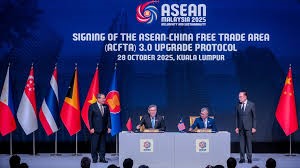
China and the ASEAN bloc have signed an upgraded version of their Free Trade Agreement (FTA 3.0) in Kuala Lumpur, focusing on digital economy, green growth, and supply chain integration amid rising U.S. tariffs targeting both sides. The new agreement also addresses emissions trading and clean energy transitions.
Strengthening Regional Economic Integration:
- FTA Upgrade Signed: China and the Association of Southeast Asian Nations (ASEAN) signed the ASEAN-China Free Trade Area (ACFTA) 3.0 to enhance economic cooperation and promote sustainable development.
- Broader Coverage: The new deal expands into areas such as the digital economy, green energy, and emerging industries, including the establishment of an emissions trading system to address greenhouse gas emissions.
- Economic Significance: ASEAN remains China’s largest trading partner, with bilateral trade reaching $771 billion in 2024. The upgraded agreement aims to boost this further through clean energy transitions and carbon offset projects.
- Leaders’ Participation: The agreement was signed during the ASEAN Summit in Kuala Lumpur, attended by Premier Li Qiang and ASEAN leaders, who emphasized the importance of sustainable forest management in the region.
- Shared Goal: Both sides aim to boost industrial integration, investment liberalisation, and regional economic interdependence while promoting environmental sustainability through carbon market cooperation.
Addressing Tariff Challenges and Global Trade Shifts
- U.S. Tariff Impact: The deal comes amid heavy U.S. tariffs on imports from China and other nations, prompting Beijing to deepen ASEAN engagement and explore new avenues for cooperation, including voluntary carbon markets.
- Li Qiang’s Statement: The Chinese Premier urged accelerating trade facilitation and strengthening supply chain connectivity, while also calling for joint efforts in environmental impact assessment and carbon offset mechanisms.
- Negotiation Timeline: Talks for the upgrade began in November 2022 and concluded in May 2025, shortly after the U.S. tariff escalation, with a focus on integrating sustainable practices into trade agreements.
- Market Access Gains: The upgraded deal will improve access in sectors like agriculture, pharmaceuticals, and digital trade, while also facilitating the development of clean development mechanisms.
- Open Economy Stance: China seeks to project itself as a supporter of open markets, despite export restrictions on rare earths, by promoting carbon market linkage and cooperation in the region.
About ASEAN (Association of Southeast Asian Nations):● ASEAN (Association of Southeast Asian Nations): A regional organization of 10 Southeast Asian countries aimed at economic growth, peace, and stability, established in 1967. ● ACFTA (ASEAN-China Free Trade Area): Originally launched in 2010, it created one of the world’s largest FTAs by trade volume. ● FTA 3.0 Focus: Emphasizes digital transformation, sustainability, and innovation-driven growth, including the implementation of nationally determined contributions to combat climate change. ● RCEP Connection: Both ASEAN and China are members of the Regional Comprehensive Economic Partnership (RCEP), which includes 15 nations and accounts for about 30% of global GDP. ● Strategic Relevance: Strengthens Asia’s intra-regional trade resilience and offers a buffer against U.S. protectionist policies while promoting sustainable development practices. |

