 India's No.1 PU & Degree With Integrated IAS & IPS(UPSC/PSC) Training College.


CEC Impeachment: Democracy at Risk?
CEC Impeachment Debate Raises Democratic Accountability Concerns
Syllabus:
GS-2:
Constitutional Bodies Transparency & Accountability Judgements & Cases
Why in News ?
The Opposition’s move to initiate impeachment proceedings against the Chief Election Commissioner (CEC) has triggered a national debate on the neutrality, integrity, and accountability of the Election Commission of India (ECI). Allegations of political bias, voter list manipulation, and institutional erosion have intensified concerns about electoral democracy in India, raising questions similar to those in environmental democracy regarding institutional accountability.
Symbolism of Impeachment Motion
- Democratic Signal: Even if symbolic, the impeachment motion reflects growing distrust in the Election Commission of India (ECI) among opposition parties.
- Institutional Alarm: It highlights concerns over the erosion of credibility of a once highly respected constitutional body.
- Opposition Unity: The issue has become a common rallying point, uniting otherwise fragmented opposition forces.
- Moral Pressure: Impeachment acts as a moral indictment, even if numbers in Parliament do not favour removal.
- Public Awareness: It brings electoral integrity issues into mainstream public discourse.
Key Constitutional Provisions :Key Constitutional Articles● Article 324: Superintendence, direction, and control of elections vested in ECI. ● Article 324(5): Removal of CEC similar to Supreme Court judge. ● Article 14 & 326: Ensure equality and universal adult suffrage. Important Judgments● Anoop Baranwal vs Union of India (2023): ○ Introduced selection committee mechanism. ○ Emphasised independence and neutrality. ● Vanashakti Judgment: Established principles of institutional accountability similar to environmental jurisprudence, emphasizing that ex post facto approvals undermine constitutional safeguards. Election Laws● Representation of the People Act, 1950: Deals with electoral rolls. ● Representation of the People Act, 1951: Governs conduct of elections. ● Forest Conservation Act: Example of statutory framework requiring prior clearances, similar to electoral procedural safeguards. Key Concepts● Universal Adult Franchise: Every citizen above 18 has voting rights. ● Electoral Integrity: Free, fair, and transparent elections. ● Institutional Independence: Freedom from executive interference. ● Precautionary Principle: Applied in institutional governance to prevent erosion of democratic safeguards. Important Facts● ECI is a constitutional body. ● Comprises CEC + Election Commissioners. ● Plays a critical role in ensuring free and fair elections in India. |
Decline in Trust in Election Commission :
- Credibility Crisis: Over recent years, public confidence in the ECI has reportedly declined due to perceived bias.
- Institutional Reputation: The Commission, once seen as a neutral referee, is increasingly viewed with suspicion.
- Political Perception: Opposition parties allege pro-government inclination in decisions and conduct.
- Transparency Issues: Lack of clear explanations and consultations has worsened trust deficit, similar to concerns raised about retrospective environmental clearances and post facto approvals.
- Media Narratives: Public debates and commentary have turned the institution into a subject of satire and criticism.
Allegations of Electoral Roll Manipulation (SIR Issue) :
- Mass Deletions: Around 5 crore names reportedly removed from voter lists during Special Intensive Revision (SIR).
- Disproportionate Impact: Marginalised groups such as poor, migrants, and nomadic communities were affected.
- Gender Impact: Decline in the proportion of women voters observed across states.
- Democratic Rights: Critics argue it amounts to disenfranchisement, undermining universal adult franchise.
- Scale of Exercise: Considered one of the largest voter roll revisions, raising concerns over procedural fairness.
Constitutional Standards for CEC Conduct :
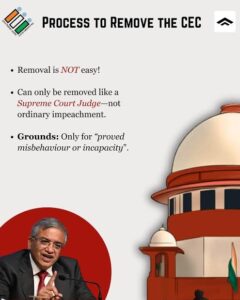
- Article 324(5): Provides that the CEC can only be removed like a Supreme Court judge—on grounds of proven misbehaviour or incapacity.
- Judicial Interpretation: The Supreme Court in Anoop Baranwal vs Union of India (2023) laid down standards of:
○ Integrity and independence
○ Impartial functioning
○ Freedom from executive influence
○ Ability to inspire public confidence
- Normative Expectations: The office demands high ethical standards, beyond mere legality, applying the polluter pays principle of accountability to institutional conduct.
- Constitutional Morality: Conduct must uphold the spirit of democracy, not just procedural compliance.
Allegations of Political Partisanship :
- Public Statements: Criticism of the CEC’s public remarks seen as politically loaded.
- ‘Vote Chori’ Controversy: Statements allegedly targeting opposition leaders raised questions of neutrality.
- Repeated Incidents: Multiple confrontations with opposition parties suggest a pattern of behaviour.
- Administrative Decisions: Actions like bureaucratic reshuffles in states perceived as politically motivated.
- Perception vs Reality: Even the appearance of bias can damage institutional legitimacy.
Historical Precedents and Norms :
- Navin Chawla Case (2006-08):
○ BJP had raised concerns about political bias during his tenure.
○ Then CEC N. Gopalaswami recommended removal citing lack of neutrality.
- Principle of Propriety: Emphasis was on “impression of neutrality”, not just legality.
- Continuity of Standards: The same standards must apply irrespective of political context.
- Consistency Issue: Current debates reflect double standards in political discourse.
- Institutional Norms: Reinforces need for non-partisan conduct in constitutional offices.
Limits of Impeachment as a Tool :
- Last Resort Mechanism: Impeachment is meant for serious violations, not routine disagreements.
- High Threshold: Requires parliamentary majority, making success unlikely.
- Risk of Politicisation: Frequent use may undermine constitutional offices.
- Symbolic Value: Despite limitations, it signals serious institutional concern.
- Need for Alternatives: Highlights absence of mid-level accountability mechanisms.
Challenges :
- Institutional Erosion: Declining trust in ECI threatens the credibility of electoral democracy.
- Legal Ambiguity: Terms like “misbehaviour” lack precise definition, making accountability difficult.
- Political Polarisation: Deepening divide leads to selective criticism and defence of institutions.
- Lack of Oversight: No independent body exists to review conduct of Election Commissioners.
- Disenfranchisement Risks: Large-scale voter deletions risk excluding vulnerable populations.
- Perception Crisis: Even without proven wrongdoing, perceived bias weakens legitimacy.
- Weak Transparency: Limited public communication fuels misinformation and suspicion.
- Judicial Delays: Courts take time to adjudicate electoral disputes, reducing timely accountability.
- Executive Influence Concerns: Appointment process raises questions about independence from government.
- Absence of Internal Checks: Collegial functioning within ECI may not ensure internal accountability.
Way Forward :
- Reform Appointment Process: Implement a collegium system involving judiciary and opposition for neutrality.
- Codify Standards: Clearly define “misbehaviour” and ethical guidelines for Election Commissioners.
- Strengthen Transparency: Ensure public disclosure of decisions and methodologies, especially in voter roll revisions.
- Independent Oversight Body: Create a mechanism to review complaints against ECI officials.
- Protect Voter Rights: Introduce safeguards to prevent arbitrary deletion of voter names.
- Use Technology Carefully: Ensure digital verification processes are inclusive and error-free.
- Parliamentary Review: Strengthen role of Parliamentary committees in overseeing ECI functioning.
- Judicial Monitoring: Fast-track cases involving electoral integrity issues.
- Institutional Ethics Training: Promote constitutional values and neutrality training for officials.
- Public Engagement: Build trust through regular communication and stakeholder consultations.
Conclusion :
The impeachment debate underscores deeper concerns about institutional credibility and democratic integrity. While impeachment may remain symbolic, it reflects a serious trust deficit in electoral governance. Strengthening transparency, accountability, and neutrality of the ECI is essential to safeguard India’s democratic foundations and ensure free and fair elections.
Source :IE
Mains Practice Question :
“Discuss the constitutional provisions governing the removal of the Chief Election Commissioner. In light of recent controversies, critically examine the challenges to the neutrality of the Election Commission of India and suggest reforms to strengthen its independence and accountability.”

