 India's No.1 PU & Degree With Integrated IAS & IPS(UPSC/PSC) Training College.


Why Bigger Isn’t Always Better in Renewable Energy
In Renewable Energy, Bigger Isn’t Always Better
Syllabus:
- GS – 3 – Energy Mix , Sustainable Development
Focus :
India’s Renewable Energy Transition – Challenges of centralised renewable energy projects, the importance of decentralised solar energy, financial inclusion, MSME participation, appropriate technology and the need to make the energy transition inclusive, employment-oriented and people-centric.
Introduction: Rethinking India’s Renewable Energy Transition
- Renewable energy has become a central pillar of India’s strategy to achieve energy security, reduce carbon emissions and fulfil its international climate commitments.
- Over the last decade, India has made significant investments in solar parks, wind energy projects, interstate transmission infrastructure, green hydrogen and battery storage.
- Government policies have largely focused on achieving ambitious national targets through large-scale infrastructure projects and centralised planning.
- However, the expansion of renewable energy capacity does not automatically translate into inclusive economic growth, employment generation or improved energy access.
- Large infrastructure projects often involve substantial financial investments, long implementation periods, cost overruns and difficulties in ensuring that benefits reach local communities.
- Therefore, India needs to complement large renewable energy projects with decentralised, community-based and locally managed energy solutions.
The Iron Law of Megaprojects: Understanding the Risks of Large Infrastructure
- Governments generally favour large infrastructure projects because they generate political visibility, attract investments, create construction contracts and provide opportunities for domestic procurement.
- However, large projects do not necessarily guarantee long-term economic benefits or efficient utilisation of public resources.
- Bent Flyvbjerg, a prominent scholar of megaprojects and infrastructure risks, has described the recurring problems associated with large infrastructure through the concept of the Iron Law of Megaprojects.
- These challenges have been observed across different infrastructure sectors, including metro rail systems, high-speed rail networks, underground tunnels and international sporting events.
- Excessive dependence on large projects can result in inefficient utilisation of public funds and limited benefits for ordinary citizens.
- Flyvbjerg therefore advocates greater emphasis on smaller, modular, replicable projects with realistic cost estimates and better risk management.
Relevance to India’s Renewable Energy Sector
- India’s renewable energy transition has also been driven significantly by large-scale targets and top-down planning.
- Large solar parks, transmission corridors and utility-scale renewable energy projects have received substantial policy and financial attention.
- However, the benefits of these investments have not always reached rural households, farmers and small businesses.
- Therefore, India must adopt a balanced approach that combines large-scale renewable energy generation with decentralised and locally appropriate solutions.
Centralised Renewable Energy Model in India
Meaning of Centralised Renewable Energy
- Centralised renewable energy refers to electricity generation through large-scale solar parks, wind farms and other renewable energy installations that supply power to the wider electricity grid.
- Such projects generally involve large investments, extensive land requirements, centralised management and long-distance electricity transmission.
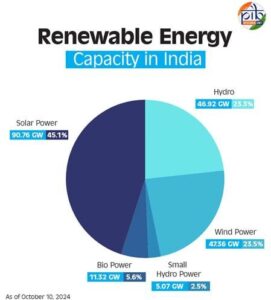
- India’s solar energy expansion has largely followed this model, particularly through the development of utility-scale solar parks.
Advantages of Centralised Renewable Energy
- Economies of Scale: Large projects can reduce the per-unit cost of electricity through bulk procurement, standardised technology and large-scale operations.
- Achievement of National Targets: Utility-scale projects help governments rapidly increase installed renewable energy capacity.
- Attracting Private Investment: Large projects provide opportunities for domestic and international investors, infrastructure companies and financial institutions.
- Grid Integration: Large renewable energy installations can contribute to the national electricity supply through interconnected transmission networks.
- Industrial Development: Large projects create demand for solar panels, inverters, batteries, transmission equipment and other renewable energy technologies.
Limitations of Centralised Renewable Energy
- Limited Local Participation: Large projects are frequently developed and managed by major companies, leaving small farmers, rural households and local entrepreneurs with limited opportunities.
- Unequal Distribution of Benefits: Investment and profits may remain concentrated among large developers rather than being distributed across local communities.
- Transmission Infrastructure Costs: Electricity generated in remote locations requires extensive transmission networks to reach consumption centres.
- Land Acquisition Challenges: Large solar parks may require substantial land, creating potential conflicts involving agricultural land, local livelihoods and ecological considerations.
- Employment Limitations: Large-scale projects involve significant capital investment but may not generate employment proportionate to their financial size, particularly after construction is completed.
- Centralised Decision-Making: Project planning may not adequately reflect local energy requirements, livelihood patterns and community priorities.
Decentralised Renewable Energy: An Alternative Development Model
Meaning of Decentralised Renewable Energy
- Decentralised renewable energy refers to electricity generation and utilisation through smaller renewable energy systems located close to the point of consumption.
- These systems can be installed at individual households, farms, village institutions, small industries and local commercial establishments.
- Examples include rooftop solar panels, solar irrigation pumps, mini-grids, solar-powered cold storage facilities and community-based renewable energy systems.
- Unlike centralised electricity generation, decentralised systems reduce dependence on long-distance transmission and enable local communities to participate directly in energy production and consumption.
Importance for India
- India receives considerable solar radiation across much of its geographical territory, creating favourable conditions for decentralised solar energy generation.
- Locally generated electricity can improve energy access in rural and remote regions where conventional electricity infrastructure is inadequate or unreliable.
- Farmers can use solar energy for irrigation, while small businesses can reduce their electricity expenditure through rooftop solar installations.
- Village-level renewable energy systems can support agricultural processing, food storage, rural enterprises and other productive activities.
- Decentralised renewable energy can therefore transform electricity from merely a consumption requirement into an instrument of rural economic development.
Role in Rural Energy Security
- Rural households and businesses often face challenges associated with unreliable electricity supply, voltage fluctuations and inadequate distribution infrastructure.
- Decentralised solar installations can provide an additional and locally accessible source of electricity.
- Solar mini-grids can support villages, schools, healthcare facilities and small commercial establishments.
- Solar-powered cold storage and irrigation facilities can improve agricultural productivity and reduce post-harvest losses.
- Such systems can also reduce dependence on diesel generators and other polluting energy sources.
Importance of Decentralised Renewable Energy for Inclusive Growth
Empowering Farmers and Agrarian Entrepreneurs
- Agriculture remains highly dependent on reliable and affordable energy for irrigation, processing and storage.
- Solar irrigation pumps can reduce farmers’ dependence on diesel and conventional electricity supply.
- Farmers can potentially earn additional income by supplying surplus electricity to the grid under appropriate arrangements.
- Solar-powered cold storage, food processing and agricultural machinery can improve the value addition of agricultural products.
- Organisations such as the SELCO Foundation have worked to develop renewable energy-linked business models for farmers and rural entrepreneurs.
- Such initiatives demonstrate how renewable energy can be integrated with livelihoods rather than being treated only as a means of electricity generation.
Promoting Micro, Small and Medium Enterprises (MSMEs)
- MSMEs are important contributors to India’s employment generation, manufacturing output and regional economic development.
- Reliable and affordable electricity is essential for their productivity and competitiveness.
- Decentralised solar installations can reduce electricity expenditure and provide greater energy independence to small enterprises.
- Solar-powered machinery, refrigeration, processing equipment and storage facilities can improve operational efficiency.
- However, the participation of MSMEs in the renewable energy transition remains limited due to financial, technological and institutional barriers.
- Therefore, targeted financing and technical assistance are necessary to enable small businesses to adopt renewable energy solutions.
Employment Generation and Local Entrepreneurship
- Decentralised renewable energy can create employment opportunities across several stages of the value chain.
- These include solar panel installation, maintenance, repair, equipment distribution, energy auditing and system management.
- Local entrepreneurs can develop businesses around solar irrigation, cold storage, rural electrification and renewable energy services.
- Unlike certain capital-intensive megaprojects, decentralised systems can support geographically distributed economic activities.
- This creates opportunities for skilled and semi-skilled workers in rural and semi-urban areas.
- Thus, decentralised renewable energy can contribute to employment-oriented development and reduce regional economic inequalities.
Reducing Regional Inequalities
- Large renewable energy projects are often concentrated in areas with favourable geographical conditions, suitable land availability and access to transmission infrastructure.
- However, energy requirements differ across regions and communities.
- Decentralised energy systems can be adapted to the needs of remote villages, tribal areas, agricultural communities and small industrial clusters.
- This can improve access to reliable electricity in regions that remain inadequately connected to conventional energy infrastructure.
- Local energy generation also reduces the dependence of rural communities on distant power-generation centres.
Promoting Women’s Economic Empowerment
- Access to reliable electricity can improve women’s participation in economic activities.
- Solar-powered equipment can support home-based enterprises, food processing, tailoring, handicrafts and other livelihood activities.
- Renewable energy can reduce the time and physical effort involved in accessing traditional energy sources.
- Women-led self-help groups can participate in the distribution, maintenance and management of decentralised energy systems.
- This can strengthen financial independence and improve women’s participation in rural entrepreneurship.
Strengthening Energy Democracy
- Decentralised renewable energy enables consumers to become electricity producers, often referred to as prosumers.
- Households, farmers and small businesses can generate electricity for their own consumption and potentially supply surplus power to the grid.
- This reduces exclusive dependence on large electricity producers and centralised distribution systems.
- Community ownership and participation can improve local accountability and encourage more democratic energy governance.
- Therefore, decentralised renewable energy has the potential to make the energy transition more participatory and inclusive.
Major Barriers to Decentralised Renewable Energy in India
Inadequate Access to Institutional Finance
- One of the biggest challenges is the limited availability of affordable credit for small renewable energy consumers.
- Large commercial banks generally prefer lending to established power companies and large infrastructure developers because they offer larger loan sizes and more predictable revenue streams.
- Small businesses and individual entrepreneurs often lack adequate collateral, credit histories and formal financial documentation.
- Consequently, many decentralised renewable energy projects face difficulties in securing institutional loans.
- Non-Banking Financial Companies (NBFCs) and other financial institutions have attempted to fill this gap.
- However, financial intermediation increases borrowing costs, resulting in higher interest rates for small consumers.
- As a result, the economics of installing solar systems often become unattractive without substantial government subsidies.
Poor Quality of Solar Equipment
- The quality of solar panels and related equipment available to consumers is not uniform.
- Smaller rural consumers may receive inferior-quality panels, inverters and batteries due to weak supplier accountability and inadequate technical awareness.
- Poor-quality equipment reduces electricity generation, increases maintenance expenditure and shortens the operational life of the system.
- Small businesses often lack the financial resources and technical knowledge to seek compensation or replace defective equipment.
- Such experiences reduce consumer confidence and discourage further adoption of renewable energy.
Weak Rural Electricity Distribution Companies
- Electricity distribution companies (DISCOMs) play an important role in integrating renewable energy into the power distribution system.
- However, many rural DISCOMs remain financially stressed, underinvested and institutionally weak.
- Their priorities are often concentrated on electricity procurement, tendering, load balancing and managing distribution losses.
- Consequently, smaller consumers and decentralised renewable energy projects receive insufficient institutional attention.
- Urban DISCOMs, on average, have attracted greater investment and are often better managed, creating differences in the capacity of urban and rural electricity distribution systems.
- Weak distribution infrastructure also creates difficulties in grid connectivity and the purchase of surplus electricity generated by small consumers.
Limited Awareness and Technical Capacity
- Many farmers and small entrepreneurs lack adequate information about the economic and technical benefits of decentralised renewable energy.
- Limited access to skilled technicians and maintenance services increases operational risks.
- Rural consumers may also face difficulties in identifying reliable suppliers and understanding the technical specifications of solar equipment.
- Therefore, awareness generation and local technical support are essential for sustained adoption.
Excessive Dependence on Subsidies
- Many small-scale renewable energy systems become financially viable only through government subsidies.
- Although subsidies can accelerate adoption, excessive dependence on them creates uncertainty regarding the long-term sustainability of business models.
- Delays in subsidy disbursement and complicated administrative procedures may discourage consumers and suppliers.
- Therefore, policy must focus on improving the underlying economics of decentralised energy rather than relying exclusively on fiscal support.
Policy and Institutional Bias Towards Large Projects
- Renewable energy policies have traditionally prioritised large-scale investments, national capacity targets and major infrastructure tenders.
- Large projects are easier to measure through installed capacity and investment commitments.
- In contrast, decentralised projects require extensive local engagement, smaller financial transactions and continuous technical support.
- This creates an institutional preference for large projects among governments, banks and infrastructure developers.
- As a result, small consumers and rural entrepreneurs have not received attention proportionate to their potential contribution to the energy transition.
Government Initiatives Supporting Decentralised Renewable Energy
PM Surya Ghar: Muft Bijli Yojana
- Launched in 2024 to promote rooftop solar installations in residential households.
- Provides financial assistance to eligible households for installing rooftop solar systems.
- Aims to reduce household electricity expenditure and encourage decentralised solar generation.
- Promotes consumer participation in the renewable energy transition.
PM-KUSUM Scheme
- The Pradhan Mantri Kisan Urja Suraksha evam Utthaan Mahabhiyan aims to support farmers through solar energy.
- Promotes decentralised renewable power plants, standalone solar agricultural pumps and solarisation of existing grid-connected agricultural pumps.
- Helps reduce dependence on diesel-powered irrigation systems.
- Provides opportunities for farmers to generate additional income through renewable energy.
National Programme on High-Efficiency Solar PV Modules
- The Production Linked Incentive (PLI) scheme for high-efficiency solar photovoltaic modules seeks to strengthen domestic manufacturing.
- Encourages domestic production of solar equipment and reduces dependence on imported components.
- A stronger domestic manufacturing ecosystem can improve the availability of renewable energy technologies.
National Solar Mission
- Launched under the National Action Plan on Climate Change.
- Aims to promote solar energy development through large-scale solar projects as well as distributed generation.
- Provides the broader policy framework for India’s solar energy expansion.
Renewable Energy Service Companies (RESCOs)
- Renewable Energy Service Companies offer alternative business models in which consumers can access solar electricity without bearing the entire initial investment.
- Under such arrangements, the service provider invests in the system and supplies electricity under an agreed payment structure.
- These models can improve access for households and small businesses facing financial constraints.
National Green Hydrogen Mission
- Seeks to develop India as a global hub for green hydrogen production, utilisation and export.
- Promotes domestic manufacturing, research and development and industrial decarbonisation.
- Although largely associated with industrial-scale energy transition, it can contribute to the development of a wider clean-energy ecosystem.
Way Forward: Making India’s Renewable Energy Transition Inclusive
Reforming the Financial Ecosystem
- Banks must develop dedicated lending products for small renewable energy consumers, farmers and MSMEs.
- Priority-sector lending mechanisms and credit guarantees can improve access to institutional finance.
- NBFCs, microfinance institutions and cooperative banks should be encouraged to provide affordable renewable energy loans.
- Digital platforms such as the Udyam portal can help identify MSMEs requiring renewable energy financing.
- Innovative financial instruments, including blended finance and pay-as-you-go models, can reduce the initial investment burden.
Strengthening Rural DISCOMs
- Rural DISCOMs require financial restructuring, technological upgradation and improved managerial capacity.
- Smart metering and modern distribution infrastructure can improve operational efficiency.
- DISCOMs should develop transparent and simplified procedures for rooftop solar connectivity and surplus electricity procurement.
- Performance indicators should include the quality of services provided to small consumers and the integration of decentralised renewable energy.
- Greater accountability can ensure that rural electricity distribution systems become active partners in the energy transition.
Ensuring Quality Standards and Consumer Protection
- Strict quality standards must be enforced for solar panels, inverters, batteries and associated equipment.
- Certification and regular inspection mechanisms should be strengthened.
- Consumers should receive transparent information about product efficiency, warranties and maintenance requirements.
- Grievance-redressal mechanisms should be made accessible to rural households and small enterprises.
- Local repair and maintenance networks can improve consumer confidence and system reliability.
Promoting MSME Participation
- MSMEs should be recognised as active participants in renewable energy generation rather than merely electricity consumers.
- Dedicated schemes can support rooftop solar, solar-powered machinery and energy-efficient production processes.
- Industrial clusters can adopt shared renewable energy facilities to reduce individual investment requirements.
- Renewable energy service providers should be encouraged to develop customised solutions for small enterprises.
- This can reduce production costs, enhance competitiveness and create green employment.
Developing Local Renewable Energy Enterprises
- Skill development programmes should train rural youth in solar installation, maintenance and repair.
- Self-help groups, farmer-producer organisations and cooperatives can be encouraged to operate decentralised energy systems.
- Entrepreneurship support should be extended to solar-powered cold storage, food processing and agricultural services.
- Institutions such as SELCO Foundation can provide valuable models for combining technology with livelihood development.
Encouraging Community-Owned Renewable Energy Projects
- Village-level renewable energy cooperatives can help communities collectively invest in and manage solar installations.
- Community ownership can improve accountability and ensure that economic benefits remain within local economies.
- Panchayati Raj Institutions should participate in identifying energy requirements and monitoring local projects.
- Renewable energy systems can be developed around schools, healthcare facilities, community centres and agricultural institutions.
Integrating Renewable Energy with Rural Development
- Renewable energy policies should be linked with agricultural development, rural industrialisation and livelihood-generation programmes.
- Solar-powered irrigation should be combined with water conservation and efficient irrigation techniques.
- Solar cold storage and processing facilities can strengthen agricultural value chains.
- Renewable energy can support rural healthcare, education, digital connectivity and small manufacturing activities.
- Such integration can transform decentralised energy into an instrument of comprehensive rural development.
Adopting a Balanced Energy Transition Strategy
- India should not completely abandon large renewable energy projects, as they remain important for meeting national electricity demand.
- Instead, the country should adopt a hybrid model combining utility-scale renewable energy with decentralised generation.
- Large solar parks can support bulk electricity requirements, while rooftop solar, mini-grids and agricultural solar systems can address local needs.
- Investment priorities should be determined by cost-effectiveness, social benefits, employment generation and environmental sustainability.
- This will ensure that national energy targets are aligned with local development priorities.
Linking Climate Finance with Local Energy Needs
- India is expected to seek greater international climate finance to accelerate its energy transition.
- However, climate finance should not remain restricted to large infrastructure projects and major energy corporations.
- Dedicated financing mechanisms should support decentralised solar systems, MSMEs, farmers and rural entrepreneurs.
- Domestic financial institutions must also recognise small-consumer energy transition as an important investment opportunity.
- The focus should shift from merely attracting large investment commitments to ensuring that climate finance generates measurable local economic and social benefits.
Conclusion: From Energy Transition to People-Centred Development
- India’s renewable energy transition is a major opportunity to achieve energy security, climate commitments and sustainable economic growth.
- However, the success of this transition cannot be determined merely by the number of solar parks established, the amount of investment attracted or progress towards national capacity targets.
- Excessive dependence on large-scale infrastructure risks concentrating economic benefits among major corporations while excluding farmers, MSMEs and rural households.
- Decentralised renewable energy provides an opportunity to democratise energy access, strengthen local entrepreneurship, generate employment and reduce regional inequalities.
- F. Schumacher’s philosophy of appropriate technology reminds us that technological progress must remain aligned with human needs and social well-being.
- India therefore needs a balanced renewable energy strategy that combines the economies of scale of large projects with the inclusiveness and adaptability of decentralised systems.
Mains UPSC Question GS 3
- India’s renewable energy transition has largely focused on large-scale infrastructure and centralised power generation. Examine the limitations of this approach and discuss the role of decentralised renewable energy in ensuring inclusive and sustainable development.

