 India's No.1 PU & Degree With Integrated IAS & IPS(UPSC/PSC) Training College.


Rare-Disease Drugs: India’s Pharma Frontier
RARE-DISEASE DRUGS AS INDIA’S NEXT PHARMA FRONTIER
Syllabus:
GS-3:
- Issues related to development and management of social Sectors- Health
GS 3:
- Research And Development
Why in the News?
India is exploring how its pharmaceutical manufacturing strength, large patient population, and evolving rare-disease policy can be leveraged to make expensive orphan drugs more accessible while creating a globally competitive industry.
NATIONAL POLICY FOR RARE DISEASES AND ACCESS TO MEDICINES● Policy Framework: India’s National Policy for Rare Diseases seeks to strengthen prevention, diagnosis, treatment, research and institutional support for patients affected by rare disorders. ● Financial Support: Government assistance mechanisms recognise the exceptional treatment costs associated with rare diseases, although financing gaps remain significant for high-cost gene and enzyme replacement therapies. ● Institutional Network: Centres of Excellence for Rare Diseases can serve as specialised hubs for diagnosis, treatment, genetic counselling, research, patient registries and multidisciplinary care. ● Affordable Distribution: Public procurement and distribution through institutions such as CGHS and Jan Aushadhi Kendras, where therapeutically appropriate, could improve availability and reduce patient-level financial barriers. ● Strategic Objective: Rare-disease policy should integrate research, regulation, domestic manufacturing, public procurement and financial protection rather than treating access merely as a charitable or welfare intervention. |
RARE DISEASES AND THE ORPHAN DRUG PROBLEM
- Global Burden: Although each rare disease affects relatively few people, nearly 8,000 rare diseases collectively constitute a substantial global public-health challenge requiring specialised therapies.
- Indian Burden: India has reported around 1,004 rare genetic disorders, while large population size and genetic diversity create significant potential for identifying patients and conducting disease-specific research.
- Market Failure: Conventional pharmaceutical markets provide weak incentives for rare-disease innovation because small patient populations limit potential revenues and increase development costs.
- Orphan Incentives: Countries such as the United States, Japan, Australia and European Union introduced special incentives including tax benefits, grants, fee waivers and market exclusivity.
- Persistent Gap: Despite thousands of identified diseases, available therapies reportedly address only around 5% of rare diseases, leaving most patients without disease-modifying treatment.
HIGH PRICES AND ACCESSIBILITY CHALLENGES
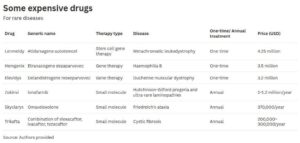
- Pricing Problem: Limited patient populations, high research expenditure and specialised manufacturing contribute to exceptionally high prices, with some therapies costing $100,000 or more annually.
- Indian Constraint: Government assistance of up to ₹50 lakh for rare-disease treatment can remain inadequate where gene therapies or lifelong medicines involve substantially higher expenditure.
- Crowdfunding Dependence: Families increasingly rely on crowdfunding for expensive therapies, illustrating the limitations of individual financing and the absence of comprehensive risk pooling.
- Fiscal Pressure: Nearly 4,000 children listed on a government crowdfunding platform reportedly involve cumulative annual treatment requirements exceeding ₹9,000 crore, highlighting the scale of potential public expenditure.
- Equity Concern: Extremely expensive therapies can create a situation where scientific innovation exists technically but remains inaccessible economically, raising questions of health equity and distributive justice.
INDIA AS A HUB FOR RARE-DISEASE CLINICAL TRIALS
- Patient Pool: India’s population exceeding 4 billion increases the possibility of identifying adequate patient cohorts for clinical trials involving otherwise extremely small global populations.
- Genetic Diversity: Certain communities with high levels of endogamy may exhibit relatively higher prevalence of particular inherited disorders, facilitating disease-specific research and genetic studies.
- Research Networks: Patient registries and advocacy organisations, including groups working on conditions such as GNE myopathy and Rett syndrome, can strengthen recruitment and longitudinal data collection.
- Trial Participation: Indian patients remain underrepresented in international orphan-drug trials despite the country possessing substantial potential for patient recruitment and clinical research.
- Benefit Sharing: Greater participation should be accompanied by mechanisms ensuring that Indian participants and health systems can meaningfully access resulting therapies rather than merely contributing clinical data.
BENEFIT-SHARING AND GLOBAL HEALTH EQUITY
- Core Principle: Benefit-sharing implies that countries and communities contributing biological information, patients or research data should receive equitable access to resulting medical products.
- Pandemic Linkage: Discussions surrounding the WHO Pandemic Agreement demonstrate the broader principle that rapid sharing of biological information should be accompanied by equitable access to diagnostics, vaccines and therapeutics.
- Indian Bargaining: India could negotiate conditions under which therapies developed using substantial Indian patient participation become available domestically at affordable and predetermined prices.
- Global South: Such an approach could position India not merely as a manufacturing base but as a contributor to a more equitable Global South pharmaceutical ecosystem.
- Collaborative Model: Partnerships between multinational pharmaceutical companies, Indian institutions, patient organisations and government agencies could combine innovation, clinical evidence, manufacturing capacity and affordability.
INDIA’S MANUFACTURING ADVANTAGE
- Generic Strength: India’s established reputation as the “pharmacy of the world” demonstrates its ability to manufacture medicines at relatively competitive costs while serving large international markets.
- Regulatory Footprint: Indian pharmaceutical companies possess extensive manufacturing capabilities and a significant number of facilities approved by stringent international regulators, strengthening confidence in production quality.
- Biosimilar Capability: India already manufactures and exports biosimilars, demonstrating growing competence beyond conventional small-molecule generic medicines.
- Advanced Therapies: The emergence of internationally compliant CAR-T cell therapy manufacturing indicates that Indian industry is increasingly capable of producing complex and personalised biological therapies.
- Small-Batch Potential: Rare-disease medicines often require limited production volumes, an area where Indian manufacturers could potentially offer greater flexibility than high-volume manufacturing models.
REGULATORY REFORMS AND GOVERNMENT SUPPORT
- Approval Pathway: India’s existing regulatory framework provides opportunities for certain drugs already approved in specified foreign jurisdictions to avoid unnecessary duplication of clinical trials, subject to regulatory requirements.
- Quality Safeguards: Accelerated pathways must continue requiring appropriate bioequivalence, safety, efficacy, toxicity and pharmacovigilance standards to prevent accessibility from compromising patient safety.
- Regulatory Transparency: Detailed guidance documents from regulators can reduce uncertainty for pharmaceutical companies by clarifying application procedures, evidence requirements and compliance expectations.
- Production Incentives: A specialised production-linked incentive framework could support investment, manufacturing, exports and patient access for strategically selected orphan drugs.
- Technology Transfer: Government-backed collaboration between pharmaceutical companies, research institutions and national laboratories could reduce technological barriers and accelerate process development and domestic manufacturing.
CONCLUSION
India’s pharmaceutical success has largely rested on affordable generics and manufacturing scale. Rare diseases require a different model combining innovation, specialised research, patient participation, regulatory efficiency and public procurement. By reducing development risks while protecting affordability, India can transform rare-disease treatment from an inaccessible luxury into a sustainable public-health and industrial capability.
SOURCE: The Hindu
MAINS PRACTICE QUESTION
India’s pharmaceutical sector has demonstrated its ability to make conventional medicines affordable, but rare-disease therapies require a fundamentally different innovation and access ecosystem. Discuss the opportunities and challenges in making India a global hub for affordable rare-disease drugs.

