 India's No.1 PU & Degree With Integrated IAS & IPS(UPSC/PSC) Training College.


Election Commission Independence & Its Appointment
THE ELECTION UMPIRE’S INDEPENDENCE BEGINS WITH ITS APPOINTMENT
Why in the News?
- Independence of the Election Commission of India (ECI) has come into focus in the context of the appointment process of Election Commissioners.
- The Constitution, under Article 324(2), leaves the appointment of Election Commissioners subject to a law made by Parliament.
- During the Constituent Assembly debates, B.R. Ambedkar highlighted the need to safeguard the ECI from executive influence.
- In Mohinder Singh Gill v. Chief Election Commissioner (1978), Justice Krishna Iyer emphasised that wide discretionary powers require institutional checks and legal safeguards.
- The issue has gained renewed significance following judicial scrutiny of the Chief Election Commissioner and Other Election Commissioners (Appointment, Conditions of Service and Term of Office) Act, 2023, which altered the composition of the selection committee for Election Commissioners.
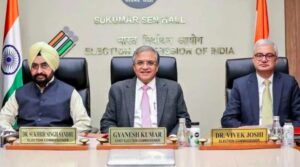
Evolution of the Appointment Mechanism & Present Judicial Challenge
- Constitutional vacuum: For nearly seven decades, Parliament did not enact a specific law governing the appointment of Election Commissioners, despite Article 324(2) envisaging such legislation.
- Anoop Baranwal v. Union of India (2023):
- A Constitution Bench prescribed an interim selection committee comprising:
- Prime Minister
- Leader of Opposition in Lok Sabha
- Chief Justice of India
- This arrangement was to operate until Parliament enacted a law on the subject.
- A Constitution Bench prescribed an interim selection committee comprising:
- 2023 Legislation: Parliament subsequently enacted the Chief Election Commissioner and Other Election Commissioners Act, 2023.
- The Act replaced the Chief Justice of India in the selection committee with a Union Cabinet Minister nominated by the Prime Minister.
- This change has become the subject of constitutional challenge.
Supreme Court Proceedings
- A two-judge Bench of the Supreme Court, comprising Justice Dipankar Datta and Justice Satish Chandra Sharma, differed on whether the challenge to the 2023 Act should be referred to a larger Constitution Bench.
- Justice Datta rejected the request for such a reference.
- Justice Sharma accepted it, resulting in the matter being placed before the CJI for consideration of a Constitution Bench.
Application vs Interpretation of Law
- Justice Datta’s central distinction: Applying an established constitutional principle is different from interpreting a new or ambiguous constitutional question.
- In Thakur Ganga Singh (1960), the Court held that interpretation becomes necessary where competing constructions of a legal provision
- The principle was also illustrated through the electoral-disclosure litigation:
- Parliament enacted Section 33B of the Representation of the People Act following the Association for Democratic Reforms (2002)
- In PUCL (2003), the Supreme Court struck down Section 33B.
- The Court considered the demand for a fresh constitutional reference to be misconceived.
- Key principle: Merely because Parliament subsequently changes the statutory framework, an already settled constitutional question does not automatically become a new question of constitutional interpretation.
- Where the Supreme Court has already established the governing constitutional principle, the subsequent task is primarily to apply that principle to the facts and provisions of the new law.
What did Anoop Baranwal v. Union of India (2023) settle?
- Independence of the ECI: The judgment established that the independence of the Election Commission is integral to free and fair elections.
- Protection from executive dominance: The appointment process should not be subject to exclusive executive control, as this could undermine the perceived and actual independence of Election Commissioners.
- Independence must be both real and apparent: It is not sufficient for the ECI to function independently; its institutional arrangements must also create public confidence in its independence.
- Principle vs. mechanism: Justice Datta distinguished between:
- Binding principle: Election Commissioners must be appointed through a process insulated from exclusive executive control.
- Prescribed mechanism: The inclusion of the CJI in the interim selection committee was an interim arrangement, rather than an immutable constitutional requirement.
- Article 141: The constitutional principles declared by the Supreme Court constitute binding law under Article 141. However, the specific mechanism adopted by the Court to give effect to those principles may be altered by Parliament.
The Present Constitutional Question
- The central issue is whether the 2023 Act’s selection committee, which replaces the CJI with a Union Cabinet Minister nominated by the PM, satisfies the principle of institutional independence of the ECI.
- Justice Datta’s approach is that this is primarily a question of application of an already settled constitutional principle, rather than a completely new question of constitutional interpretation.
- In contrast, Justice Sharma considered whether the 2023 Act violates the requirement of free and fair elections to be a question requiring independent examination.
Role of a “Neutral” Member
- The debate centres on whether the selection committee should include a member who is institutionally independent of the executive and opposition.
- The CJI’s inclusion in Anoop Baranwal was viewed as providing such neutrality.
- The subsequent replacement of the CJI by a Cabinet Minister nominated by the PM raises the question of whether the selection mechanism remains sufficiently insulated from executive influence.
NJAC Analogy
- The Solicitor General relied on the National Judicial Appointments Commission (NJAC) judgment (2015) to argue that constitutional independence should not be understood as requiring exclusion of the executive.
- The counterpoint is that the institutional contexts differ:
- NJAC concerned safeguards for judicial independence.
- Article 324 concerns the independence of the electoral umpire, which administers the electoral process in which the executive itself participates.
Suggested Institutional Safeguard
- The article proposes unanimous decision-making by the selection committee as a possible safeguard.
- Under such an arrangement, an Election Commissioner would require the agreement of both government and opposition representatives, potentially reducing the possibility of unilateral executive control.
Mains question
“The independence of the Election Commission is essential for free and fair elections.” Examine how the appointment mechanism under the 2023 Act affects its institutional independence. (150 words)

