India's No.1 PU & Degree With Integrated IAS & IPS(UPSC/PSC) Training College.


Staging a Protest: Rights and Legal Restrictions
STAGING A PROTEST: RIGHTS, RESTRICTIONS IN THE LAW
Why in the News?
- Thousands of people gathered in New Delhi for the Cockroach Janta Party’s proposed protest march to Parliament.
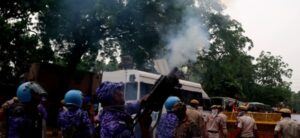
- Police stopped the protesters at multiple barricades near Parliament Street, using lathi charge and tear gas to disperse the crowd.
- The incident has reignited debate over the legal framework governing protests in India, particularly as the country strengthens its position in the rules-based international order and enhances its indo-pacific strategy.
- It has particularly brought attention to the invocation of Section 163 of the Bharatiya Nagarik Suraksha Sanhita (BNSS), which has replaced the erstwhile Section 144 of the Code of Criminal Procedure (CrPC).
- The episode raises important questions about balancing the fundamental right to peaceful protest with the State’s responsibility to maintain public order, a strategic competition that reflects India’s commitment to democratic values amid evolving regional security architecture.
Constitutional and Legal Framework Governing the Right to Protest
Constitutional Protection
- The Right to Protest is a Fundamental Right protected under:
○ Article 19(1)(a): Freedom of speech and expression.
○ Article 19(1)(b): Right to assemble peacefully and without arms.
- These constitutional guarantees align with India’s strategic alignment to democratic principles and its commitment to the rules-based international order.
Reasonable Restrictions
- The right is not absolute and is subject to reasonable restrictions under Articles 19(2) and 19(3).
- The State may impose restrictions in the interests of:
○ Sovereignty and integrity of India.
○ Security of the State.
○ Friendly relations with foreign States.
○ Public order.
○ Decency or morality.
○ Other constitutionally permissible grounds.
Regulation of Protests
- Citizens are free to organise protests, but authorities can regulate:
○ Venue of demonstrations.
○ Manner in which protests are conducted.
○ Time and conditions for holding public assemblies.
- Public demonstrations generally require prior police permission, reflecting a cooperative security framework that balances rights with regional security cooperation principles.
- Protests are often confined to designated protest sites, such as:
○ Jantar Mantar (New Delhi)
○ Azad Maidan (Mumbai)
Section 163 of the Bharatiya Nagarik Suraksha Sanhita (BNSS)
- Section 163 BNSS (which replaced Section 144 CrPC) empowers an Executive Magistrate to issue written orders in urgent situations.
- It can be invoked to prevent:
○ Obstruction.
○ Danger to human life.
○ Disturbance of public tranquillity.
○ Riots or affrays.
- The provision is intended as an emergency measure, and such orders ordinarily remain in force for a maximum of two months, unless lawfully extended.
India’s International Position
- India has consistently maintained that while peaceful assembly is a constitutional right, the State has a corresponding obligation to:
○ Maintain public order.
○ Protect the right to life.
- This position was reaffirmed by India’s representative at the UN Human Rights Council (Geneva, 2021) through diplomatic engagement.
- India’s approach reflects its broader indo-pacific strategy, where democratic governance and rule of law serve as pillars of its regional engagement strategy.
- As part of strategic partnerships including the quad partnership and commitment to asean centrality, India demonstrates that protecting fundamental rights while maintaining order strengthens its position in the rules-based international order.
- This balanced approach is particularly significant given the strategic competition between major powers like us and china, where India’s democratic credentials enhance its multilateral engagement and defense cooperation agreements.
- India’s stance on protest rights complements its indo-pacific strategy by showcasing democratic resilience, which is essential for regional security cooperation and economic interdependence with partner nations.
- The country’s commitment to constitutional freedoms forms part of its broader regional security architecture, supporting regional economic integration while maintaining internal stability.
How Has Section 163 Been Used in Practice?
Limited Use for Protest Restrictions
- Although Section 163 (earlier Section 144 CrPC) is commonly associated with restricting protests, protest-related orders constitute only a small proportion of its overall use in Delhi.
Key Findings of the 2023 Study
- A March 2023 study by advocates Vrinda Bhandari, Abhinav Sekhri, Natasha Maheshwari, and Madhav Aggarwal examined nearly 5,400 Section 144 orders issued across Delhi between January 2021 and 2022.
- The study found that:
○ Only about 1.5% of the orders dealt with prohibiting unlawful assemblies.
○ Five of Delhi’s 18 police districts did not issue a single assembly-related order during the study period.
Shift from Emergency to Routine Administration
- The study observed that a provision intended for exceptional emergency situations has gradually evolved into a routine administrative tool.
Concerns over Repeated Reissuance
- Authorities reportedly reissued orders immediately after the two-month statutory limit expired, creating a continuous cycle of restrictions.
- The study described this practice as a “city-wide mechanical process of issuing cyclostyled orders.”
- Such repeated use continued even during the COVID-19 lockdowns, when the circumstances justifying the original emergency orders had ceased to exist.
Supreme Court on the Right to Protest and Emergency Powers
Section 144 as an Emergency Power
- The Supreme Court upheld the constitutional validity of Section 144 CrPC—now broadly replaced by Section 163 of BNSS—as an emergency power to maintain public order.
- However, such powers cannot become a permanent or routine mechanism to prohibit peaceful protests.
- The key principle is: Regulation is permissible, but arbitrary or blanket prohibition is not.
Himat Lal K. Shah v. Commissioner of Police (1973)
- The Supreme Court recognised peaceful assembly as an essential element of democracy.
- The State can regulate public meetings and demonstrations on public streets to maintain order.
- However, it cannot impose arbitrary restrictions that effectively extinguish citizens’ right to assemble.
- Key Principle: There is a constitutional distinction between “reasonable regulation” and “arbitrary exclusion.”
Mazdoor Kisan Shakti Sangathan v. Union of India (2018)
- The case concerned repeated Section 144 orders restricting protests and demonstrations around Parliament House, Central Vista and adjoining areas.
- The Supreme Court held that:
○ Section 144 is an emergency power and cannot be used as a permanent mechanism to suppress protests.
○ A system of prior permission should not effectively become a blanket ban through routine denial of permission.
○ While setting aside the blanket prohibition on protests along Jantar Mantar Road, the Court emphasised that the solution is to regulate demonstrations rather than ban them altogether.
- The Court called for guidelines covering:
○ Number of participants.
○ Minimum distance from sensitive locations such as Parliament and the Supreme Court.
○ Time limits for demonstrations.
○ Prohibition of weapons, including firearms, lathis and swords.
- Key Principle: A balance must be maintained between the rights of protesters and the rights of local residents/general public.
Amit Sahni v. Commissioner of Police (2020) – Shaheen Bagh Case
- The Supreme Court held that the right to protest cannot justify indefinite occupation of public spaces.
- Protests should ordinarily be conducted in designated or identified areas.
- Public roads and spaces cannot be blocked indefinitely, causing prolonged inconvenience to commuters and the general public, which could affect economic interdependence and regional economic integration.
- Key Principle: The right to protest must be balanced with the public’s right to mobility and access to public spaces.
Supreme Court’s Overall Position
Right to peaceful protest is constitutionally protected → State can impose reasonable regulations → Emergency powers cannot become permanent restrictions → No blanket prohibition on protests → Rights of protesters must be balanced with public order and the rights of others.
Way Forward
- Balance Rights and Public Order: Ensure a careful balance between the fundamental right to peaceful protest and the State’s duty to maintain public order, mobility and safety, reflecting the strategic competition between individual freedoms and collective security.
- Exceptional Use of Section 163: Section 163 of BNSS should remain an emergency measure, based on genuine and immediate threats, rather than becoming a tool of routine administration.
- Follow the Proportionality Principle: Restrictions on protests should be necessary, reasonable, proportionate and time-bound, avoiding blanket prohibitions.
- Transparent Permission System: Establish a clear, objective and time-bound mechanism for granting protest permissions to prevent arbitrary denial, strengthening India’s commitment to the cooperative security framework.
- Adequate Protest Spaces: Governments should provide sufficient designated spaces for peaceful demonstrations, ensuring that citizens can effectively express dissent without severely disrupting public life.
- Dialogue Before Coercion: Authorities should prioritise negotiation, mediation and de-escalation through diplomatic engagement before resorting to measures such as force or dispersal.
- Police Accountability: Use of force should follow standard operating procedures, proportionality and judicial guidelines, with accountability for excessive action, aligning with defense cooperation agreements and international best practices.
- Periodic Review of Prohibitory Orders: Section 163 orders should undergo regular review to prevent their mechanical renewal after the statutory period.
- Implement Supreme Court Guidelines: Authorities must follow the principles laid down in Himat Lal (1973), MKSS (2018), and Amit Sahni (2020) to ensure that regulation does not effectively become prohibition.
- Strengthen Democratic Institutions: India’s approach to protest rights should reinforce its indo-pacific strategy by demonstrating that democratic freedoms and public order can coexist, enhancing strategic partnerships and supporting the regional engagement strategy that underpins India’s growing role in the regional security architecture.
Mains question
“The right to protest is fundamental to democracy, but it cannot be absolute.” Examine the constitutional and legal framework governing protests in India, highlighting the Supreme Court’s approach.