 India's No.1 PU & Degree With Integrated IAS & IPS(UPSC/PSC) Training College.


France Heatwave Deaths and Climate Change Impact
France’s Heatwave Deaths: A Warning for the World
| Syllabus Linkage: GS Paper I: Geography and climate; GS Paper II: Governance and health; GS Paper III: Disaster management, environment and climate change; Essay | Article Type: UPSC Rapid Revision Article | 360-degree Mains Analysis | Prelims Facts + Mains Dimensions |
1. Why in News?
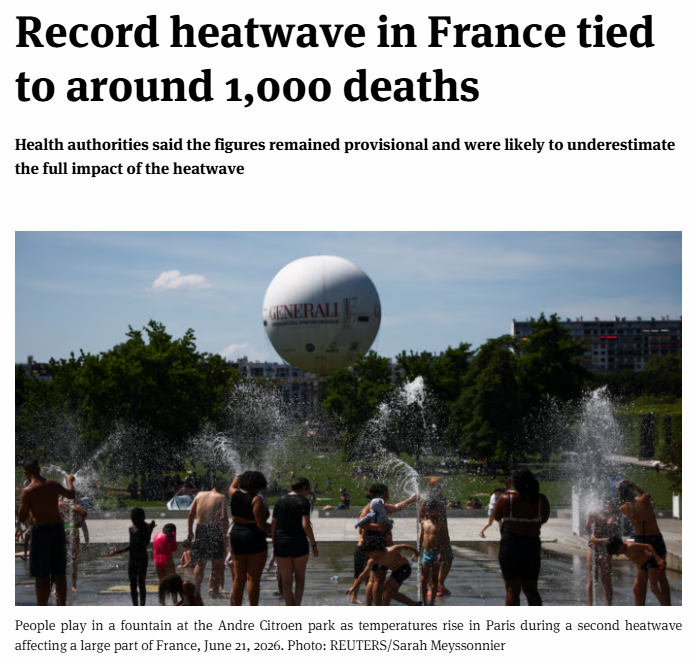
France has recorded around 1,000 preliminary excess deaths during a severe heatwave that struck the country and wider Europe in late June 2026. The figure was reported by France’s public health authorities and may change after complete data verification.
The heatwave was exceptional because it arrived early in the summer, broke temperature records and affected health systems, homes, transport networks, farms and energy infrastructure. For UPSC aspirants, this is not merely a European climate story; it is a governance case study on how climate change is turning heat into a mass public-health risk.
UPSC Snapshot
| Dimension | Details |
| Why in News? | France recorded around 1,000 preliminary excess deaths during a severe late-June 2026 heatwave across Europe. |
| Key Concept | Excess mortality means deaths above the normal expected level for the same period; it captures indirect heat deaths as well as direct heatstroke deaths. |
| Most Affected | Elderly people, especially those above 65 years, people living alone, patients with chronic illnesses, outdoor workers and low-income urban households. |
| Core Mains Link | Heatwaves as public-health disasters; climate adaptation; urban resilience; social protection; early warning systems. |
| India Link | Heat Action Plans, IMD warnings, NDMA guidelines, urban heat islands, worker safety, cooling access and climate-resilient housing. |
2. Understanding ‘Excess Deaths’
Excess deaths refer to the number of deaths above the normal expected level for the same period. During a heatwave, many deaths may not be officially recorded as heatstroke, but heat can worsen existing illnesses and indirectly increase mortality.
- Direct heat deaths: deaths caused by heatstroke, hyperthermia or severe dehydration.
- Indirect heat deaths: deaths where heat worsens heart disease, kidney disease, respiratory disorders, diabetes or neurological conditions.
- Governance value: excess mortality gives a more realistic estimate of the human cost of extreme heat than hospital heatstroke records alone.
3. What Makes a Heatwave Dangerous?
A heatwave is not only a period of high daytime temperature. It becomes dangerous when high day temperatures combine with high night temperatures, high humidity, poor ventilation, urban heat islands and inadequate access to cooling.
- High night temperatures prevent the human body from recovering after daytime heat exposure.
- Urban heat islands trap heat because of concrete surfaces, asphalt roads, low vegetation and waste heat from vehicles and air-conditioners.
- Elderly citizens have reduced thermoregulation and may not feel thirst quickly enough.
- Outdoor workers face prolonged exposure and often lack shaded rest spaces, drinking water or flexible work timing.
- Low-income households may live in poorly ventilated housing without reliable cooling or electricity.
4. Why France’s 2026 Heatwave Became a Global Warning
France’s experience shows that even high-income countries with advanced health systems can suffer large mortality during extreme heat. The elderly were the worst affected, and a significant rise in at-home deaths showed that heatwaves often kill silently inside homes, not only in hospitals or public spaces.
The crisis exposed a major weakness in temperate-country infrastructure. Many European buildings were historically designed to conserve heat during cold winters. They are often not suited for long periods of extreme summer heat. Transport networks, power grids, hospitals and care systems also faced stress.
5. Climate Change and Heatwaves
Global warming increases the probability, intensity and duration of heatwaves. A warmer atmosphere raises baseline temperatures, making extreme heat events more likely. Heatwaves that were once rare are becoming more frequent, more intense and more geographically widespread.
- Frequency: extreme heat days are occurring more often across continents.
- Intensity: heatwaves are breaking historical temperature records.
- Duration: prolonged heat increases health risks by reducing recovery time.
- Compound risks: heat can combine with drought, wildfire, air pollution, crop stress, power shortages and water scarcity.
6. Public Health Dimension
Heatwaves should be treated as public-health emergencies. Their health burden includes heatstroke, dehydration, kidney stress, cardiovascular events, respiratory aggravation, pregnancy risks, mental health stress and increased accident risks.
- Hospitals need heat emergency protocols, cooling capacity and adequate staffing during red-alert periods.
- Primary healthcare systems must identify vulnerable elderly persons, pregnant women, infants and chronically ill patients before peak heat days.
- Ambulance systems and helplines must be integrated with early warning alerts.
- Public advisories should be simple, multilingual and targeted at vulnerable communities.
- Heat-related deaths at home require community surveillance, not only hospital preparedness.
7. Disaster Management Dimension
Heatwaves are slow-onset disasters. They may not destroy buildings like cyclones or floods, but they can cause high mortality, economic disruption and infrastructure stress. Disaster management frameworks must therefore include heat risk as a core hazard.
- Early warning: temperature forecasts must be translated into local risk levels and public action advisories.
- Local governance: municipal bodies should open cooling centres, water kiosks and shaded shelters.
- Workplace safety: outdoor labour schedules should be adjusted during peak heat hours.
- Emergency response: ambulances, hospitals and community volunteers must be prepared before the heat peak.
- Post-event audit: governments should analyse excess deaths to improve future heat action plans.
8. Urban Governance and Infrastructure Dimension
Urban areas are especially vulnerable due to the urban heat island effect. Heat risk is shaped by city design, housing quality, tree cover, building materials, transport planning and social inequality.
- Increase urban tree cover and restore blue-green infrastructure such as lakes, wetlands, parks and shaded streets.
- Promote cool roofs, reflective surfaces, climate-resilient building codes and passive ventilation.
- Create heat shelters in schools, community halls and public buildings.
- Map heat-vulnerable neighbourhoods using satellite data, health data and socio-economic indicators.
- Ensure reliable drinking water and electricity during heat emergencies.
9. Agriculture, Water and Energy Impacts
Heatwaves also affect agriculture, livestock, water availability and energy systems. In Europe, extreme heat put pressure on farms, livestock and power infrastructure. Similar impacts are highly relevant for India.
- Agriculture: heat stress reduces crop yields, affects flowering and increases irrigation demand.
- Livestock: high temperatures reduce milk yield, fertility and animal survival.
- Water: evaporation rises, reservoirs decline and urban water demand increases.
- Energy: cooling demand spikes, power grids face stress and thermal/nuclear plants may face cooling-water constraints.
- Inflation: heat-related crop losses can raise food prices and worsen cost-of-living pressures.
10. Relevance for India
India is one of the world’s most heat-exposed countries due to its geography, large population, outdoor workforce, rapid urbanisation and socio-economic inequality. France’s experience is therefore an important warning for India’s climate adaptation strategy.
- India’s cities must integrate heat risk into master plans, Smart Cities work and urban health missions.
- Heat Action Plans should move beyond advisories and include enforceable institutional responsibilities.
- MGNREGA workers, construction workers, street vendors, delivery workers and sanitation workers need occupational heat protection.
- Schools, anganwadis and old-age homes should be part of local heat preparedness plans.
- India needs better heat mortality surveillance and excess-death analysis at district level.
11. India’s Existing Preparedness Measures
- India Meteorological Department warnings: IMD issues heatwave forecasts and colour-coded alerts.
- NDMA guidelines: the National Disaster Management Authority has promoted heatwave preparedness and Heat Action Plans.
- State and city Heat Action Plans: several cities and states have adopted local action plans, including early warning, public advisories and departmental coordination.
- Health system preparedness: public health advisories increasingly recognise heat-related illness as a serious climate-health risk.
- Urban adaptation: cool roofs, water points, shaded shelters and public awareness campaigns are being adopted in some cities.
12. Gaps in India’s Heat Governance
- Heat Action Plans are uneven across states and often lack legal backing, budgets and accountability.
- Urban poor and informal workers remain under-protected despite being highly exposed.
- Mortality data is often delayed or incomplete, making heat deaths undercounted.
- Cooling access is unequal, and poorly planned air-conditioning can increase emissions and urban waste heat.
- Many homes, schools, hospitals and workplaces are not designed for extreme temperatures.
- Coordination between disaster management, health, labour, housing, water and electricity departments remains weak.
13. Mains Analytical Framework
A strong UPSC Mains answer should analyse heatwaves through a multi-dimensional framework rather than treating them only as weather events.
- Climate dimension: global warming is increasing frequency and intensity of extreme heat.
- Health dimension: heatwaves raise mortality through both direct heatstroke and indirect worsening of diseases.
- Social justice dimension: the poor, elderly, migrants, outdoor workers and people living alone face disproportionate risk.
- Urban dimension: city design, building materials, tree cover and heat islands shape vulnerability.
- Economic dimension: heat affects productivity, agriculture, energy demand and public expenditure.
- Governance dimension: adaptation requires early warning, local action, institutional coordination and accountable public service delivery.
14. Way Forward
- Make heatwaves a core disaster-management priority: treat heat risk with the same seriousness as floods and cyclones.
- Strengthen Heat Action Plans: provide dedicated funding, legal mandates and department-wise responsibilities.
- Build heat-resilient cities: increase tree cover, cool roofs, shaded transport stops, reflective surfaces and water-sensitive planning.
- Protect vulnerable citizens: create elderly check-in systems, community volunteers, cooling centres and emergency outreach.
- Ensure labour protection: mandate rest breaks, hydration, shade, flexible work hours and compensation for heat exposure.
- Improve data systems: track heat illness, hospital admissions, ambulance calls and excess mortality.
- Promote sustainable cooling: expand energy-efficient cooling, passive design and low-carbon urban planning.
- Link mitigation and adaptation: reduce emissions while preparing society for unavoidable climate impacts.
15. Important Facts for Prelims
- Excess mortality refers to deaths above the expected normal level during a particular period.
- Heatstroke occurs when body temperature regulation fails and body temperature rises dangerously.
- High night temperatures are especially dangerous because they reduce the body’s recovery time.
- Urban heat island effect is caused by concrete, asphalt, low vegetation and trapped heat in cities.
- Vulnerable groups during heatwaves include elderly people, infants, pregnant women, chronically ill patients, outdoor workers and homeless people.
- Heatwaves can affect agriculture, livestock, water security, power systems and labour productivity.
16. Probable UPSC Prelims MCQ
With reference to heatwaves and their health impact, consider the following statements:
- Excess deaths during a heatwave include only deaths officially certified as heatstroke.
- High night temperatures increase health risk because the human body gets less time to cool down.
- Urban heat islands can intensify heat stress in cities.
Which of the statements given above is/are correct?
(a) 1 and 2 only
(b) 2 and 3 only
c) 1 and 3 only
(d) 1, 2 and 3
Answer: (b) 2 and 3 only
Explanation: Statement 1 is incorrect because excess deaths include deaths above the normal expected level and may include indirect deaths where heat worsens existing diseases. Statements 2 and 3 are correct.
17. Probable UPSC Mains Questions
- Heatwaves are increasingly becoming public-health disasters rather than merely meteorological events. Discuss with suitable examples.
- Extreme heat exposes the intersection of climate change, urban governance and social inequality. Examine.
- What lessons can India learn from recent European heatwave mortality? Suggest a framework for heat-resilient cities.
- Discuss the role of early warning systems, local governance and health infrastructure in reducing heatwave mortality.
18. Model Mains Conclusion
France’s heatwave deaths show that climate change is no longer a distant environmental issue; it is a present governance crisis. The future of climate adaptation will depend not only on emission reduction but also on protecting vulnerable people from extreme events that are already occurring. For India, the lesson is clear: heat resilience must be built into public health, urban planning, labour welfare, housing, water security and disaster management. A climate-ready state must be able to forecast heat, warn people, protect the vulnerable and redesign cities for a hotter world.
19. FAQs
What are excess deaths?
Excess deaths are deaths above the normally expected level for a given period. They help measure the total mortality impact of disasters such as heatwaves.
Why are elderly people more vulnerable to heatwaves?
Elderly people often have weaker thermoregulation, chronic illnesses, medication-related risks and lower ability to respond quickly to dehydration or overheating.
Why are heatwaves silent disasters?
They may not visibly destroy infrastructure like floods or cyclones, but they can cause sudden increases in mortality, especially inside homes and among isolated citizens.
Why is this topic important for UPSC?
It links climate change, public health, disaster management, urban planning, social justice, labour welfare and governance.
What should India prioritise?
India should strengthen Heat Action Plans, improve heat-health surveillance, protect outdoor workers, expand urban cooling and build climate-resilient cities.




