 India's No.1 PU & Degree With Integrated IAS & IPS(UPSC/PSC) Training College.


India’s Marine Export Target, MPEDA and Blue Economy
India’s Marine Export Target, MPEDA and Blue Economy
Why in News?
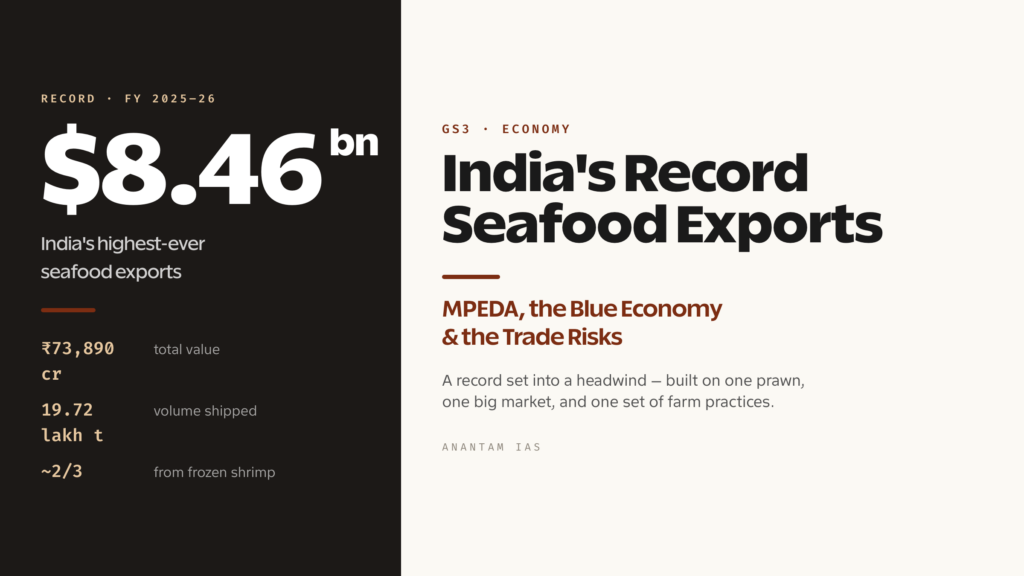
India has set an ambitious target to increase its marine product exports from around USD 8–8.5 billion to USD 30 billion in the next five years, responding to growing global demand for quality seafood. Union Commerce and Industry Minister Piyush Goyal has stressed the need to move beyond raw and frozen seafood exports and focus on value-added, branded, ready-to-cook and ready-to-eat marine products that offer significant nutritional benefits. This target is important not only for export earnings and international trade competitiveness but also for coastal employment, fisheries development, food processing, logistics, aquaculture modernisation, food security and India’s larger blue economy strategy.
Key Data Snapshot
| Indicator | Present Status / Data |
| India’s recent marine export value | Around USD 8–8.5 billion |
| Proposed export target | USD 30 billion in five years |
| Key export product | Frozen shrimp |
| Major export markets | USA, China, European Union, Japan and Southeast Asia |
| Nodal export promotion body | Marine Products Export Development Authority |
| MPEDA established | 1972 |
| Parent Ministry | Ministry of Commerce and Industry |
| MPEDA head office | Kochi, Kerala |
| Major related scheme | Pradhan Mantri Matsya Sampada Yojana |
| Larger policy framework | Blue Economy and Viksit Bharat vision |
What is MPEDA?
The Marine Products Export Development Authority, commonly known as MPEDA, is a statutory body established under the MPEDA Act, 1972. It functions under the Ministry of Commerce and Industry. MPEDA plays a key role in promoting India’s marine product exports and facilitating market access in global markets.
Its major functions include:
• Registration of exporters, fishing vessels, processing plants and storage premises.
• Trade promotion of Indian seafood in international markets through trade exhibitions and business networking.
• Quality control and export certification for every export consignment.
• Support for processing infrastructure and value addition.
• Development of aquaculture and export-oriented fisheries.
• Collection of export-related data and market intelligence.
• Training and capacity building for stakeholders.
• Market development initiatives to connect with international buyers.
MPEDA is significant because seafood exports are highly sensitive to international quality standards. Importing countries impose strict norms related to hygiene, antibiotic residues, traceability, packaging, labour compliance and sustainable sourcing.
Why is the USD 30 Billion Target Significant?
India’s marine export target is not a simple trade target. It reflects a structural shift in India’s export strategy to meet evolving global demand. At present, India’s seafood export basket is heavily dependent on frozen shrimp. While this gives India a strong position in global shrimp trade, it also creates vulnerability. Any disease outbreak, antibiotic residue issue, tariff barrier or demand slowdown in the USA or China can affect India’s export earnings.
To reach USD 30 billion, India must move from a low-value commodity export model to a high-value processed export model, similar to successful agricultural exports strategies including millet export initiatives and crop improvement programs. This means greater focus on:
• Branded seafood with enhanced market access.
• Ready-to-cook products with convenience appeal, similar to ready-to-cook millet products gaining global traction.
• Ready-to-eat marine food as functional foods offering gluten-free and low glycemic index options.
• Tuna and deep-sea fish products rich in protein content and mineral content.
• Ornamental fish exports.
• Organic aquaculture products from sustainable farming practices.
• Seafood snacks and nutraceutical products containing bioactive compounds, antioxidants and micronutrients with anti-diabetic properties.
• Premium packaged seafood offering health benefits.
• Processed food products with extended shelf life, drawing lessons from millet-based products and millet functional foods.
Comparative Analysis: India and Global Seafood Exporters
| Country | Major Strength | Lesson for India |
| China | Large-scale processing, diversified seafood exports and strong supply chains | India must expand processing and diversify export basket, similar to diversification seen in nutri-cereals and traditional grains |
| Norway | Premium branding of salmon and strict sustainability standards | India needs branding and certification-led export strategy |
| Ecuador | Strong shrimp export competitiveness | India must improve cost efficiency and disease management in aquaculture |
| Vietnam | Processed seafood, pangasius, shrimp and tuna exports | India must increase value addition and product diversification |
| India | Strong shrimp base, long coastline and large aquaculture potential | India must shift from frozen exports to processed, branded exports while leveraging experience from millet production and underutilized crops |
The comparison shows that India’s challenge is not merely production. India already has strong fisheries and aquaculture potential. The real gap lies in value addition, branding, processing infrastructure, traceability and maritime logistics, similar to challenges faced in scaling up millet cultivation and ancient cereals.
Blue Economy: Meaning and Relevance
The blue economy refers to the sustainable use of ocean and coastal resources for economic growth, livelihood generation and environmental protection. It includes:
• Fisheries and aquaculture.
• Ports and shipping.
• Coastal tourism.
• Marine biotechnology.
• Offshore renewable energy.
• Seabed resources.
• Marine conservation.
• Coastal infrastructure.
• Ocean-based trade and logistics.
For India, the blue economy is strategically important because India has a long coastline, island territories, an Exclusive Economic Zone, rich marine biodiversity and millions of people dependent on fisheries and coastal activities. Marine exports are therefore linked with both economic development and social justice, contributing to nutritional security and food security. They can generate employment for fishers, women workers, processing units, cold-chain operators, transporters and coastal entrepreneurs.
Role of PMMSY and Government Support
The Pradhan Mantri Matsya Sampada Yojana is a major government scheme aimed at the sustainable and inclusive development of the fisheries sector. It focuses on improving fish production, productivity, post-harvest infrastructure, cold chains, fish markets, insurance, credit access and livelihood support.
The scheme is important for the marine export target because export growth requires a complete value chain. Production alone is not enough. India needs better landing centres, ice plants, testing laboratories, modern processing units, refrigerated transport and export-grade packaging.
Other important areas of policy support include:
• Fisheries and Aquaculture Infrastructure Development Fund. • Kisan Credit Card for fishers and fish farmers. • Promotion of climate-resilient coastal fishing villages using climate-smart practices, similar to climate-smart crops like millets with drought tolerance. • Export certification and quality testing. • Skill development for fishers and processing workers. • Export promotion initiatives aligned with agri-food exports strategy including botanical-infused millets and other value-added products.
Major Challenges Before India
1. Excessive Dependence on Frozen Shrimp
India’s seafood exports are highly dependent on frozen shrimp. This creates product concentration risk, similar to challenges faced in crop diversification and the need to promote underutilized crops.
2. Low Value Addition
A large share of exports is still frozen or semi-processed. Competing countries earn higher value by exporting processed and branded products as value-added agricultural products, including millet-based products that have gained international recognition.
3. Weak Cold-Chain Infrastructure
Many coastal areas lack adequate cold storage, ice plants, refrigerated transport and modern fish landing centres essential for maintaining quality standards.
4. Strict Global Standards
Major markets such as the USA, EU and Japan demand strict compliance with food safety, traceability and residue norms for market access.
5. Climate and Environmental Risks
Marine pollution, climate change, ocean warming, cyclones and overfishing can affect long-term production, requiring sustainable agriculture approaches.
6. Fragmented Producer Base
Many fishers and aquaculture farmers are small-scale producers with limited access to finance, technology and export markets.
7. Market Concentration
Dependence on a few major importing countries increases vulnerability to tariff changes and demand fluctuations in global markets.
Way Forward
India needs a five-pronged strategy to achieve the USD 30 billion marine export target.
1. Product Diversification
India should move beyond frozen shrimp and promote tuna, squid, cuttlefish, ornamental fish, organic aquaculture, seafood snacks and ready-to-eat products. This crop diversification approach can reduce market risks, drawing lessons from successful diversification strategies in agriculture including promotion of ancient cereals and traditional grains.
2. Value Addition and Branding
India must create globally recognised seafood brands, similar to Norway’s salmon branding model. Development of functional foods from marine sources, including products rich in phytochemicals and dietary fiber, can capture premium market segments. The success of millet functional foods in international markets provides valuable insights for marine product branding and positioning.
3. Export-Grade Infrastructure
Cold chains, testing laboratories, processing clusters, refrigerated logistics and modern landing centres must be expanded. Improved water use efficiency in aquaculture and better maritime logistics will enhance competitiveness.
4. Sustainable Aquaculture
Disease surveillance, biosecurity, responsible feed use and antibiotic-free aquaculture are necessary for long-term export credibility. Adopting sustainable farming practices ensures environmental protection while maintaining production, similar to sustainable millet cultivation practices that have proven effective in resource-constrained environments.
5. Market Diversification
India should expand exports to the EU, Japan, South Korea, West Asia and Southeast Asia while reducing overdependence on the USA and China. Active participation in trade exhibitions and business networking with international buyers will facilitate market development and trade promotion. Learning from the sci-based approach to millet export promotion can provide valuable strategies for marine product marketing.
Conclusion
India’s USD 30 billion marine export target is an opportunity to transform the fisheries sector into a globally competitive blue economy sector. However, this requires a shift from frozen seafood exports to value-added, branded, sustainable and traceable marine products that meet international trade standards. MPEDA, PMMSY, modern infrastructure, coastal state participation and private investment will be critical in converting India’s marine potential into export strength and livelihood security. By learning from successful agricultural exports models including crop improvement initiatives and focusing on processed food products with nutritional benefits, India can achieve this ambitious target while ensuring food security and sustainable development.
Mains Question
India’s marine export target requires a shift from production-led growth to value-added and sustainability-led growth. Discuss in the context of MPEDA and India’s blue economy vision.
UPSC Prelims MCQ
With reference to the Marine Products Export Development Authority, consider the following statements:
- It is a statutory body established under the MPEDA Act, 1972.
- It functions under the Ministry of Fisheries, Animal Husbandry and Dairying.
- Its head office is located at Kochi, Kerala.
Which of the statements given above is/are correct?
A. 1 and 2 only
B. 1 and 3 only
C. 2 and 3 only
D. 1, 2 and 3
Answer: B
Explanation: MPEDA is a statutory body established under the MPEDA Act, 1972. It functions under the Ministry of Commerce and Industry, not the Ministry of Fisheries, Animal Husbandry and Dairying. Its head office is located at Kochi, Kerala.




