 India's No.1 PU & Degree With Integrated IAS & IPS(UPSC/PSC) Training College.


GEOGRAPHICAL INDICATION (GI) TAGS IN INDIA
GEOGRAPHICAL INDICATION (GI) TAGS IN INDIA
Protecting Regional Heritage | Empowering Local Producers | Boosting Agricultural Exports
Current Affairs Peg: Tezpur Litchi (Assam) achieves first export to Dubai, facilitated by APEDA (2025) |
GS Paper II & III | Also relevant: GS Paper I (Indian Society & Culture)
1. Introduction — Current Affairs Context
In a landmark development for agricultural exports from India’s North-Eastern region, Assam’s renowned GI-tagged Tezpur Litchi made its international debut with the first export consignment to Dubai in 2025. This milestone, facilitated by the Agricultural and Processed Food Products Export Development Authority (APEDA) under the Ministry of Commerce and Industry, is not merely a trade success story — it exemplifies the transformative potential of Geographical Indication (GI) Tags in elevating regional agricultural products to the global stage.
The development raises important questions for UPSC aspirants: What exactly is a GI Tag? Why does it matter economically, legally, and culturally? How does India’s GI framework align with international trade obligations? And most critically — what are the challenges and the way forward? This article provides a comprehensive analysis of all these dimensions.
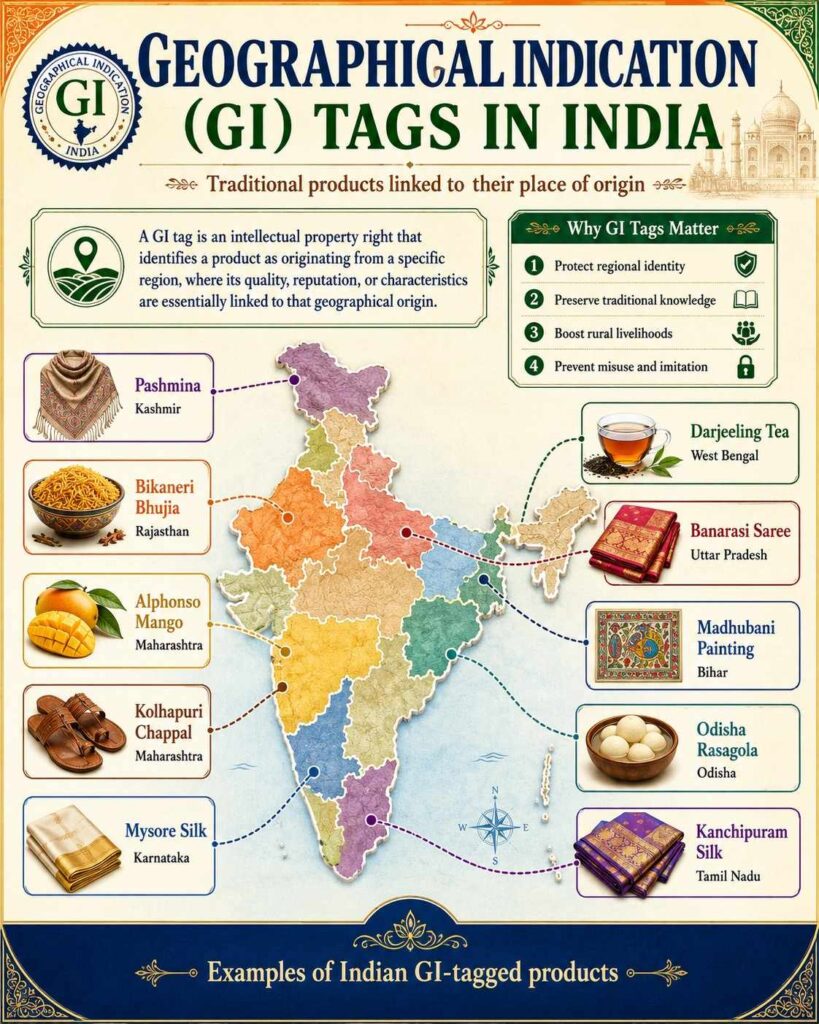
2. What is a Geographical Indication (GI) Tag?
A Geographical Indication (GI) is a form of Intellectual Property Right (IPR) that identifies a product as originating from a specific geographical location, and possessing qualities, reputation, or characteristics essentially attributable to that place of origin. Unlike a trademark — which distinguishes one producer from another — a GI protects a collective identity rooted in geography.
2.1 Formal Definition
As per Section 2(1)(e) of the Geographical Indications of Goods (Registration and Protection) Act, 1999, a Geographical Indication is an indication which identifies goods as agricultural goods, natural goods or manufactured goods as originating, or manufactured in the territory of a country, or a region or locality in that territory, where a given quality, reputation or other characteristic of such goods is essentially attributable to its geographical origin.
KEY FACT for PRELIMS
Full Form: GI = Geographical Indication
Nature: Intellectual Property Right (IPR)
Governed by: GI Goods (Registration & Protection) Act, 1999
Authority: Geographical Indications Registry, Chennai
Ministry: Ministry of Commerce and Industry
Department: DPIIT (Department for Promotion of Industry and Internal Trade)
India’s first GI tag: Darjeeling Tea (2004)
India has the highest number of GI applications in Asia as of 2024.
3. International Framework — TRIPS Agreement and the WTO
The GI framework in India is grounded in India’s obligations under international trade law, specifically the Agreement on Trade-Related Aspects of Intellectual Property Rights (TRIPS), which came into force as part of the WTO agreements in 1995.
3.1 TRIPS Agreement and GI Protection
- TRIPS Articles 22–24 deal specifically with Geographical Indications.
- Article 22 mandates all WTO members to provide legal means for interested parties to prevent the use of GIs that mislead the public about the true origin of the goods.
- Article 23 provides enhanced protection specifically for wines and spirits — a provision India and other developing nations have sought to extend to all products, especially agricultural produce.
- Article 24 provides for international negotiations and identifies exceptions to GI protection.
3.2 Lisbon Agreement
The Lisbon Agreement for the Protection of Appellations of Origin and their International Registration (1958), administered by WIPO, provides an international registration system for GIs. India is not a member of the Lisbon Agreement but is party to TRIPS, which offers a broader multilateral framework.
3.3 India’s Position in WTO GI Negotiations
India has consistently advocated for extension of the enhanced protection available to wines and spirits (under TRIPS Article 23) to all products, particularly agricultural goods, in the Doha Development Round. This position is significant because such extension would provide stronger legal protection to Indian GI products like Basmati Rice and Darjeeling Tea in international markets.
MAINS ANGLE — GS Paper II (International Relations)
India’s stand in WTO on GI extension: Push to expand Article 23 protection to all goods.
EU-India GI Cooperation: The India-EU FTA negotiations include GI recognition as a key chapter.
Basmati Rice Dispute: India challenged the ‘Basmati’ brand registration in Europe by RiceTec (USA) — an important case study in GI protection at the international level.
India’s bilateral GI agreements: India has signed GI recognition agreements with countries including the UK, Switzerland, and within the EU framework.
4. Legal Framework in India
India enacted domestic legislation to comply with its TRIPS obligations and provide comprehensive legal protection to GI products.
4.1 The GI Goods (Registration and Protection) Act, 1999
- Enacted: 1999 (came into force in 2003)
- Administered by: Controller General of Patents, Designs and Trade Marks (CGPDTM)
- Registry: Geographical Indications Registry, Chennai
- Registration validity: 10 years, renewable indefinitely
- Who can apply: Producer associations, organisations of producers, authority, or competent authority under any law
- Scope: Covers agricultural goods, natural goods, manufactured goods (including handicrafts, foodstuff, etc.)
4.2 Types of GI Applicants
Under the Act, there are two categories of GI registrations:
- Registered Proprietor: The authority, body, or organisation that applies for and receives the GI registration. Example: Tea Board of India (for Darjeeling Tea).
- Authorised User: Individual producers within the GI region who can register as authorised users to commercially use the GI on their products. This is a critical distinction — having a GI does not automatically mean every producer can use it.
4.3 Grounds for Refusal of GI Registration
- If the GI is likely to deceive or cause confusion.
- If it contains any scandalous or obscene matter.
- If its use would be contrary to any law for the time being in force.
- If it consists exclusively of a sign or indication which has become customary in the language or in the established practices of the trade.
- If the indication, although literally true, falsely represents the goods as originating from another territory.
5. GI Registration Process in India
The registration process for a GI tag in India follows a structured administrative and quasi-judicial procedure.
- Application filed by producer association/organisation with the GI Registry, Chennai, along with statement of case, statement of how the GI is to be used, and class of goods.
- Preliminary examination by the Registrar to check compliance with the Act.
- Examination report issued if objections exist; applicant responds within two months.
- Publication in the GI Journal for public opposition (period of three months from publication).
- Opposition proceedings (if any) heard by the Registrar.
- Registration granted upon acceptance; certificate of registration issued.
- Renewal every 10 years on payment of prescribed fees.
EXAM TIP — Prelims
GI Registry is in Chennai (NOT in Delhi or any other city — a frequent source of error).
GI protection is NOT automatic — it requires formal registration under the Act.
A GI Tag can be renewed indefinitely (unlike a Patent which expires after 20 years).
The GI Journal is the official publication for GI notices in India.
6. India’s GI Landscape — Statistics and Major Products
India is home to one of the most diverse collections of GI-tagged products in the world, reflecting its rich ecological, cultural, and artisanal heritage.
6.1 Key Statistics
- India has registered over 600 GI tags as of 2024, making it one of the largest repositories of GI products in Asia.
- The majority of India’s GI tags are in the categories of Handicrafts and Handlooms, followed by Agricultural and Foodstuff products.
- Karnataka is among the top states with the highest number of GI-tagged products, reflecting its rich cultural and agricultural diversity.
- The first Indian product to receive a GI tag was Darjeeling Tea in 2004.
6.2 Major GI-Tagged Products in India-
The table below provides a representative selection of GI-tagged products across major categories:
| Product | State / Region | Category | Year of GI |
| Darjeeling Tea | West Bengal | Agricultural | 2004 |
| Tezpur Litchi | Assam | Horticultural | 2015 |
| Shahi Litchi | Bihar | Agricultural | 2018 |
| Kashmir Saffron | Jammu & Kashmir | Agricultural | 2020 |
| Nagpur Orange | Maharashtra | Agricultural | 2014 |
| Basmati Rice | North India (Punjab, Haryana, UP, etc.) | Agricultural | 2016 |
| Coorg Arabica Coffee | Karnataka | Agricultural | 2004 |
| Malabar Pepper | Kerala & Karnataka | Agricultural | 2011 |
| Mysore Silk | Karnataka | Textile | 2005 |
| Kancheepuram Silk | Tamil Nadu | Textile | 2005 |
| Banarasi Saree | Uttar Pradesh | Textile | 2009 |
| Pochampally Ikat | Telangana | Textile | 2004 |
| Kullu Shawl | Himachal Pradesh | Handicraft | 2004 |
| Bidriware | Karnataka | Handicraft | 2005 |
| Aranmula Kannadi | Kerala | Handicraft | 2004 |
| Kolhapuri Chappal | Maharashtra & Karnataka | Handicraft | 2019 |
| Mysore Agarbathi | Karnataka | Manufactured | 2005 |
| Tirupati Laddu | Andhra Pradesh | Foodstuff | 2009 |
| Alphonso Mango | Ratnagiri, Maharashtra | Agricultural | 2018 |
Note: The above is an illustrative selection. India has 600+ registered GI tags covering products across all states and Union Territories.
6.3 Category-wise Distribution
- Agricultural/Horticultural: Darjeeling Tea, Tezpur Litchi, Kashmir Saffron, Basmati Rice, Nagpur Orange, Alphonso Mango, Coorg Arabica Coffee, Malabar Pepper
- Textiles and Handlooms: Mysore Silk, Kancheepuram Silk, Banarasi Saree, Pochampally Ikat, Kullu Shawl, Chanderi Saree, Patan Patola
- Handicrafts: Bidriware, Aranmula Kannadi, Kolhapuri Chappal, Kundan Meenakari, Blue Pottery of Jaipur, Dhokra Metal Craft
- Manufactured/Foodstuff: Tirupati Laddu, Mysore Agarbathi, Goan Feni, Kolkata Rosogolla, Navara Rice (Kerala)
- Natural Products: Coorg Green Cardamom, Alleppey Green Cardamom, Srinagar Saffron
7. Case Study: Tezpur Litchi — From Farm to Dubai
The export of Tezpur Litchi to Dubai in 2025 represents a watershed moment for agricultural GI products from India’s North-Eastern region. A detailed understanding of this case is essential for UPSC aspirants, especially for Mains answer writing with a current affairs dimension.
7.1 Profile of Tezpur Litchi
- Origin: Tezpur, Sonitpur district, Assam — situated along the Brahmaputra valley
- GI Tag Year: 2015, registered by the Assam State Agricultural Marketing Board
- Distinctive Features: Sweetness, juicy pulp, attractive red colour, pleasant aroma, superior shelf quality — characteristics directly attributable to the unique agro-climatic conditions of the Brahmaputra valley
- Season: Short harvest window (typically May–June), making timely logistics and cold-chain infrastructure critical for exports
- Socio-economic relevance: Principal income source for thousands of smallholder farming families in Assam’s Sonitpur, Biswanath, and Lakhimpur districts
7.2 Role of APEDA
The Agricultural and Processed Food Products Export Development Authority (APEDA) played a pivotal role in facilitating the Dubai export. Understanding APEDA is important in its own right for UPSC preparation.
- Full Form: Agricultural and Processed Food Products Export Development Authority
- Established: 1985, under the APEDA Act, 1985
- Under: Ministry of Commerce and Industry
- Mandate: Development and promotion of exports of scheduled products including fresh fruits and vegetables, processed foods, dairy products, meat, poultry, cereals and cereal products
- Key functions: Registration of exporters, capacity building, market development, quality certification, funding infrastructure projects, promotion of GI-tagged agri exports
- Significance for GI exports: APEDA acts as a bridge between GI-holding producer associations, state governments, and international markets — making it central to India’s agricultural export strategy
7.3 Significance of the Tezpur Litchi Export
- First international export of Tezpur Litchi — a qualitative leap for North-Eastern agricultural GI products
- Demonstrates that GI tagging, when backed by institutional support (APEDA), translates to real export market access
- Positions Assam as an emerging player in India’s agricultural exports beyond the conventional regions
- Validates the ‘One District One Product’ (ODOP) approach — leveraging unique regional products for economic development
- Sends a strong message to producers in the North-East: GI registration has tangible commercial returns
- Dubai — as a major re-export hub for South Asia and the Middle East — could open doors to larger Gulf and European markets.
8. GI Tags vs. Other Forms of Intellectual Property
A nuanced understanding of how GI Tags compare with other IPRs is frequently tested in UPSC Prelims and helps structure Mains answers:
| Feature | GI Tag | Trademark | Patent |
| Who can own | Community / Group | Individual / Company | Individual / Company |
| Duration | 10 years (renewable) | 10 years (renewable) | 20 years (non-renewable) |
| Purpose | Protect regional identity | Identify commercial source | Protect inventions |
| Transferability | Cannot be transferred | Can be transferred / licensed | Can be transferred |
| Legal basis (India) | GI Goods Act, 1999 | Trade Marks Act, 1999 | Patents Act, 1970 |
| Example | Darjeeling Tea | Tata (brand name) | Drug molecule |
CRITICAL DISTINCTION — Frequently Asked in Prelims
A GI Tag CANNOT be transferred, assigned, or licensed to a person outside the geographical region.
A Trademark CAN be transferred or licensed irrespective of geography.
A GI TAG protects COLLECTIVE identity — no individual or company can own it.
Misuse of a GI Tag is a criminal offence under the GI Goods Act — punishable with imprisonment up to 3 years and/or fine up to Rs. 2 lakh.
9. Significance of GI Tags — A Multi-Dimensional Analysis
9.1 Economic Significance
- GI-tagged products typically command a significant price premium (20–30% or more) over non-GI counterparts, directly benefiting producer communities.
- GI tags boost agricultural exports by providing verified identity and legal protection in international markets, reducing the risk of substitution or imitation.
- They support rural economies and livelihoods, particularly for smallholder farmers and artisan communities — aligning with the goal of doubling farmers’ income.
- Linked to India’s agricultural export target: Government’s vision of USD 100 billion in agri-food exports, where GI products play a key differentiating role.
9.2 Legal / Intellectual Property Significance
- GI Tags provide legal protection against misappropriation and passing off — i.e., preventing producers from other regions from misusing a GI name to sell inferior goods.
- They protect against biopiracy — the unauthorised use of traditional knowledge and genetic resources linked to specific regions.
- Enforcement of GI rights, both domestically (through the GI Goods Act) and internationally (through TRIPS and bilateral agreements), protects India’s legitimate commercial interests.
9.3 Cultural and Heritage Significance
- GI Tags serve as a formal recognition and preservation mechanism for India’s intangible cultural heritage embedded in traditional crafts, weaving traditions, and culinary practices.
- They incentivise the continuation of traditional skills and knowledge systems that might otherwise be lost to modernisation.
- Products like Bidriware (Karnataka), Kancheepuram Silk (Tamil Nadu), and Channapatna Toys (Karnataka) represent centuries-old artistic traditions — GI registration ensures their survival.
9.4 Agricultural and Environmental Significance
- GI protection incentivises sustainable, traditional farming and craft practices, many of which are inherently environmentally friendly.
- It discourages industrialisation of artisanal production and preserves biodiversity by maintaining demand for traditional varieties (e.g., specific rice cultivars, heritage fruit varieties).
- GI-linked tourism (Geo-tourism or ‘origin tourism’) promotes rural development while incentivising conservation of the geographical landscapes that make the product unique.
10. Challenges in GI Implementation in India
Despite India’s impressive GI portfolio, several structural and systemic challenges impede the full realisation of GI potential:
10.1 Low Awareness Among Producers
A significant proportion of producers of GI-tagged goods are unaware of the GI registration and its commercial benefits. This results in failure to register as ‘Authorised Users’ — the legal prerequisite for commercially exploiting the GI tag on products. Without authorised user status, producers cannot legally label their products with the GI tag.
10.2 Enforcement Deficit
The machinery for enforcement of GI rights remains inadequate, especially at the state and district levels. Counterfeit goods masquerading as GI-protected products continue to circulate, particularly in urban markets and tourist areas, eroding the value of the GI tag. The police and judiciary lack specialised training to handle GI infringement cases.
10.3 Limited International Protection
GI protection under India’s domestic law does not automatically extend to foreign countries. India must negotiate bilateral recognition agreements or pursue product-specific litigation in foreign jurisdictions to protect Indian GI tags abroad. The Basmati rice dispute and the ‘Darjeeling’ trademark controversy in Europe illustrate this challenge.
10.4 Weak Value Chain Linkages
GI registration alone does not guarantee market access or price premiums. Without adequate backward linkages (post-harvest infrastructure, cold chains, standardised quality protocols) and forward linkages (market development, branding, export facilitation by agencies like APEDA), the commercial benefit to individual producers remains limited.
10.5 Slow Registration Process
The registration process, while legislatively defined, has been subject to significant backlogs and delays in practice. Many deserving products remain unregistered for years, leaving their producers unprotected. Procedural complexity also discourages small producer associations from filing applications independently.
10.6 Traditional vs. Industrial Production Conflict
For certain GI products, the boundary between traditional artisanal production (which the GI system aims to protect) and mechanised production has been legally contested. Determining what constitutes ‘authentic’ production under a GI is often contentious and can lead to prolonged disputes within producer communities.
11. Government Initiatives Related to GI
- One District One Product (ODOP) Scheme: Launched under the Ministry of Food Processing Industries to promote and develop a specific product from each district, with several ODOP products having GI tags or being GI candidates. Tezpur Litchi aligns with this vision.
- GI Tag for North-Eastern Products: Ministry of Development of North Eastern Region (MDoNER) actively facilitates GI registration for handicraft, textile, and agricultural products from the eight North-Eastern states, recognising their unique heritage.
- National Intellectual Property Rights (IPR) Policy 2016: India’s first dedicated IPR Policy explicitly recognises the role of GIs in promoting India’s cultural heritage and economic development. The policy aims to streamline registration, enhance enforcement, and raise public awareness.
- APEDA’s GI Export Facilitation: APEDA has developed dedicated export promotion programmes for GI-tagged agri products, providing assistance in packaging, certification, cold-chain logistics, and market identification.
- GI Week / National IP Awareness Mission: Periodic awareness campaigns by CGPDTM and DPIIT to educate producers, farmer associations, and artisan groups about the benefits of GI registration.
12. Way Forward — Policy Recommendations
- Extend enhanced TRIPS Article 23 protection to all categories of GI products in WTO negotiations — India should continue to lead this push in the Doha Development Agenda.
- Fast-track GI registration for products from economically marginalised communities, especially tribal and artisan groups in Scheduled Areas, through a simplified and expedited process.
- Establish a National GI Enforcement Authority with dedicated investigative and prosecutorial powers to address counterfeit GI products, reduce the enforcement deficit, and send a credible deterrent signal.
- Develop a robust Authorised User registration ecosystem — producer associations must be supported with legal literacy programmes to register as authorised users and properly use GI tags on their products.
- Integrate GI products into the India Post Network and e-commerce platforms (ONDC, GeM) to provide direct market access to rural GI producers, bypassing exploitative middlemen.
- Scale up APEDA’s GI export facilitation support with dedicated cold-chain and post-harvest infrastructure investment — particularly for perishable horticultural GI products like Tezpur Litchi.
- Actively negotiate GI chapters in bilateral Free Trade Agreements (FTAs) — including the India-UK FTA, India-EU BTIA, and India-Gulf region agreements — to secure recognition and protection of Indian GI tags in key markets.
- Promote GI-linked geo-tourism as a rural development strategy, creating origin-story narratives around GI products to build consumer trust and premium positioning in domestic and international markets.
13. Summary — Key Takeaways
REVISION NOTES — All You Need to Know
GI Tag: An IPR protecting products with specific geographical origin and qualities linked to that geography.
Legal Basis in India: GI Goods (Registration and Protection) Act, 1999.
Authority: GI Registry, Chennai | Under DPIIT | Ministry of Commerce and Industry.
International Basis: TRIPS Agreement, WTO (Articles 22–24).
Registration Validity: 10 years, indefinitely renewable.
India’s 1st GI Tag: Darjeeling Tea (2004).
India has 600+ GI Tags as of 2024 — one of Asia’s largest.
GI vs Trademark: GI = collective identity, non-transferable. Trademark = individual/company, transferable.
GI vs Patent: GI renewable indefinitely; Patent expires after 20 years.
APEDA: Under Ministry of Commerce; facilitates GI-tagged agri product exports.
Tezpur Litchi: GI tagged product of Assam; first international export to Dubai (2025) via APEDA.
Key Challenges: Enforcement deficit, low producer awareness, limited international protection, weak value chains.
Way Forward: TRIPS extension, National GI Enforcement Authority, FTA GI chapters, e-commerce integration.
14. UPSC Prelims — Previous Year Questions (PYQs) Related to GI Tags
Q1. Which one of the following is the correct definition of a Geographical Indication as applicable in India?
(a) An indication given by the government to a product based on its nutritional quality
(b) An indication which identifies goods as originating from a territory where a given quality or reputation is linked to its geographical origin
(c) A certification given by an international body to products with unique taste and aroma
(d) An indication given by FSSAI to products meeting food safety standards
Answer: (b)
Explanation: Under Section 2(1)(e) of the GI Goods (Registration and Protection) Act, 1999, a GI identifies goods as originating from a specific territory where a quality, reputation or characteristic is essentially attributable to its geographical origin. Options (a), (c), and (d) describe unrelated certification systems.
Q2. Consider the following statements regarding Geographical Indication (GI) Tags in India:
(1) GI Tags are registered by the Patents Office in New Delhi.
(2) GI registration is valid for 10 years and can be renewed indefinitely.
(3) A GI Tag can be transferred or licensed to a producer outside the geographical region.
Which of the statements given above is/are correct?
(a) 1 and 3 only
(b) 2 only
(c) 1 and 2 only
(d) 2 and 3 only
Answer: (b)
Explanation: Statement 1 is WRONG — GI Tags are registered by the Geographical Indications Registry in Chennai, NOT in Delhi. Statement 2 is CORRECT — registration is valid for 10 years and renewable indefinitely. Statement 3 is WRONG — GI Tags, unlike trademarks, cannot be transferred or licensed outside the geographical region.
Q3. Which of the following bodies is responsible for the registration of Geographical Indication Tags in India?
(a) Food Safety and Standards Authority of India (FSSAI)
(b) Agricultural and Processed Food Products Export Development Authority (APEDA)
(c) Geographical Indications Registry under DPIIT
(d) Quality Council of India (QCI) under the Ministry of Commerce
Answer: (c)
Explanation: The Geographical Indications Registry, based in Chennai, operates under the Department for Promotion of Industry and Internal Trade (DPIIT), Ministry of Commerce and Industry. FSSAI is a food safety regulator, APEDA is an export promotion body, and QCI deals with quality standards — none of them register GI Tags.
Q4. Which one of the following is NOT a GI-tagged product from Karnataka?
(a) Mysore Silk
(b) Bidriware
(c) Darjeeling Tea
(d) Mysore Agarbathi
Answer: (c)
Explanation: Darjeeling Tea is a GI-tagged product from Darjeeling district, West Bengal — India’s first GI tag (2004). Mysore Silk, Bidriware, and Mysore Agarbathi are all GI-tagged products from Karnataka.
Q5. With reference to the Agreement on Trade-Related Aspects of Intellectual Property Rights (TRIPS), which Articles specifically deal with Geographical Indications?
(a) Articles 15 to 18
(b) Articles 22 to 24
(c) Articles 27 to 34
(d) Articles 39 to 42
Answer: (b)
Explanation: TRIPS Articles 22–24 specifically deal with Geographical Indications. Article 22 provides general protection; Article 23 provides enhanced protection for wines and spirits (India advocates extending this to all products); Article 24 provides for international negotiations.
15. Practice Questions — Prelims (MCQs)
Q6. Consider the following pairs: (GI-tagged product — State).
- Tezpur Litchi — Assam.
- Kashmir Saffron — Himachal Pradesh.
- Tirupati Laddu — Andhra Pradesh.
- Pochampally Ikat — Telangana.
How many of the above pairs are correctly matched?
(a) Only one
(b) Only two
(c) Only three
(d) All four
Answer: (c)
Explanation: Pair 2 is incorrect — Kashmir Saffron is a GI-tagged product from Jammu & Kashmir, NOT Himachal Pradesh. All other pairs are correctly matched: Tezpur Litchi (Assam), Tirupati Laddu (Andhra Pradesh), Pochampally Ikat (Telangana).
Q7. Which of the following statements about APEDA is INCORRECT?
(a) APEDA was established under the APEDA Act, 1985.
(b) APEDA functions under the Ministry of Commerce and Industry.
(c) APEDA is responsible for the registration of GI Tags in India.
(d) APEDA facilitates export of scheduled agricultural and processed food products.
Answer: (c)
Explanation: APEDA (Agricultural and Processed Food Products Export Development Authority) is an export promotion body — its mandate is to develop and promote exports of scheduled agricultural and processed food products. It does NOT register GI Tags. GI registration is done by the GI Registry, Chennai, under DPIIT.
Q8. The GI protection in India does NOT extend to which of the following?
(a) Agricultural goods
(b) Handmade crafts
(c) Software products developed in a specific state
(d) Natural goods
Answer: (c)
Explanation: The GI Goods (Registration and Protection) Act, 1999 covers agricultural goods, natural goods, and manufactured goods (including handicrafts, foodstuff, etc.). Software products developed in a specific state do not qualify for GI protection — software is protected by Copyright and Patent law, not GI law.
Q9. With reference to GI Tags, which of the following is NOT a benefit of GI registration for producers?
(a) Legal protection against imitation and counterfeiting
(b) Ability to transfer ownership of the GI to a multinational company
(c) Better market recognition and potential price premium
(d) Access to export promotion support from agencies like APEDA
Answer: (b)
Explanation: GI Tags cannot be transferred or assigned to any individual or entity outside the designated geographical region — including multinational companies. This is a fundamental distinction between GI Tags and Trademarks. All other options correctly represent benefits of GI registration.
Q10. India’s National Intellectual Property Rights Policy was launched in which year, and what was its key feature regarding GIs?
(a) 2014 — provided for compulsory licensing of all GI products
(b) 2016 — recognised the role of GIs in promoting cultural heritage and economic development
(c) 2018 — mandated automatic international GI protection under WTO
(d) 2020 — transferred GI administration to the Ministry of Agriculture
Answer: (b)
Explanation: India’s National IPR Policy was launched in 2016. It is India’s first dedicated IPR policy and explicitly recognises GIs as a tool for promoting India’s cultural heritage, traditional products, and economic development of rural communities. It did not provide for compulsory licensing of GI products or automatic international protection.
16. UPSC Mains — Previous Year Questions (PYQs) Related to GI Tags
Q1. “Geographical Indications (GI) are a valuable instrument for rural economic development in India.” Critically examine this statement with suitable examples. [15 marks, UPSC CSE Mains 2021 (GS III — Economy)]
Key Points to Cover:
- Definition and legal basis of GI in India (GI Act 1999, TRIPS)
- How GI tags generate economic value: price premium, export facilitation, brand protection
- Examples: Darjeeling Tea (tea industry employment), Mysore Silk (artisan income), Kashmir Handicrafts (cottage industry)
- APEDA’s role in converting GI tags into export opportunities
- Critical perspective: registration alone insufficient without enforcement, market linkages, and authorised user awareness
- Way forward: GI + ODOP + e-commerce + FTA chapters
- Conclusion: GI as necessary but not sufficient condition for rural economic development
Q2. India’s stand on extending enhanced TRIPS protection (Article 23) to all GI products beyond wines and spirits has been a significant diplomatic priority in multilateral trade negotiations. Evaluate the merits of India’s position and the challenges it faces. [10 marks, UPSC CSE Mains 2019 (GS II — International Relations)]
Key Points to Cover:
- Explain TRIPS Articles 22–24 and the current scope of enhanced protection
- India’s argument: Products like Darjeeling Tea, Basmati Rice, handicrafts deserve same level of international legal protection as Champagne or Scotch Whisky
- Merits: Prevent misuse of Indian GI names abroad, protect export earnings, level the playing field in international trade
- Challenges: Opposition from USA, EU, Australia, Canada (who benefit from use of generic terms like ‘basmati’, ‘Darjeeling-type’)
- Relevant disputes: Basmati rice (RiceTec USA), ‘Yoga’ trademark controversies
- India’s coalition building: Supported by developing nations (Cuba, Thailand, Brazil) in WTO
- Progress under Doha Development Round — stalled, need for fresh strategy
Q3. How do Geographical Indication Tags contribute to the preservation of India’s intangible cultural heritage? Discuss with specific examples from handicraft traditions. [10 marks, UPSC CSE Mains 2022 (GS I — Culture)]
Key Points to Cover:
- Concept of intangible cultural heritage under UNESCO Convention 2003
- GI as a legal and economic instrument for heritage preservation
- Case studies: Bidriware (Karnataka) — 14th century craft; Aranmula Kannadi (Kerala) — unique alloy mirror; Dokra Craft (West Bengal/Chhattisgarh)
- Mechanism: GI creates market incentive for continuing traditional production, sustaining knowledge transfer across generations
- Challenges: Artisan ageing, diminishing apprentices, industrial competition
- Complementary measures: UNESCO recognition, Craftmark, SHG support
- Balance between authentic preservation and sustainable livelihood
17. Practice Questions — Mains (Descriptive)
These practice questions cover different GS papers and test your ability to synthesise knowledge. Attempt these with a 7–8 minute writing constraint to simulate actual exam conditions.
Q1. The export of Tezpur Litchi to Dubai marks a turning point for agricultural produce from India’s North-Eastern states. Analyse the significance of this development in the context of India’s agricultural export policy and the role of GI Tags therein. [15 (Practice) marks]
Key Points to Cover:
- Brief profile of Tezpur Litchi — GI tag, characteristics, agro-climatic basis
- Significance of North-East in India’s Look East/Act East Policy — agricultural dimension
- Role of GI tag in providing market identity and legal protection for export
- APEDA’s specific contribution: logistics, certification, market linkage
- India’s agricultural export policy: USD 100 billion export target, APEDA mandate
- Challenges specific to NE agricultural exports: landlocked geography, infrastructure gaps, post-harvest losses
- Way forward: Cold-chain infrastructure in Assam, bilateral produce trade agreements with UAE
- Conclusion: GI + institutional support (APEDA) = viable model for NE agricultural exports
Q2. Distinguish between Geographical Indication Tags and Trademarks as forms of Intellectual Property Rights. In what ways is the GI framework better suited to protect the interests of traditional producer communities in India? [10 (Practice) marks]
Key Points to Cover:
- Definitions: GI (GI Act 1999, TRIPS Article 22) vs Trademark (Trade Marks Act 1999)
- Key distinctions: Ownership (collective vs individual), Transferability, Duration, Basis (geography vs commercial identity)
- GI advantages for producer communities: prevents individual capture by middlemen, protects collective reputation, cannot be sold away
- Examples: If ‘Darjeeling Tea’ were a trademark, one large company could own and control it, excluding smallholder farmers — GI prevents this
- Limitations of GI: Cannot be enforced automatically in foreign countries unlike WTO-protected trademarks
- Conclusion: Both are complementary IPR tools — India needs parallel use of GI (for origin) and collective trademarks (for branding) for best protection
Q3. Despite having over 600 registered GI tags, India has not fully leveraged this resource for economic development and export promotion. Critically analyse the challenges and suggest a comprehensive policy framework to address them. [15 (Practice) marks]
Key Points to Cover:
- Brief context: India’s GI landscape — 600+ tags, diverse categories, enormous potential
- Challenge 1: Enforcement deficit — counterfeit GI products in domestic markets
- Challenge 2: Low authorised user registration — producers unaware of how to commercially use GI
- Challenge 3: Weak international protection — limited bilateral GI agreements
- Challenge 4: Poor value chain integration — GI without market access is meaningless
- Challenge 5: Registration backlog in GI Registry, Chennai
- Policy Framework recommendations: National GI Enforcement Authority; GI chapters in FTAs; ONDC/GeM integration for GI products; APEDA-GI product export fund; compulsory GI literacy programmes for producer associations; Fast-track process for tribal/artisan GI products
- Case success model: Tezpur Litchi export (APEDA + GI) as replicable model
- Conclusion: GI potential remains unfulfilled without end-to-end institutional ecosystem
Q4. The protection of Basmati rice under Geographical Indication norms has been a contentious issue in India’s trade diplomacy. Examine the issue, India’s claims, and the lessons for India’s GI policy. [10 (Practice) marks]
Key Points to Cover:
- Background: Basmati rice — characteristics, growing regions (Punjab, Haryana, UP, Uttarakhand, HP, J&K, Delhi)
- The RiceTec Inc. dispute (USA): American company attempted to patent Basmati rice traits — India challenged at USPTO (1997-2002); India secured partial victory
- European GI registration: Ongoing struggle to get ‘Basmati’ recognised as a protected GI in EU markets against competition from Pakistani Basmati
- TRIPS Article 22 vs Article 23 limitation: Only wines/spirits get stronger protection; Basmati gets only basic protection
- India-Pakistan dimension: Both countries claim Basmati; EU accepted joint-region GI concept
- Lessons: (i) Need for proactive international IP monitoring (ii) Domestic GI + international registration strategy (iii) Push for TRIPS Article 23 extension (iv) APEDA + Ministry of External Affairs coordination




