India's No.1 PU & Degree With Integrated IAS & IPS(UPSC/PSC) Training College.


AUKUS Countries to Develop Advanced Underwater Drone Technology
AUKUS Countries to Develop Advanced Underwater Drone Technology
The United States, United Kingdom and Australia have announced a new partnership to develop advanced underwater drone technology under the AUKUS defence pact. The announcement was made during the Shangri-La Dialogue in Singapore, one of Asia’s major security forums.
These underwater drones are officially known as Uncrewed Undersea Vehicles (UUVs). They can operate below the sea without a human crew and are expected to strengthen the maritime defence capabilities of the three countries. According to reports, the technology is expected to be delivered from 2027.
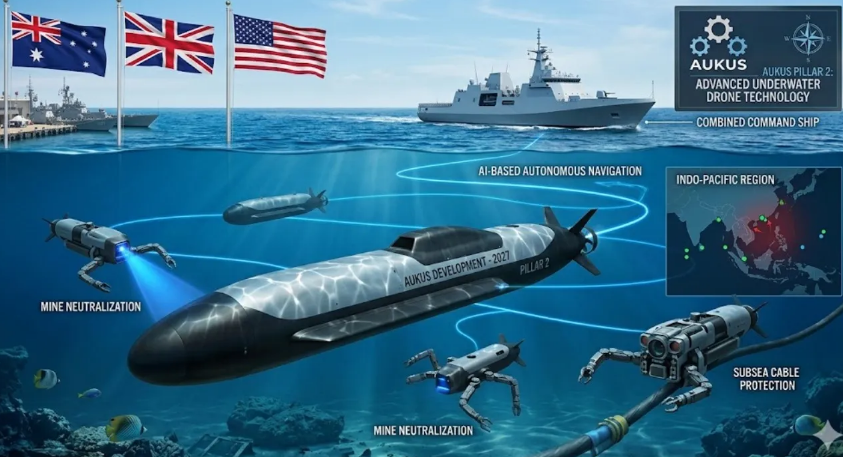
The project is important because modern warfare is increasingly moving towards autonomous and unmanned systems. Underwater drones can be used for maritime surveillance, intelligence gathering, anti-submarine warfare, anti-surface warfare, electronic warfare and protection of undersea infrastructure.
One of the key reasons behind this development is the growing importance of undersea cables and pipelines. Submarine communication cables carry a large part of global internet, financial and defence communication. Any attack or damage to these cables can create serious economic and security problems. Therefore, AUKUS countries want stronger technology to monitor and protect the seabed.
Like any major maritime project, the deployment of underwater drones will require environmental clearance and compliance with coastal regulation zone regulations in respective countries. The environmental impact assessment process ensures that underwater operations maintain a pollution free environment and follow the precautionary principle to protect marine ecosystems. Defence projects must adhere to environmental clearances even when operating in sensitive marine areas, and the polluter pays principle applies to any environmental damage caused during operations. Environmental jurisprudence, including principles established through the Vanashakti judgment, emphasizes environmental democracy and proper regulatory oversight. The EIA notification framework requires that projects obtain proper environmental clearances rather than seeking ex post facto or retrospective environmental clearances, which undermine the ex-post regulatory process. While the Forest Conservation Act primarily applies to terrestrial projects, the broader environmental regulatory framework ensures that even defence initiatives respect ecological considerations.
This project comes under AUKUS Pillar Two, which focuses on advanced defence technologies such as artificial intelligence, cyber technology, quantum technology, hypersonics and undersea systems. It is different from AUKUS Pillar One, which deals with helping Australia acquire nuclear-powered submarines.
The development also has major geopolitical significance. The Indo-Pacific region has become a centre of strategic competition due to China’s growing naval presence. Through this project, the US, UK and Australia aim to strengthen deterrence and improve underwater security cooperation.
For competitive exams, this news is important because it connects with AUKUS, Indo-Pacific geopolitics, maritime security, autonomous warfare and protection of critical undersea infrastructure.