 India's No.1 PU & Degree With Integrated IAS & IPS(UPSC/PSC) Training College.


QUAD Dialogue, Critical Minerals and India-US Cooperation: Competitive Exam Notes
QUAD Dialogue, Critical Minerals and India-US Cooperation: Competitive Exam Notes
Why in News?
The 11th Quad Foreign Ministers’ Meeting was held in New Delhi. The meeting was attended by the foreign ministers of India, the United States, Japan and Australia. It focused on the Indo-Pacific region, maritime security, supply chains, critical minerals, emerging technologies and regional stability.
This topic is important for competitive exams because it connects international relations, Indo-Pacific strategy, critical minerals, supply chain security, China factor, semiconductor ecosystem and emerging technologies.
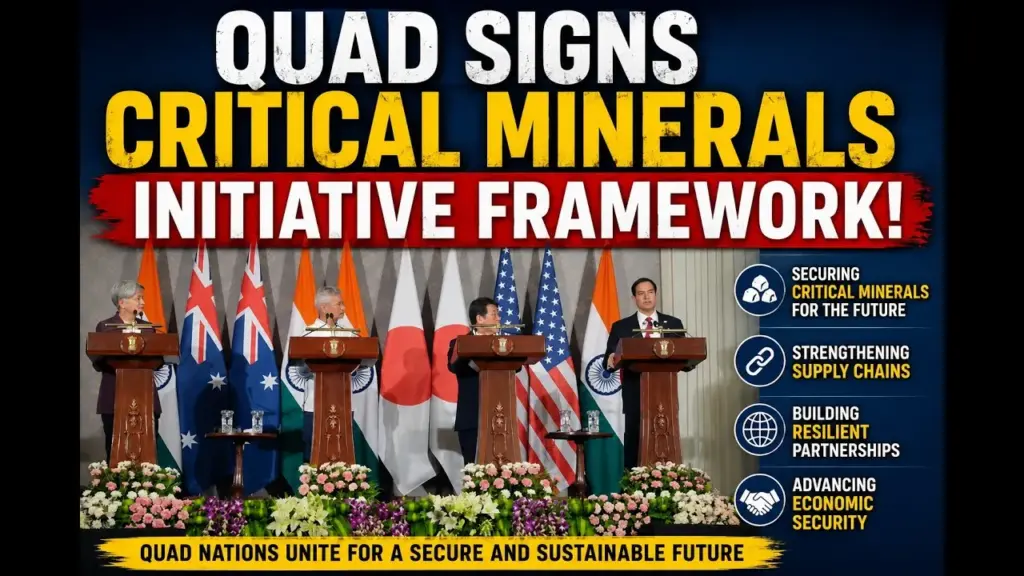
What is QUAD?
QUAD stands for Quadrilateral Security Dialogue. The word “quadrilateral” means four-sided. In international relations, QUAD refers to the strategic grouping of four countries:
- India
- United States
- Japan
- Australia
The main objective of QUAD is to promote a free, open, inclusive and rules-based Indo-Pacific region.
The Quad is not a military alliance like NATO. It is a strategic dialogue platform where member countries cooperate on security, technology, climate, health, infrastructure, cyber security, disaster relief and supply chains.
Importance of QUAD for India
QUAD is important for India because the Indo-Pacific has become a major centre of global geopolitics. India’s trade, energy security and maritime interests are closely linked with the Indian Ocean and Pacific region.
Through QUAD, India can strengthen cooperation with major democratic partners and reduce excessive dependence on any single country for technology, minerals and strategic supply chains.
Philippines and Luzon Economic Corridor
Apart from QUAD, another important development is the growing strategic importance of the Philippines in the Indo-Pacific.
The Luzon Economic Corridor is linked with the Philippines, the United States and Japan. It aims to connect important locations such as Subic Bay, Clark, Manila and Batangas. This corridor is expected to support transport, digital connectivity, clean energy, semiconductor supply chains and advanced manufacturing.
Recently, there was discussion about a planned AI industrial hub in Luzon. The Philippines clarified that the project would operate under Philippine law and that no special diplomatic immunity would be automatically granted to foreign personnel.
This is important because it shows how supply chains, artificial intelligence, semiconductor manufacturing and strategic geography are becoming closely connected in the Indo-Pacific.
What are Critical Minerals?
Critical minerals are minerals that are essential for modern industries, clean energy, defence, space, electronics and emerging technologies, but their supply is vulnerable to disruption.
A mineral becomes “critical” mainly because of two reasons:
It is economically important.
Its supply is risky or concentrated in a few countries.
Examples of critical minerals include:
- Lithium
- Cobalt
- Nickel
- Graphite
- Gallium
- Germanium
- Indium
Rare earth elements
These minerals are used in electric vehicles, batteries, solar panels, wind turbines, semiconductors, defence equipment, satellites, mobile phones, nuclear technology and artificial intelligence infrastructure.
Why are Critical Minerals Strategically Important?
Critical minerals are important because future economic growth depends heavily on advanced technologies. Without secure access to these minerals, a country may face difficulties in developing electric vehicles, renewable energy, defence systems, space technology, electronics and semiconductors.
Many critical minerals are mined or processed by a limited number of countries. China has a dominant position in the processing of several rare earth and critical minerals. This creates a supply chain risk for countries like India.
If a country controls mineral processing, it can use export restrictions as a strategic tool. Therefore, critical minerals are now seen not only as economic resources but also as instruments of geopolitical power.
India-US Critical Minerals Framework
India and the United States signed a bilateral Critical Minerals Framework to strengthen cooperation in the mining, processing and supply of critical minerals and rare earth elements.
This agreement is important because it aims to:
Secure supply chains
Reduce dependence on China
Promote mining and processing cooperation
Support clean energy technology
Strengthen semiconductor and defence supply chains
Encourage private and public investment
Build resilient and trusted mineral networks
For India, this is significant because India wants to become a major manufacturing hub in electric vehicles, batteries, semiconductors, clean energy and defence technology.
Minerals Security Partnership
MSP in this context does not mean Minimum Support Price. Here, MSP stands for Minerals Security Partnership.
The Minerals Security Partnership is a US-led initiative launched to strengthen global critical mineral supply chains. India joined the MSP in June 2023.
The purpose of MSP is to ensure that critical minerals are produced, processed and recycled in a secure, sustainable and reliablei minerals, not agriculture.
Pax Silica Initiative
Pax Silica is a US-led initiative linked with secure supply chains for emerging technologies. The term “Pax” means peace, while “Silica” refers to silicon-related technology and the wider semiconductor ecosystem.
Pax Silica focuses on building resilient supply chains for:
- Critical minerals
- Semiconductors
- Artificial intelligence infrastructure
- Advanced manufacturing
- Energy inputs
Digital and technological systems
India joined the Pax Silica initiative in February 2026. This is important because the global race for artificial intelligence and semiconductors requires secure access to minerals, chips, energy and manufacturing capacity.
Rare Earth Elements
Rare earth elements are a group of 17 elements. They include 15 lanthanides along with scandium and yttrium.
They are called “rare earth” not because they are always extremely rare, but because they are difficult to extract and process economically.
Rare earth elements are used in:
- Magnets
- Electric vehicles
- Wind turbines
- Smartphones
- Defence systems
- Missiles
- Lasers
- Satellites
- Semiconductors
For exams, remember:
Total rare earth elements = 17
India’s Concern
India has identified several critical minerals as essential for its economic and strategic development. However, India is not self-sufficient in many of them. Some minerals are unavailable domestically, while others exist in limited quantities or need advanced processing technology.
Therefore, India is focusing on:
- Domestic exploration
- Overseas mineral assets
- International partnerships
- Recycling of critical minerals
- Processing capacity
- Supply chain diversification
This is essential for achieving self-reliance in clean energy, defence, electronics and advanced technologies.
UPSC Prelims Facts
- QUAD has four members: India, US, Japan and Australia.
- QUAD stands for Quadrilateral Security Dialogue.
- The 11th Quad Foreign Ministers’ Meeting was held in New Delhi.
- Critical minerals are essential minerals with high economic importance and supply risk.
- Examples include lithium, cobalt, nickel, graphite, gallium, germanium, indium and rare earth elements.
- MSP stands for Minerals Security Partnership.
- India joined MSP in June 2023.
- Pax Silica is linked with critical minerals, semiconductors and AI supply chains.
- India joined Pax Silica in February 2026.
- There are 17 rare earth elements.
- China dominates processing of many critical minerals and rare earths.
- Critical minerals are important for EVs, batteries, defence, space, AI, semiconductors and clean energy.
Probable Prelims Question
With reference to critical minerals, consider the following statements:
Critical minerals are important for clean energy, defence, electronics and emerging technologies.
Supply risk is one of the reasons why a mineral is classified as critical.
Rare earth elements are not used in defence and semiconductor-related technologies.
The Minerals Security Partnership is related to securing critical mineral supply chains.
Which of the statements given above are correct?
A. 1, 2 and 4 onlyB. 1 and 3 onlyC. 2, 3 and 4 onlyD. 1, 2, 3 and 4
Answer: A. 1, 2 and 4 only
Explanation: Rare earth elements are used in defence, electronics, clean energy and advanced technologies. Therefore, statement 3 is incorrect.
Mains Angle
Critical minerals have become central to global geopolitics. Countries are competing to secure minerals needed for clean energy, semiconductors, electric vehicles, artificial intelligence and defence technologies. India’s participation in QUAD, MSP, Pax Silica and the India-US Critical Minerals Framework shows its attempt to build resilient supply chains and reduce dependence on China.
For India, critical minerals are not only an economic requirement but also a strategic necessity. They are essential for Atmanirbhar Bharat, green transition, digital economy, defence modernisation and technological sovereignty.
Conclusion
The 11th Quad dialogue and India-US cooperation on critical minerals show that the future of geopolitics will be shaped not only by military power but also by technology, minerals, supply chains and industrial capacity. For competitive exams, students should connect this topic with Indo-Pacific strategy, China factor, critical minerals, semiconductor supply chains, artificial intelligence and India’s strategic autonomy.




