 India's No.1 PU & Degree With Integrated IAS & IPS(UPSC/PSC) Training College.


Anaimangalam Copper Plates Returned to India: Chola Empire and UPSC Notes
Anaimangalam Copper Plates Returned to India: Chola Empire and UPSC Relevance
Why in News?
The Netherlands has returned the Anaimangalam Copper Plates, also known as the Leiden Plates, to India. These plates are around 1,000 years old and are linked to the powerful Chola dynasty of Tamil Nadu.
The return of these plates is significant because they had remained in the Netherlands for nearly 300 years. Their repatriation highlights India’s efforts to recover cultural artefacts taken away during the colonial period.
For UPSC and other competitive exams, this topic is important because it connects South Indian history, Chola administration, maritime power, Indian Ocean trade, art and culture, and cultural diplomacy.
What are the Anaimangalam Copper Plates?
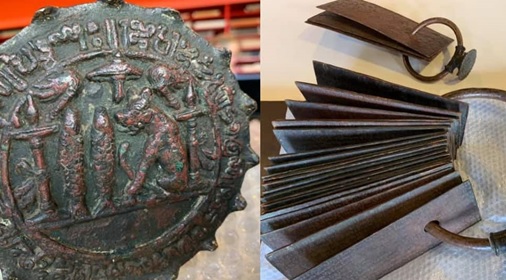
The Anaimangalam Copper Plates are important Chola-period inscriptions connected with Nagapattinam in present-day Tamil Nadu. They record royal grants and revenue arrangements, especially linked to religious institutions and maritime connections.
These plates are also called the Leiden Plates because they were preserved at Leiden University in the Netherlands.
The plates are divided into two sets. The first set contains 21 large copper plates tied together with a copper or bronze ring. This set bears the royal seal of Rajendra Chola I. Out of these 21 plates, 5 are written in Sanskrit and 16 are written in Tamil.
The second set contains 3 smaller copper plates written in Tamil. These carry a seal associated with Kulottunga Chola I.
How did the Plates Reach the Netherlands?
The plates were originally associated with Nagapattinam, an important port town during the Chola period. During the colonial period, the Dutch East India Company controlled parts of the Tamil coast and built a fort at Nagapattinam called Fort Vijf Sinnen.
During this period, the copper plates were discovered and later taken to the Netherlands. Over time, they became part of collections there. Their return to India is an example of cultural restitution, where historical artefacts are returned to their country of origin.
Chola Empire: Historical Background
The Imperial Cholas flourished mainly between the 9th and 13th centuries CE. They became one of the most powerful dynasties of South India.
The Cholas expanded their rule across South India and also influenced Sri Lanka, the Maldives and Southeast Asia. They were not only strong on land but also had one of the most powerful navies in medieval India.
Ancient references to earlier Cholas are found in sources such as Ashokan inscriptions, but the most powerful phase of Chola history came during the Imperial Chola period.
Rajaraja Chola I
Rajaraja Chola I was one of the greatest rulers of the Chola dynasty. He expanded the Chola Empire and strengthened its administration, army and navy.
He is best known for building the Brihadisvara Temple at Thanjavur, one of the finest examples of Chola architecture. This temple is dedicated to Lord Shiva and is part of the Great Living Chola Temples, a UNESCO World Heritage Site.
Rajendra Chola I
Rajendra Chola I was the son and successor of Rajaraja Chola I. He expanded the empire further and founded a new capital called Gangaikonda Cholapuram after his successful northern expedition.
Rajendra Chola I is especially important for competitive exams because he launched naval campaigns against the Srivijaya Empire in Southeast Asia.
If the question asks, “Which Chola ruler launched military campaigns against the Srivijaya Empire?”, the correct answer is Rajendra Chola I.
This shows that the Cholas were a major maritime power and controlled important trade routes in the Indian Ocean.
Cholas as a Maritime Power
The Cholas had a strong navy and used it for trade, diplomacy and military campaigns. Important ports such as Nagapattinam and Poompuhar played a major role in maritime trade.
The Chola expedition against Srivijaya shows their strategic interest in Southeast Asia and Indian Ocean trade routes. Their maritime activity helped India build strong commercial and cultural relations with Southeast Asia.
Chola Art and Architecture
The Cholas made remarkable contributions to Indian art and architecture. Their temples are famous examples of Dravidian architecture.
Important Chola temples include:
- Brihadisvara Temple, Thanjavur
- Brihadisvara Temple, Gangaikonda Cholapuram
- Airavatesvara Temple, Darasuram
Together, these are known as the Great Living Chola Temples.
The Cholas are also famous for bronze sculptures, especially the image of Nataraja, the dancing form of Lord Shiva. Chola bronzes were made using the lost-wax casting technique, an important point for UPSC art and culture.
UPSC Relevance
- The Anaimangalam Copper Plates are important for both Prelims and Mains.
- For Prelims, remember the following facts:
- Anaimangalam Copper Plates are linked with the Chola dynasty.
- They are also called the Leiden Plates.
- They are connected with Nagapattinam.
- The larger set contains 21 plates.
- 5 plates are in Sanskrit and 16 are in Tamil.
- The larger set has the seal of Rajendra Chola I.
- The smaller set has the seal of Kulottunga Chola I.
- Rajendra Chola I launched naval campaigns against Srivijaya.
- Chola bronzes used the lost-wax technique.
- The Great Living Chola Temples are a UNESCO World Heritage Site.
For Mains, this topic can be linked with cultural restitution, India’s heritage diplomacy, Indian Ocean trade, and South India’s contribution to Indian civilisation.
Probable UPSC Prelims Question
With reference to the Anaimangalam Copper Plates, consider the following statements:
i) They are associated with the Chola dynasty.
ii) They are also known as the Leiden Plates.
iii) They provide evidence of Chola links with Nagapattinam and Southeast Asia.
iv) They are written only in Sanskrit.
Which of the statements given above are correct?
A. 1 and 2 onlyB. 1, 2 and 3 onlyC. 2, 3 and 4 onlyD. 1, 2, 3 and 4
Answer: B. 1, 2 and 3 only
The plates are not written only in Sanskrit. They contain both Sanskrit and Tamil inscriptions.
Conclusion
The return of the Anaimangalam Copper Plates is important for India’s cultural heritage and diplomacy. These plates provide valuable information about the Chola Empire, especially its administration, maritime strength, religious patronage and links with Southeast Asia.




