 India's No.1 PU & Degree With Integrated IAS & IPS(UPSC/PSC) Training College.


Hide & Seek on Employment Guarantee? UPSC
PLAYING HIDE AND SEEK ON EMPLOYMENT GUARANTEE
Syllabus:
GS 2:
- Government policies and intervention
- Welfare schemes for vulnerable section
Why in the News?
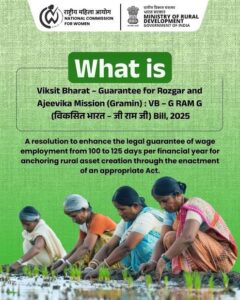
The proposed Viksit Bharat Guarantee for Rozgar and Ajeevika Mission (Gramin) Act (VB-GRAMG Act) has sparked widespread criticism for potentially diluting the legally enforceable employment guarantee provided under MGNREGA, despite claims of expansion and reform by the Union government.
EMPLOYMENT GUARANTEE AS A RIGHTS-BASED POLICY● Conceptual Foundation: Employment guarantee programmes rest on justiciable rights, ensuring income security during economic distress through legally enforceable entitlements. ● Global Significance: MGNREGA is internationally recognised as a model social protection instrument, influencing employment schemes across developing economies. ● Governance Logic: Rights-based frameworks reduce discretion, enhance accountability, and empower citizens to claim entitlements, not merely receive benefits. ● Risk of Dilution: Replacing rights with administrative discretion reverses decades of welfare jurisprudence and democratic accountability. ● Indian Legacy: India’s leadership in employment guarantees risks erosion if legal certainty is sacrificed for centralised fiscal control. |
DILUTED GUARANTEE FRAMEWORK
- Conditional Applicability: Section 5(1) empowers the Union government to notify where the guarantee applies, effectively nullifying universality, which contradicts the very essence of a rights-based employment guarantee.
- Discretion Over Rights: By allowing selective geographic activation, the Act converts a statutory entitlement into an administrative discretion, undermining predictability and worker confidence.
- Illusory Expansion: The promise of 125 days of work remains contingent on notification, making the enhancement meaningless without assured applicability across all rural areas.
- Erosion of Legal Certainty: Unlike MGNREGA’s nationwide mandate, the VB-GRAMG framework introduces policy uncertainty, weakening workers’ ability to demand work as a legal right.
- Contradictory Design: A guarantee that may be switched off by executive notification is structurally incompatible with the constitutional logic of social protection laws.
MISLEADING CLAIMS OF ENTITLEMENT EXPANSION
- Redundant Provision: Extending workdays to 125 could have been achieved under MGNREGA itself, without repealing or replacing an existing rights-based statute.
- State Precedents: Several States already provide 125 days of employment under MGNREGA, exposing the lack of necessity for an entirely new legislative framework.
- Policy Overreach: Replacing MGNREGA to claim credit for marginal changes reflects political repackaging, not substantive welfare reform.
- Cost Without Justification: The administrative transition risks implementation disruption without delivering commensurate gains in worker protection or access.
- Symbolism Over Substance: The Act prioritises optics of reform over strengthening proven institutional mechanisms that already exist under MGNREGA.
THE DISENTITLEMENT MYTH
- Imaginary Problem: The so-called “disentitlement clause” under MGNREGA addressed frivolous applications, a problem that never materialised over two decades of implementation.
- Unused Provision: The clause was never operationalised, rendering its removal under VB-GRAMG legally inconsequential rather than a progressive reform.
- False Narrative: Claims that earlier provisions denied workers their due are factually incorrect, as eligibility protections were already robust under MGNREGA.
- Misplaced Emphasis: Highlighting the removal of an unused clause diverts attention from substantive dilution of enforceable employment guarantees.
- Policy Misdirection: The disentitlement argument functions as rhetorical cover, not evidence-based justification for replacing MGNREGA.
NORMATIVE FUNDING AND BUDGET CAPS
- End of Demand-Driven Model: Shifting from demand-driven to normative funding implicitly abandons the employment guarantee principle central to MGNREGA.
- De Facto Ceilings: Normative allocations will function as hard budget caps, discouraging States from expanding employment even during distress periods.
- Equity Fallacy: Claims of correcting inter-State imbalance ignore evidence showing no correlation between MGNREGA utilisation and State income levels.
- Poor States Disadvantaged: Budget caps disproportionately harm high-poverty States, which require flexible spending rather than restrictive fiscal ceilings.
- Better Alternative Ignored: Raising MGNREGA wage rates in poorer States would address inequities more effectively than imposing uniform expenditure limits.
TECHNOLOGICAL SOLUTIONISM AND CORRUPTION
- Digital Overconfidence: VB-GRAMG’s faith in advanced digital tools ignores documented failures of technology-led implementation in welfare delivery systems.
- Exclusion Risks: Aadhaar-based payments, biometric failures, and platform glitches have excluded genuine workers, weakening trust in employment programmes.
- Corruption Paradox: Technical complexities often increase intermediaries’ power, enabling fund diversion rather than eliminating corruption.
- Worker Alienation: Repeated payment failures reduce worker participation, indirectly facilitating collusion with corrupt actors.
- Learning Deficit: The Act fails to incorporate lessons from past digital disruptions, repeating systemic mistakes instead of correcting them.
CONCLUSION
The VB-GRAMG Act offers little substantive improvement over MGNREGA while significantly weakening its core principle of universal, demand-driven employment guarantee. By introducing discretionary applicability, budget caps, and uncritical reliance on digital systems, it places workers’ rights in jeopardy. Rather than reforming a globally admired programme, the Act risks hollowing it out for administrative convenience and political credit.
SOURCE: TH
MAINS PRACTICE QUESTION
Critically examine how the shift from demand-driven employment guarantee to normative funding under the proposed VB-GRAMG Act may impact rural livelihoods and federal welfare delivery in India.

