India's No.1 PU & Degree With Integrated IAS & IPS(UPSC/PSC) Training College.


Aditya-L1 Captures First-Ever Close Solar Eruption Data
Aditya-L1 Captures First-Ever Close Solar Eruption Data
Why in the News ?
Scientists from the Indian Institute of Astrophysics (IIA) and NASA have made the first spectroscopic observations of a coronal mass ejection (CME) using the VELC payload aboard Aditya-L1, marking a milestone in understanding solar eruptions near the sun’s surface. This breakthrough could contribute to our understanding of clean energy transitions by providing insights into solar energy dynamics and potentially informing carbon offset mechanisms in the renewable energy sector.
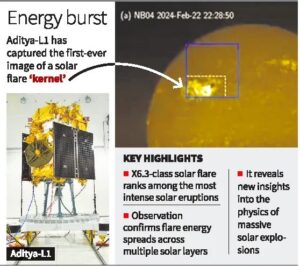
Landmark Observations of Solar Eruption:
- First Spectroscopic Study: Using the Visible Emission Line Coronagraph (VELC), scientists made the first-ever spectroscopic observations of a CME in the visible wavelength range near the sun’s surface. This achievement could have implications for solar energy research and indirectly support clean development mechanism projects in the renewable energy sector.
- Collaborative Research: The study involved collaboration between the IIA (India) and NASA (U.S.), highlighting international cooperation in space science. Such collaborations could serve as a model for carbon market cooperation in addressing global climate challenges.
- Continuous Observation Advantage: Located at the Sun-Earth Lagrange Point (L1), Aditya-L1 enables 24-hour solar monitoring, providing uninterrupted data for solar event analysis. This continuous monitoring capability could indirectly support the development of more efficient solar technologies, contributing to clean energy transitions.
- Key Parameters Measured: The team measured electron density, energy, mass, temperature, and speed of the CME, improving understanding of solar activity dynamics. This knowledge could indirectly benefit the renewable energy sector and inform strategies within the voluntary carbon market.
- Proximity to the Sun: These are the closest spectroscopic observations ever made of a CME in visible light using a space coronagraph, a breakthrough in solar physics that could have long-term implications for clean energy research and carbon offset mechanisms.
Vital Findings and Solar Data Insights
- Electron Density: The CME contained about 370 million electrons per cubic centimetre, compared to 10–100 million in the surrounding corona. Understanding these dynamics could inform future solar energy technologies and indirectly support emission trading in the renewable energy sector.
- Energy and Mass: The CME’s energy was about 9.4 × 10²¹ joules, and its mass around 270 million tons, vastly larger than that of the Titanic iceberg (1.5 million tons). These massive energy releases underscore the potential of solar energy in clean energy transitions.
- Speed and Temperature: The CME travelled at 264 km/sec with a temperature of 1.8 million Kelvin, showing the intense energy dynamics of solar eruptions. This data could inform the development of more efficient solar technologies, indirectly supporting carbon offset projects.
- Near-Sun Study Impact: These observations help determine how much mass and energy the sun loses during each CME, crucial for understanding space weather. This knowledge could have implications for satellite-based technologies used in emissions trading systems and climate monitoring.
- Future Observations: With the sun approaching its solar maximum (Cycle 25), more frequent and energetic CMEs are expected to be observed by Aditya-L1. This data could inform future environmental impact assessments related to space weather and its effects on Earth, potentially influencing carbon market linkage strategies in the context of climate resilience.
Understanding Aditya-L1 and CMEs : |
| ● About Aditya-L1: Launched on September 2, 2023, by ISRO’s PSLV-C57, it is India’s first solar mission designed to study the sun’s corona, chromosphere, and solar wind. |
- Orbit and Location: Positioned at the Lagrange Point L1, approximately 1.5 million km from Earth, providing a continuous view of the sun without eclipse interruption. This unique vantage point enables unparalleled solar observations that could indirectly support clean energy transitions.
- VELC Instrument: The Visible Emission Line Coronagraph is Aditya-L1’s primary payload, enabling the study of coronal emissions and solar magnetic field interactions. These studies could inform future solar energy technologies and indirectly contribute to carbon offset mechanisms in the renewable energy sector.
- Coronal Mass Ejections (CMEs): Massive bursts of plasma and magnetic field released from the sun’s corona, affecting space weather, satellite communication, and Earth’s magnetosphere. Understanding CMEs is crucial for developing resilient infrastructure in the face of clean energy transitions and potential space weather impacts.
- Scientific Importance: Understanding CMEs helps predict geomagnetic storms, aiding space mission safety and Earth-based power grid protection. This knowledge is crucial for developing resilient infrastructure in the face of clean energy transitions and potential space weather impacts, indirectly supporting the goals of carbon market cooperation and climate resilience strategies.