 India's No.1 PU & Degree With Integrated IAS & IPS(UPSC/PSC) Training College.


Why Academic Freedom Matters in Universities Today
Why Academic Freedom Matters in Universities
Syllabus
GS 2: Government intervention
Why in the News?
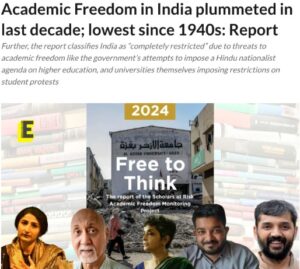
Recently, debate on academic freedom has intensified amid rising concerns over government interference in university curricula, research funding, and campus discourse, questioning autonomy, accountability, and higher education’s role in strengthening democracy. This has led to increased interest in academic freedom reports and their implications for higher education policy.
Introduction
- Academic freedom is the lifeblood of higher education and a fundamental value in academia.
- Universities are meant to be spaces where questions are encouraged, ideas are debated, and independent thinking thrives.
- Without freedom in learning, teaching, and research, intellectual growth, creativity, and democratic accountability suffer.
- The concept of student academic freedom is equally crucial in fostering an environment of open inquiry and critical thinking.
Meaning and Importance of Academic Freedom
Encouraging Questions and Critical Thinking
- Academic freedom allows students to ask questions without fear.
- Teachers can challenge established knowledge in their fields as part of their teaching responsibilities.
- Institutions can express views and critique policies across economic, social, and political spheres.
Knowledge Development
- Progress in knowledge depends on questioning existing ideas.
- Students first learn current knowledge, then move to critical evaluation and independent thought.
- Confidence to challenge even authoritative sources spoken or printed is essential for knowledge security.
Institutional Autonomy in Teaching
- Universities should decide what to teach without outside interference, guided by their educational mission.
- Limiting academic content damages learning and intellectual diversity.
- Open invitation policies for guest speakers are vital to stimulate debate and broaden perspectives.
Freedom in Research and Innovation
Determining Research Agenda
- Universities must choose their own research priorities.
- Faculty should set their research agendas without political or ideological pressure.
- The freedom to pursue diverse research outcomes is crucial for academic legitimacy.
Funding Without Bias
- Financial support should come through transparent, peer-reviewed systems.
- No preference or prejudice should influence funding decisions.
- Diverse funding sources, including private philanthropy, should be managed to avoid conflicts of interest.
Encouraging Unorthodox Thinking
- Dissenting and unconventional ideas must be valued within the academic community.
- Fundamental research requires more freedom, resources, and time.
- Such an environment fosters breakthroughs and nurtures exceptional thinkers.
Disturbing Reality in India
Regulated and Restricted Curricula
- Curricula are tightly controlled, with prescribed readings decided externally.
- Important works are sometimes excluded for non-academic reasons.
- Teachers lose the power to design their own syllabi, impacting their teaching responsibilities.
Suppression of Non-Mainstream Research
- Research challenging mainstream narratives in social sciences or humanities often faces barriers.
- Government agencies control much of the research funding, limiting independent inquiry and potentially influencing research outcomes.
Lack of Global Recognition
- India’s universities have produced no Nobel laureates in recent decades.
- The lack of academic freedom is a major contributing factor to this deficit in international recognition.
Curbing Debates and Discussions
- Discussions critical of ruling governments face restrictions.
- Administrative actions or legal threats discourage open dialogue.
- Even social media posts can lead to disciplinary measures, raising concerns about surveillance measures on campus.
Control Over Faculty Travel
- In central universities, faculty must sign undertakings before traveling abroad for conferences.
- Undertakings include promises not to participate in anti-government activities, even during personal trips.
Pressure on Private Universities
- Similar restrictions are expanding into private institutions.
- Risk-averse management often complies with government preferences to avoid conflict.
- Dissenting faculty or students can face swift disciplinary action, leading to self-censorship.
Autonomy and Accountability
Universities’ Role in Society
- Beyond teaching, universities generate ideas for science, technology, policy, and innovation.
- Faculty often act as public intellectuals, engaging citizens through writing and speaking.
Political Accountability
- Universities assess government performance, fostering democratic checks and balances.
- Academic critique is a pillar of informed public debate and a safeguard against corporate capture of public policy.
Public Funding and Control
- Government funding does not justify excessive control over university governance.
- Public universities must be accountable to society, not just the state.
- Donor agreements must be transparent to prevent undue donor influence.
Ensuring Accountability Mechanisms
- Governance structures should encourage transparency and responsibility.
- University rankings and autonomy scorecards, though imperfect, provide a public measure of performance.
Need for Comprehensive Autonomy
Full Freedom in Decision-Making
- Universities require complete administrative, financial, and academic independence.
- Liberation from excessive regulatory control, especially by the University Grants Commission, is necessary.
Reforming Legal Frameworks
- Acts of Parliament and State legislatures that govern universities often impose restrictions.
- Reforms should replace control with systems that promote freedom of thought within constitutional frameworks.
Value of Diversity in Higher Education
- Uniformity kills creativity and innovation.
- Diversity and differentiation among institutions are essential for excellence.
The Global Perspective on Academic Freedom
Restrictions in Democratic Nations
- Even democracies like Argentina, Hungary, and Türkiye limit academic freedom.
- Governments may fear dissent or seek ideological control over the academic community.
Authoritarian Controls
- In dictatorships and one-party states such as China, Russia, and Vietnam, freedom in social sciences and humanities is heavily restricted.
- China, however, maintains merit-based academic appointments despite limits on public expression.
Surprising Developments in the United States
- Traditionally a leader in academic freedom, the US saw cuts to research grants under the Trump administration.
- Continued restrictions could weaken its global leadership in education and innovation.
- Concerns about foreign interference have led to increased scrutiny of international partnerships.
Why Governments Seek Control
Fear of Criticism
- Universities question policies and challenge official narratives, which can make governments uncomfortable.
- Dissenting academic voices are often seen as political threats to established regulatory structures.
Desire for Ideological Conformity
- Some governments prefer academic content that aligns with their political ideology.
Dependence on State Funding
- Universities reliant on government grants may be more willing to accept interference.
- Faculty members may self-censor due to fear of losing resources or facing penalties.
Individual Compromises
- Some academics remain silent out of fear, while others compromise for personal benefits.
- This behavior can undermine the integrity of the tenure track system.
Consequences of Losing Academic Freedom
Decline in Education Quality
- Without freedom, the teaching-learning process becomes mechanical and uninspiring.
- Students lose the opportunity to develop independent thinking, a key aspect of student academic freedom.
Stifling Creativity in Research
- Innovation suffers when scholars cannot pursue new ideas or challenge norms.
- Data protection concerns may limit access to crucial information for research.
Losses to Society and the Economy
- Reduced academic output harms science, technology, culture, and governance.
- Ultimately, the economy, democracy, and society all pay the price of restricted academic freedom.
Way Forward
- Strengthen Autonomy: Remove political interference in academic and research matters.
- Ensure Transparent Funding: Create impartial, peer-reviewed funding systems.
- Protect Freedom of Expression: Safeguard the right to question, debate, and publish without fear.
- Integrate Accountability: Maintain checks through governance reforms, public reporting, and independent rankings.
- Value Diversity: Encourage varied approaches to learning and research instead of enforcing uniformity.
- Enhance Student Representation: Involve students in decision-making processes to uphold student academic freedom.
- Develop Institutional Guidelines: Create clear policies to address conflicts of interest and maintain campus integrity.
- Foster International Collaboration: Promote international partnerships while safeguarding against undue foreign interference.
Conclusion
Without academic freedom, universities cannot fulfil their role in fostering independent thought, research innovation, and societal progress. Protecting this freedom safeguards democracy itself, ensuring higher education remains a space for creativity, questioning, and truth-seeking. The academic freedom index serves as a crucial measure of institutional health and societal openness. By upholding academic integrity, respecting freedom of association, and promoting shared governance, universities can maintain their essential role in advancing knowledge and supporting democratic principles. It is imperative that university leadership, policymakers, and the academic community work together to preserve and enhance the fundamental values of academic freedom.
Source: The Hindu
Mains Practice Question
Discuss the importance of academic freedom for the development of knowledge and innovation. Evaluate the challenges faced by Indian universities in ensuring this freedom and suggest measures to strengthen academic scholarship while maintaining institutional credibility.

