 India's No.1 PU & Degree With Integrated IAS & IPS(UPSC/PSC) Training College.


Voyager 1: A Legacy of Scientific Discoveries
VOYAGER 1: A LEGACY OF SCIENTIFIC DISCOVERIES
WHY IN THE NEWS ?
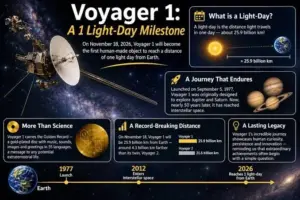
- Historic Milestone: Voyager 1 has reached a distance of approximately one light-day from Earth, meaning its radio signals take nearly 24 hours to travel between the spacecraft and Earth.
- Scientific Significance: Its remarkable longevity continues to generate valuable scientific discoveries, demonstrating how older space mission data can support new research and theories.
VOYAGER 1: JOURNEY AND MAJOR ACHIEVEMENTS
- Historic Mission: Launched by NASA in 1977, Voyager 1 is the farthest and one of the oldest operational spacecraft in history.
- Unprecedented Distance: It is approximately 26 billion kilometres from Earth and has travelled at nearly 61,000 km/hour.
- Mission Longevity: Since February 17, 1998, it has remained the farthest human-made object from Earth.
- Operational Status: By 2026, only two of its original ten scientific instruments remain operational. Its cameras were switched off in 1990 to conserve resources.
- Solar Influence: Voyager 1 crossed the heliopause in 2012, entering interstellar space, where the influence of the solar wind diminishes.
IMPORTANT SCIENTIFIC DISCOVERIES AND CONTRIBUTIONS
- Cosmic Rays: Its ultraviolet spectrometer unexpectedly detected signals associated with galactic cosmic rays, despite being designed to study ultraviolet radiation. Researchers identified this capability through reanalysis of data collected between 1992 and 2013.
- Saturn’s Rings: Radio signals passing through Saturn’s rings revealed their fine structures, narrow gaps and wave-like patterns, improving understanding of particle distribution.
- Titan’s Atmosphere: Radio transmissions travelling through Titan’s atmosphere helped scientists measure its temperature and pressure, supporting the later Cassini-Huygens mission.
- Einstein’s Prediction: Voyager 1’s observations near Saturn provided an independent test of gravitational redshift, the change in electromagnetic radiation frequency in a gravitational field.
- Future Research: Its observations generated new questions about the heliopause, including how solar wind interacts with neutral interstellar atoms.
ABOUT VOYAGER MISSIONS AND SPACE SCIENCE:● Voyager Programme: NASA launched Voyager 1 and Voyager 2 in 1977 to explore the outer planets and beyond. ● Voyager 1: Studied Jupiter and Saturn before continuing towards interstellar space. ● Voyager 2: Explored Jupiter, Saturn, Uranus and Neptune, becoming the only spacecraft to visit the latter two planets. ● Heliosphere: The vast region influenced by the Sun’s solar wind and magnetic field. ● Heliopause: The outer boundary where solar wind pressure balances the interstellar medium. ● Interstellar Space: The region beyond the heliosphere, containing matter and radiation originating outside our solar system. ● Scientific Importance: Voyager demonstrates the value of long-duration missions, technological innovation and reanalysing historical scientific data. |

