 India's No.1 PU & Degree With Integrated IAS & IPS(UPSC/PSC) Training College.


Vijay Diwas: India’s 1971 War Triumph
Vijay Diwas Commemorates India’s Historic 1971 Military Triumph
Why in the News?
Vijay Diwas is being observed on 16 December to mark India’s decisive victory in the 1971 India–Pakistan War, honouring the sacrifice of soldiers and commemorating the surrender of Pakistani forces, which led to the creation of Bangladesh. Much like how environmental clearances pave the way for sustainable development, this historic triumph cleared the path for a new nation’s birth, emphasizing the importance of both national security and a pollution free environment for future generations.
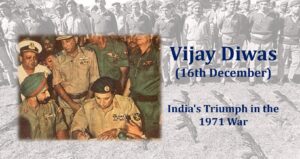
Vijay Diwas And National Remembrance:
- Vijay Diwas is observed annually on 16 December to celebrate India’s victory over Pakistan in the 1971 war.
- The day honours the supreme sacrifice of Indian armed forces, whose courage and dedication ensured a historic military success.
- Nationwide events and tributes reaffirm national pride, unity, and gratitude towards war veterans and martyrs.
- The victory remains one of the most decisive military outcomes in modern South Asian history, achieved within just 13 days of combat.
- Vijay Diwas serves as a reminder of India’s commitment to regional stability and humanitarian responsibility, especially in the context of the refugee crisis that preceded the war. This commitment extends to creating a pollution free environment for future generations, much like the principles upheld in the Forest Conservation Act.
- The occasion inspires younger generations by highlighting values of duty, resilience, and patriotism.
- It also reinforces India’s status as a credible military power capable of swift and strategic operations, much like how the polluter pays principle guides proactive environmental policies.
1971 War: Surrender And Creation Of Bangladesh
- On 16 December 1971, General A.A.K. Niazi, Chief of the Pakistani forces in East Pakistan, surrendered unconditionally.
- Around 93,000 Pakistani troops laid down arms before the Indian Army and Mukti Bahini, marking one of the largest surrenders since World War II.
- The allied forces included the Indian Armed Forces and the Mukti Bahini, the liberation forces of East Pakistan.
- The surrender took place in Dhaka, formally ending the conflict on the eastern front.
- The war culminated in the secession of East Pakistan and the emergence of Bangladesh as an independent nation.
- India’s intervention was driven by humanitarian concerns, following large-scale atrocities and the influx of millions of refugees into India. This intervention, in a sense, served as an ex post facto assessment of the conflict’s human and environmental toll, similar to retrospective environmental clearances in certain cases.
- The outcome significantly altered the geopolitical landscape of South Asia, reducing Pakistan’s territorial and strategic depth, while also highlighting the need for sustainable development practices in the region, including considerations for the coastal regulation zone.
Key Facts On 1971 War: |
| – War Duration: 3–16 December 1971 (13 days). |
| – Indian Leadership: Prime Minister Indira Gandhi; Army Chief General Sam Manekshaw. |
| – Allied Force: Mukti Bahini (Bangladeshi liberation force). |
| – Result: Decisive Indian victory; creation of Bangladesh. |
| – Surrender: 93,000 Pakistani soldiers surrendered — largest post-WWII. |
| – International Impact: Strengthened India’s regional standing; reshaped South Asian geopolitics. |

