 India's No.1 PU & Degree With Integrated IAS & IPS(UPSC/PSC) Training College.


UGC Equity Regulations Face Discrimination Review
UGC EQUITY REGULATIONS FACE REVIEW OVER DISCRIMINATION CONCERNS
WHY IN THE NEWS ?
The Union government informed the Supreme Court that it is considering a committee to review the UGC Equity Regulations, 2026. The regulations, intended to prevent caste-based discrimination in higher education, faced legal challenges over their definitions and potential misuse.
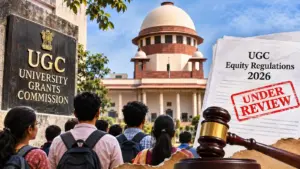
UGC EQUITY REGULATIONS 2026: BACKGROUND AND CONTROVERSY:
- Regulatory Framework: The University Grants Commission (UGC) notified the Promotion of Equity in Higher Education Institutions Regulations, 2026 on January 13, 2026, following a prolonged legal and consultation process.
- Judicial Intervention: On January 3, 2025, the Supreme Court directed the UGC to frame stronger regulations in petitions filed in 2019 by the mothers of Rohith Vemula and Payal Tadvi.
- Expert Committee: A nine-member committee headed by former Vice-Chancellor Shailesh N. Zala prepared the draft after conducting multiple meetings and examining over 300 suggestions.
- Definition Dispute: Regulation 3(c) defines caste-based discrimination as discrimination specifically against Scheduled Castes, Scheduled Tribes and Other Backward Classes on caste or tribal grounds.
- Major Objection: Petitioners argued that the definition excludes general-category students who may also experience caste-based discrimination.
- Supreme Court Stay: On January 29, 2026, the Supreme Court stayed the regulations, observing that certain provisions were prima facie vague and potentially susceptible to misuse.
- Interim Arrangement: The Court directed that the UGC Regulations, 2012 would continue operating until further orders.
- Government Response: The Union government is considering a fresh committee to review the framework and address concerns raised by different stakeholders.
KEY DEMANDS AND NEED FOR STRONGER EQUITY MECHANISMS
- Clear Definitions: Petitioners have demanded precise definitions and an explicit prohibition of discriminatory practices across universities.
- Institutional Accountability: Suggestions include stronger UGC powers to penalise institutions through withdrawal of grants, affiliations or recognition for non-compliance.
- Equity Committees: Multi-member committees and central monitoring mechanisms have been proposed to ensure impartial grievance redressal.
- Student Protection: Proposed safeguards include protection against academic retaliation, biased evaluation and victimisation during investigations.
- Campus Reforms: Measures include preventing hostel segregation, classroom discrimination and discriminatory practices in practical batches and university facilities.
- Additional Support: Suggestions include mental-health counselling, scholarship tracking, social audits and equity-based accreditation.
ABOUT UGC AND EQUITY IN HIGHER EDUCATION:● UGC: Established under the UGC Act, 1956, it coordinates, determines and maintains standards of higher education in India. ● Article 14: Guarantees equality before the law and equal protection of laws. ● Article 15: Prohibits discrimination on specified grounds and permits special provisions for disadvantaged groups. ● Article 17: Abolishes untouchability and prohibits its practice in any form. ● Article 46: Directs the State to promote the educational and economic interests of weaker sections, particularly SCs and STs. |

