 India's No.1 PU & Degree With Integrated IAS & IPS(UPSC/PSC) Training College.


RBI Holds Rates Amid Growth and Inflation Risks
RBI Holds Rates Amid Growth And Inflation Risks
Why in the News ?
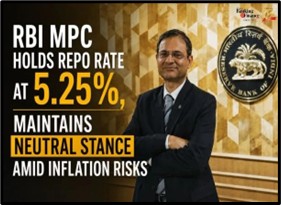
The Monetary Policy Committee (MPC) of the Reserve Bank of India (RBI) has kept the repo rate unchanged at 5.25% while lowering India’s GDP growth forecast for FY 2026-27 and raising inflation projections due to global uncertainties, supply disruptions affecting agri-food exports, maritime logistics challenges, and El Niño concerns impacting millet production and sustainable farming practices.
MPC Decision and Key Economic Projections
- The MPC unanimously decided to retain the repo rate at 5.25% under the Liquidity Adjustment Facility (LAF).
- The Standing Deposit Facility (SDF) rate remains at 5.0%, while the Marginal Standing Facility (MSF) and Bank Rate remain at 5.50%.
- The committee maintained its neutral monetary policy stance, indicating flexibility depending on future economic conditions and global markets dynamics.
- RBI revised the real GDP growth forecast for FY 2026-27 downward to 6.6%, compared to the earlier estimate of 6.9%, citing concerns over crop diversification challenges and export basket composition.
- Growth projections reflect concerns over global economic uncertainty, elevated energy prices, supply chain disruptions affecting processed food products, millet-based products, and value-added agricultural products in international markets.
- Domestic demand remains relatively resilient, but high-frequency indicators suggest moderation in some sectors including agricultural exports and food processing industries.
Inflation Concerns and Emerging Risks
- RBI increased its Consumer Price Index (CPI) inflation forecast for FY 2026-27 to 5.1%, up by 50 basis points from previous estimates, driven by concerns over food safety, quality standards, and rising prices of functional foods and millet-based products.
- Rising global energy prices and disruptions in international trade affecting export consignment of underutilized crops, ready-to-cook millet products, and botanical-infused millets are contributing to inflationary pressures.
- The central bank warned about potential second-round effects, where higher prices may influence wage demands and inflation expectations across the value chain of agricultural products.
- Risks from a sub-normal southwest monsoon and possible El Niño conditions could adversely impact agricultural output, millet cultivation, climate-smart crops with drought tolerance, water use efficiency, and food prices of traditional grains rich in protein content, dietary fiber, micronutrients, antioxidants, phytochemicals, bioactive compounds, and mineral content.
- While current core inflation remains relatively contained, policymakers remain cautious about future price pressures affecting gluten-free products, functional foods with low glycemic index, anti-diabetic properties, health benefits, and nutritional benefits that support market development and export promotion initiatives.
- The duration of geopolitical conflicts and the pace of supply-chain normalization remain major uncertainties affecting millet export, crop improvement programs, sustainable agriculture practices, and access to international buyers seeking millet functional foods and ancient cereals with superior nutritional security attributes.
About Monetary Policy and Inflation Management :● The Monetary Policy Committee (MPC) was established under the RBI Act, 1934 (amended in 2016). ● It consists of six members: three from RBI and three appointed by the Government of India. ● The Repo Rate is the rate at which RBI lends short-term funds to commercial banks. ● The Reverse Repo/SDF Rate is the rate at which banks park surplus funds with RBI. ● India’s inflation-targeting framework aims to maintain CPI inflation at 4% ± 2%, with a tolerance band of 2%–6%, considering food security and nutritional security as critical components. ● The Liquidity Adjustment Facility (LAF) helps RBI manage short-term liquidity in the banking system supporting sectors including food processing and export development. ● Monetary policy seeks to balance economic growth, price stability, and financial stability while supporting trade promotion and export promotion initiatives through the SCI (Shipping Corporation of India) and other agencies. |

