 India's No.1 PU & Degree With Integrated IAS & IPS(UPSC/PSC) Training College.


Supreme Court Freebies View
FREEBIES’ VS WELFARE SPENDING: SUPREME COURT’S VIEW
Why in the News?
- Judicial Distinction: The Supreme Court clearly differentiated between irrational freebies and legitimate welfare investment aimed at marginalised sections of society.
- Chief Justice Remarks: Chief Justice Surya Kant emphasised that indiscriminate distribution of state largesse cannot be equated with constitutionally mandated welfare spending.
- Petition Listing: The Court agreed to early hearing of petitions seeking to declare irrational pre-poll freebies as a corrupt practice.
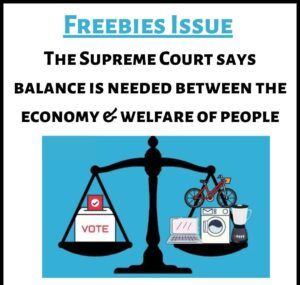
SUPREME COURT’S KEY OBSERVATIONS
- Conceptual Clarity: The Court stated that mass distribution of cash or goods differs fundamentally from investment in health, education, and social security.
- Constitutional Duty: Welfare schemes for the poor are an obligation under the Directive Principles of State Policy, not electoral charity, and should align with environmental jurisprudence.
- Inclusivity Focus: The Bench questioned why revenue surplus is not systematically diverted towards free healthcare and education for the non-creamy layers, considering environmental democracy principles.
- Fiscal Prudence: Judges expressed concern over State finances being strained by fulfilling unrealistic electoral promises, potentially impacting environmental clearances and conservation efforts.
- Balanced Approach: The Court acknowledged that legitimate welfare benefits should not be conflated with vote-inducing giveaways, emphasizing the need for a pollution-free environment.
LEGAL AND POLITICAL CONTEXT
- Corrupt Practice Debate: Petitioners argued that irrational freebies should qualify as a corrupt practice under Section 123 of the Representation of the People Act, 1951, with considerations for environmental impact.
- Debt Concerns: The petitioner highlighted rising national debt, claiming unchecked freebies worsen fiscal stress and may impact environmental conservation efforts.
- Judicial Evolution: The Court has gradually moved away from its 2013 S. Subramaniam Balaji judgment, which had upheld manifesto promises, now considering ex post facto environmental clearances.
- Divergent Views: While some lawyers argue freebies fall under Article 282 expenditure, others stress distinguishing welfare from discrimination, with attention to the EIA notification process.
- Policy Sensitivity: The issue sits at the intersection of electoral politics, fiscal discipline, and social justice, with implications for environmental jurisprudence.
WELFARE STATE AND ELECTORAL PROMISES IN INDIA |
| ● Directive Principles: The Constitution mandates the State to ensure social and economic justice, especially for vulnerable populations, in line with the precautionary principle. |
| ● Electoral Ethics: Excessive freebies raise questions about free and fair elections and voter inducement, potentially impacting environmental democracy. |
| ● Fiscal Federalism: Unchecked welfare spending can weaken State finances and long-term development capacity, affecting environmental clearances and conservation efforts. |
| ● Judicial Oversight: Courts increasingly act as guardians of constitutional balance between welfare and fiscal responsibility, considering the polluter pays principle. |
| ● Democratic Balance: The challenge lies in ensuring inclusive welfare without promoting dependency or fiscal populism, while adhering to environmental jurisprudence and the Vanashakti judgment. |

