 India's No.1 PU & Degree With Integrated IAS & IPS(UPSC/PSC) Training College.


Stamp & Coin Honoring Syama Prasad Mookerjee
Stamp and Coin Launched Honouring Syama Prasad Mookerjee
Why in the News?
The Ministry of Culture organized an event in New Delhi marking the 125th birth anniversary of Dr. Syama Prasad Mookerjee, where a commemorative postage stamp and coin were unveiled to honour his contributions to nation-building and social reform.
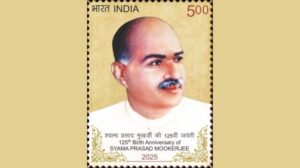
Commemoration and Cultural Tribute:
- The Ministry of Culture held a special programme and exhibition in New Delhi to honour Bharat Kesari Dr. Syama Prasad Mookerjee.
- The event marked the biannual commemoration of his 125th birth anniversary.
- Union Ministers Gajendra Singh Shekhawat and Dr. Jitendra Singh jointly unveiled a commemorative postage stamp and coin dedicated to his legacy.
- The Ministry committed to conducting year-long events over two years to remember his contributions.
Legacy and Political Contributions
- Dr. Mookerjee was hailed as a nation-builder who opposed appeasement politics and emphasized national integration.
- Gajendra Singh Shekhawat credited him for paving the path for many nationalist workers and leaders.
- He is remembered for his strong stance against special privileges, particularly in the case of Jammu and Kashmir.
Role in Jammu and Kashmir
- Dr. Jitendra Singh highlighted Mookerjee’s opposition to Article 370, which granted special status to Jammu and Kashmir.
- Dr. Mookerjee’s ideological struggle culminated in the abrogation of Article 370 in 2019.
- He is remembered as a social reformer and political visionary whose ideals continue to inspire the nation.
Key points: Life and Legacy of Dr. Syama Prasad Mookerjee: |
| Birth & Family: Born in Calcutta; son of Sir Ashutosh Mookerjee, noted educationist and VC of Calcutta University. |
| Academic Achievements: |
| ○ Represented Calcutta University at British Empire Conference. |
| ○ Became youngest Vice-Chancellor of Calcutta University in 1934 (at age 33). |
| ○ Launched journals Bang Wani (1922) and The Nationalist (1940s). |
| Political Career: |
| ○ Initially joined Indian National Congress; later joined Hindu Mahasabha. |
| ○ Finance Minister in Bengal’s coalition govt (1937); Hindu Mahasabha President (1940). |
| ○ Founded Bharatiya Jana Sangh in 1951. |
| Post-Independence Contributions: |
| ○ Served as Minister for Industry and Supply. |
| ○ Key in founding Chittaranjan Locomotive Works, Sindri & Hindustan Fertilizer. |
| Ideology: |
| ○ Opposed Article 370; promoted unity, nationalism, and Hindu identity. |
| ○ Opposed linguistic division of India. |
| Death & Legacy: |
| ○ Died in 1953 during protest in J&K custody. |
| ○ Remembered as “The Lion of Parliament.” |

