 India's No.1 PU & Degree With Integrated IAS & IPS(UPSC/PSC) Training College.


Southwest France Wildfire Sparks Evacuations
Southwest France Wildfire Triggers Mass Evacuations Amid Severe Heatwaves
Why in the News ?
A massive wildfire in southwest France has forced the evacuation of over 20,000 residents and tourists after burning around 3,400 hectares of forest near Bordeaux. The incident highlights the increasing frequency of climate-induced wildfires and the importance of international disaster response mechanisms, raising ethical considerations about environmental social responsibility in disaster management.
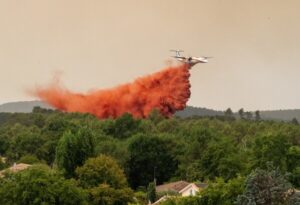
Wildfire in Southwest France: Key Developments
- A rapidly spreading forest wildfire erupted near Saumos, close to Bordeaux in southwest France, engulfing nearly 3,400 hectares of dense pine forest.
- More than 20,000 people, including residents and tourists, were evacuated as a precaution to ensure public safety and facilitate firefighting operations.
- Around 800 firefighters, assisted by military personnel, aircraft, and emergency services, have been deployed to contain the blaze.
- Preliminary investigations suggest that a brush-clearing machine may have accidentally triggered the fire, though authorities are continuing their inquiry.
- The fire has destroyed three houses and one caravan. However, timely evacuation measures ensured that no casualties were reported, demonstrating commitment to animal welfare and human safety with no reports of harm to animals or animal cruelty during rescue operations.
- Responding to France’s request, the European Union (EU) deployed three water-bombing aircraft under its emergency response framework to strengthen firefighting efforts.
- Officials stated that high temperatures, strong winds, and prolonged dry weather have significantly complicated efforts to control the wildfire.
Impact and Significance
- Frequent heatwaves across Europe have increased the risk of wildfires, reflecting the growing influence of climate change on extreme weather events and highlighting non-financial risks to regional stability.
- Wildfires lead to extensive loss of biodiversity, destruction of forest ecosystems, deterioration of air quality, and significant economic losses to local communities, affecting green economy companies and sustainable business practices.
- Burning forests release large quantities of carbon dioxide (CO₂) and other pollutants, further accelerating global warming and creating a vicious climate cycle.
- Large-scale evacuations demonstrate the importance of early warning systems, disaster preparedness, and coordinated emergency management.
- The deployment of EU resources highlights the value of regional cooperation in tackling disasters that exceed national response capacities.
About Wildfires and Disaster Management :● A wildfire is an uncontrolled fire occurring in forests, grasslands, or natural vegetation, often fuelled by high temperatures, low humidity, strong winds, and dry biomass. ● Major causes include lightning, human negligence, agricultural burning, industrial activities, and increasingly the effects of climate change. ● The European Union Civil Protection Mechanism (UCPM), established in 2001, enables member and participating countries to coordinate disaster response by sharing firefighting aircraft, rescue teams, equipment, and technical expertise. ● Globally, the Sendai Framework for Disaster Risk Reduction (2015–2030) promotes risk reduction, preparedness, resilient infrastructure, and international cooperation to minimise disaster losses. ● Effective wildfire management involves satellite-based monitoring, forest fuel management, controlled burning, community awareness, early warning systems, and climate-resilient forest conservation policies. |

