India's No.1 PU & Degree With Integrated IAS & IPS(UPSC/PSC) Training College.


Soil Sakhis Empower Women, Improve Agriculture in Maharashtra
Soil Sakhis Empower Women, Improve Agriculture in Maharashtra
Why in the News ?
The ‘Soil Sakhis’ initiative in drought-prone districts of Maharashtra is gaining attention for improving soil health, crop yields, and women’s empowerment. It highlights the role of community-led climate-resilient agriculture in addressing agrarian distress and sustainability challenges while promoting environmental democracy through grassroots participation.
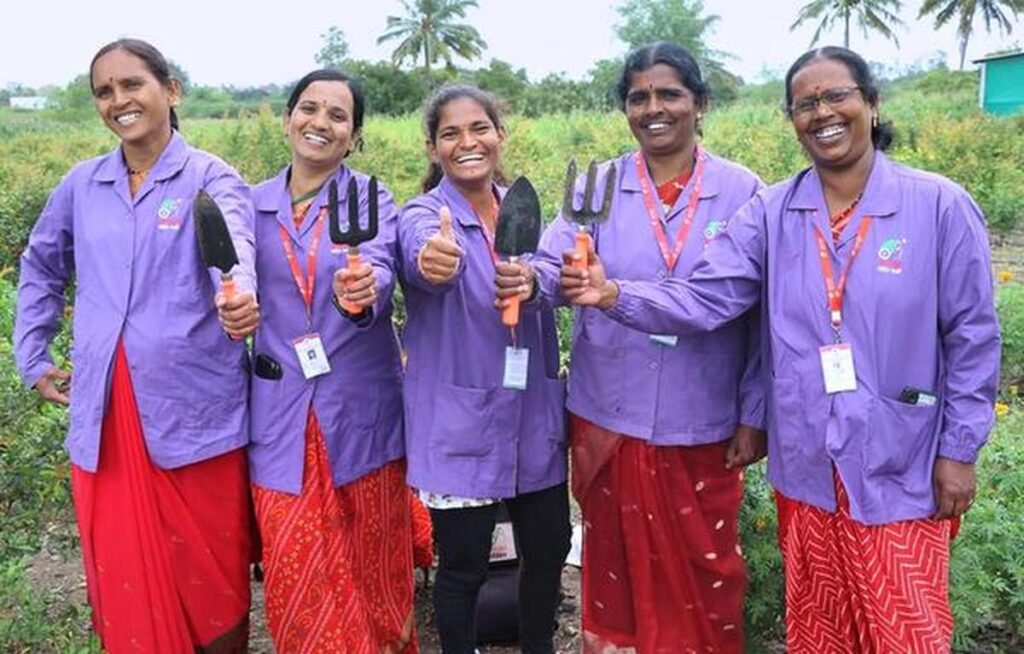
Women-Led Soil Health and Agricultural Transformation:
- The Mann Deshi Foundation launched the Soil Sakhis programme (2023) under its Agriculture and Climate Action Programme, incorporating principles of environmental impact assessment for sustainable farming.
- Implemented across Satara, Sangli, Solapur, Kolhapur, and Pune, focusing on drought-prone regions with adherence to environmental clearance norms for agricultural interventions.
- Women from marginalised backgrounds are trained to collect soil samples and guide farmers following the precautionary principle in agricultural practices.
- Around 2,394 farmers across nine talukas have benefited from scientific soil testing.
- Soil Sakhis earn ₹8,000–₹10,000/month, promoting financial independence.
- They act as community agronomists, bridging the gap between science and farming practices while promoting environmental jurisprudence at the grassroots level.
- The initiative promotes sustainable farming by reducing excess fertilizer use, aligning with the polluter pays principle.
- Achieved reduction of 988.37 tonnes of CO₂ emissions, aiding climate mitigation and contributing to a pollution free environment.
- Provides actionable soil reports, enabling better crop planning and input use.
- Enhances farmers’ resilience in climate-vulnerable regions.
Socio-Economic Impact and Grassroots Empowerment
- Women earlier seen as ‘farmers’ wives’ are now recognized as knowledge providers.
- They engage in training programmes, bio-input creation, and market negotiations.
- Example: Devaki Aivale works with 30 farmers daily, applying scientific methods.
- Sheetal Kale, a widow, gained expertise and now advises her entire family.
- Women travel extensively (up to 80 km/day) to support farmers.
- Initiative builds confidence, leadership, and decision-making capacity among rural women.
- Encourages collective awareness campaigns, transforming village mindsets.
- Farmers receive scientific insights, previously inaccessible to smallholders.
- Case study: Archana Babar’s mango yield increased by 40% after soil correction.
- Strengthens community networks, turning farmers into an extended support system.
About Soil Health, Climate Agriculture and Institutions:● Soil Health Importance: Determines crop productivity, nutrient availability, and sustainability. ● Soil Testing: Identifies deficiencies like nitrogen, phosphorus, potassium, and pH imbalance. ● Climate-Resilient Agriculture: Focuses on sustainable inputs, reduced emissions, and adaptive practices, often requiring environmental clearances for large-scale implementation. ● ICAR (Indian Council of Agricultural Research): Apex body for agricultural research and innovation. ● National Research Centre on Pomegranate (Solapur): Supports fruit crop research in dry regions. ● Organic Farming: Reduces dependence on chemical fertilizers, improves soil fertility. ● Carbon Footprint in Agriculture: Linked to fertilizer use and soil degradation. ● Government Schemes: ○ Soil Health Card Scheme (2015) – provides soil nutrient status. ○ Paramparagat Krishi Vikas Yojana (PKVY) – promotes organic farming. ● Agro-Climatic Challenges: Maharashtra faces frequent droughts and water scarcity. ● Women in Agriculture: Critical role but often under-recognized in policy frameworks. ● Forest Conservation Act: Regulates land use changes affecting agricultural expansion in forest areas. ● EIA Notification: Governs environmental assessments for agricultural and developmental projects. ● Vanashakti Judgment: Landmark ruling emphasizing environmental compliance in development projects. ● Retrospective Environmental Clearances: Also known as ex post facto or post facto clearances, these remain controversial in environmental governance. |