 India's No.1 PU & Degree With Integrated IAS & IPS(UPSC/PSC) Training College.


India’s Exam-Centric System: Stress and Crisis
India’s Exam-Centric Education System: Stress, Centralisation, and the Crisis of Opportunity
Syllabus:
- GS – 3 – Education system in India
Focus :
The article critically examines India’s examination system, arguing that it has evolved into a mechanism of social control rather than a tool for educational advancement. It highlights rising student stress, excessive centralisation, dependence on private coaching, declining educational investments, and the broader socio-economic consequences of an exam-oriented culture that prioritises endurance over genuine learning and opportunity. Much like environmental impact assessment frameworks evaluate developmental projects, there is an urgent need to assess the true impact of examination policies on student welfare and educational outcomes.
Introduction
- The article presents a sharp critique of India’s examination system in the backdrop of controversies surrounding examinations such as NEET and CBSE.
- It argues that students face not only academic pressure but also systemic failures that increase uncertainty and stress, requiring regulatory frameworks similar to environmental clearances to ensure transparency and accountability in examination administration.
The Growing Crisis of Trust in India’s Examination System
1.Recurring Examination Scandals
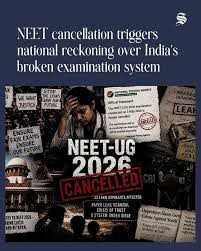
- Recent controversies related to examinations such as NEET and CBSE have shaken public confidence in the credibility of the examination system.
- Allegations of paper leaks, irregularities, technical glitches, and administrative lapses have created uncertainty among students, with some reforms being implemented ex post facto rather than through preventive measures.
- Such incidents raise serious questions about the fairness and transparency of competitive examinations, highlighting the need for robust oversight mechanisms comparable to environmental clearances in project approvals.
2.Impact on Students
- Students preparing for competitive examinations already face immense psychological pressure.
- Examination controversies add another layer of anxiety because students begin to doubt whether merit alone determines success.
- The uncertainty surrounding examinations creates feelings of helplessness and frustration among aspirants.
- Students often perceive themselves as victims of circumstances beyond their control, much like communities affected by post facto regulatory decisions.
3.Declining Public Confidence
- Public examinations derive legitimacy from trust in their fairness and integrity.
- Repeated administrative failures weaken confidence in institutions responsible for conducting examinations, necessitating principles of environmental democracy and participatory governance in educational administration.
- When trust erodes, students and parents become increasingly dependent on coaching centres and informal networks.
- A crisis of confidence in examinations can eventually undermine faith in the broader educational system.
Underinvestment in Higher Education
1.The Need for Greater Public Investment
- The author argues that educational stress could be significantly reduced through increased investment in higher education, applying the precautionary principle to prevent future crises.
- Expanding educational infrastructure would create more opportunities for students and contribute to a pollution free environment in terms of reducing academic stress and anxiety.
- Greater availability of quality institutions would reduce excessive competition.
- Increased funding could improve faculty quality, research capabilities, and student support services, requiring comprehensive environmental impact assessment of educational policies before implementation.
2.Limited Seats and High Stakes
- A major source of stress is the scarcity of quality educational opportunities.
- Millions of students compete for a relatively small number of seats in prestigious institutions.
- As a result, even minor differences in examination scores can have major consequences.
- The high stakes attached to each examination intensify anxiety and pressure.
3.Consequences of Resource Constraints
- Limited investment contributes to overcrowded institutions and inadequate facilities.
- Public universities often struggle with funding shortages.
- Students increasingly turn toward expensive private institutions and coaching centres.
- Educational inequality widens as financial resources become an important determinant of success.
Centralisation and the ‘One Nation’ Approach
1.Rise of Centralised Examination Systems
- The article criticises the increasing centralisation of educational assessments.
- Examinations such as CUET represent efforts to standardise admissions across institutions, sometimes implemented through ex-post regulatory changes without adequate consultation.
- Policymakers view centralisation as a means to improve uniformity and efficiency.
- However, critics question whether such reforms genuinely improve educational outcomes, calling for environmental jurisprudence-like principles in educational governance.
2.Concerns Regarding Pedagogical Value
- The author argues that some centralised examinations serve administrative objectives rather than educational goals.
- Standardisation may overlook regional diversity and institutional autonomy, much like how uniform regulations can ignore local contexts similar to coastal regulation zone variations.
- Different educational institutions often have distinct missions and requirements.
- Uniform examinations may not adequately capture these differences.
3.Logistical and Administrative Challenges
- Large-scale centralised examinations face significant operational challenges.
- Technical failures, scheduling issues, and coordination problems can affect millions of students simultaneously.
- Centralisation may increase the consequences of administrative errors, requiring retrospective environmental clearances-like mechanisms to address past irregularities.
- A single failure can have nationwide implications.
The Expansion of the Coaching Industry
1.Growth of Private Tuition
- India has witnessed an extraordinary expansion of the coaching and private tuition sector.
- Students increasingly rely on external coaching to succeed in competitive examinations.
- Coaching has become an almost essential component of examination preparation.
- The phenomenon extends even to very young children.
2.Data on Private Tuition
- According to survey findings cited in the article, nearly half of all students participate in private tuition.
- Even preschool children increasingly receive coaching support.
- Such trends indicate the growing commercialisation of education.
- Coaching has become deeply embedded in the educational ecosystem.
3.Financial Burden on Families
- Families spend substantial portions of their income on private tuition.
- Educational expenditure often imposes financial strain on households.
- Poor and middle-class families make significant sacrifices to support children’s education.
- This reinforces socio-economic inequalities, suggesting the need for a polluter pays principle where institutions creating educational stress bear responsibility for remedial measures.
4.Coaching and Educational Inequality
- Access to high-quality coaching is often determined by financial capacity.
- Wealthier students enjoy advantages unavailable to many others.
- Educational outcomes become increasingly linked to economic resources.
- Meritocracy becomes difficult to sustain under such conditions, requiring regulatory oversight similar to the Forest Conservation Act to protect educational equity.
The International Dimension: Global Competition and Brain Drain
1.Preparing Students for Examinations Rather than Innovation
- The article suggests that excessive examination focus reduces India’s competitive potential.
- Talented students devote years to mastering examination strategies.
- Valuable time and creativity are consumed by preparation for tests.
- Opportunities for innovation and research may be neglected.
2.Advantages for Competing Nations
- Countries investing heavily in research, innovation, and skill development may gain comparative advantages.
- Educational systems that encourage creativity often produce stronger innovation ecosystems.
- Excessive emphasis on examinations may reduce India’s ability to compete globally.
- Human capital remains underutilised.
3.Migration of Talent
- Many talented Indian students seek educational opportunities abroad.
- Overseas institutions often provide more flexible and research-oriented environments.
- This contributes to concerns regarding brain drain.
- The loss of highly skilled individuals affects national development.
Examinations as Instruments of Social Control
1.Atomisation of Individuals
- The author argues that the examination system isolates students from one another.
- Competitive pressures encourage individual advancement rather than collective engagement.
- Students become preoccupied with personal success.
- Opportunities for broader social and political participation diminish, undermining principles of environmental democracy in educational governance.
2.Permanent Exhaustion and Competition
- Students spend years preparing for successive examinations.
- Continuous competition creates mental and emotional exhaustion, preventing the creation of a pollution free environment conducive to holistic development.
- Limited time remains for civic engagement, reading, or public debate.
- Educational experiences become narrowly focused on career advancement.
3.Weakening of Collective Action
- Highly competitive environments make collective mobilisation difficult.
- Students facing intense pressure often prioritise individual goals.
- Organised demands for educational reform become less likely, similar to challenges in environmental activism highlighted in the Vanashakti judgment.
- Institutional accountability consequently remains weak.
The Human Cost of the Examination Culture
1.Mental Health Challenges
- Examination pressure contributes significantly to mental health concerns.
- Anxiety, depression, and burnout have become common among students.
- Fear of failure can lead to severe emotional distress.
- Mental health support remains inadequate in many educational institutions.
2.Loss of Childhood and Youth
- Increasing academic pressure affects students from very early ages.
- Childhood experiences become dominated by preparation and competition.
- Opportunities for creativity, play, and holistic development decline.
- Educational success becomes the defining objective of adolescence.
3.The Burden of Constant Evaluation
- Students face continuous assessment and comparison.
- Social status often becomes linked to academic performance.
- Failures are highly visible and emotionally damaging.
- Such conditions create long-term psychological pressures.
Conclusion
- The system increasingly functions as a mechanism that tests endurance, reinforces competition, and promotes conformity.
- Recurring examination controversies, excessive centralisation, dependence on coaching, and inadequate public investment have intensified student stress, requiring reforms based on the precautionary principle and EIA notification-like transparency mechanisms.
- The author calls attention to the need for systemic reforms that prioritise educational quality, opportunity, transparency, and student well-being, applying principles similar to environmental jurisprudence to ensure accountability through the polluter pays principle.
- Ultimately, education should empower individuals through knowledge, creativity, and critical thinking rather than merely train them to survive an endless cycle of examinations and competition, creating a truly pollution free environment for intellectual growth.
Mains UPSC Question GS 3
- “India’s examination-centric education system has increasingly become a mechanism of social control rather than a means of educational empowerment.” Critically examine the statement in the context of rising student stress, coaching culture, and educational reforms in India. (250 words).

