 India's No.1 PU & Degree With Integrated IAS & IPS(UPSC/PSC) Training College.


Sardar@150 Unity March: National Unity Symbol
Sardar@150 Unity March Promotes National Unity, Patriotism, and Judicial Reforms
Why in the News?
Union Minister Dr. Mansukh Mandaviya launched the Sardar@150 Unity March in New Delhi to mark the 150th birth anniversary of Sardar Vallabhbhai Patel. The initiative aims to inspire unity, patriotism, and civic responsibility among youth, reinforcing the vision of Viksit and Aatmanirbhar Bharat while enhancing public confidence in democratic processes and the justice delivery system. This march also highlights the importance of ongoing judicial reforms and the rule of law in nation-building.
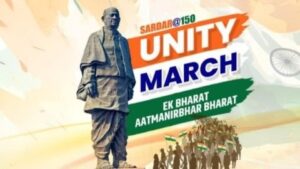
National Movement for Youth Engagement and Legal Awareness:
- Dr. Mansukh Mandaviya, Minister for Youth Affairs and Sports, announced that the march is a nationwide movement, not merely a commemoration, emphasizing the need for a robust legal framework to support national development.
- The campaign seeks to engage youth in nation-building and foster active participation in India’s development journey, promoting access to justice and civic engagement, including awareness of fundamental rights under Article 21 of the Constitution.
- The march aims to ignite a sense of collective responsibility, encouraging young citizens to contribute to social, economic, and civic growth, including marginalized communities, while also addressing issues of judicial pendency and delays.
- The event symbolizes India’s commitment to Viksit Bharat (Developed India) and Aatmanirbhar Bharat (Self-Reliant India), with a focus on strengthening the justice delivery system through initiatives like virtual courts and fast-track courts.
- Through this initiative, the government seeks to promote the ideals of unity, patriotism, and civic consciousness across all regions, strengthening democratic integrity and the principle of separation of powers.
Phases and Vision of the Unity March
- The first phase of the Sardar@150 campaign will be held in every district from 31st October to 25th November 2025, incorporating discussions on judicial accountability and the importance of speedy trials.
- The initiative will include youth parades, debates, and cultural activities celebrating Patel’s ideals and discussing policy implementation, including the role of alternative dispute resolution mechanisms like Lok Adalats.
- It emphasizes the Ek Bharat Shreshtha Bharat spirit, promoting harmony among India’s diverse communities and addressing the need for efficient case disposal and reduction of pending cases.
- The march conveys messages of self-reliance, unity, and swadeshi values, aligning with India’s national development goals and the ongoing e-courts project to modernize the judiciary.
- By involving youth at the grassroots, it aims to transform commemoration into a participatory nation-building movement that enhances public confidence in governance and the overall justice delivery system.
Sardar Vallabhbhai Patel’s Enduring Legacy: |
| ● Sardar Vallabhbhai Patel (1875–1950), known as the Iron Man of India, was India’s first Deputy Prime Minister and Home Minister, instrumental in shaping the country’s legal and administrative framework. |
| ● He played a historic role in integrating over 560 princely states into the Indian Union post-Independence, demonstrating exceptional skills in dispute resolution and contract enforcement. |
| ● Patel was a key leader of India’s freedom struggle, known for his organizational strength and pragmatic leadership, which laid the foundation for many of today’s judicial reforms. |
| ● His legacy of national unity and administrative vision continues to guide India’s governance model and policy implementation, including efforts to improve case management systems and reduce judicial overload. |
| ● The Statue of Unity in Gujarat, inaugurated in 2018, stands as a global tribute to his contributions and symbolizes democratic integrity and the rule of law. |

