 India's No.1 PU & Degree With Integrated IAS & IPS(UPSC/PSC) Training College.


RBI’s ‘Goldilocks’ rate cut: growth, inflation in sync
RBI Cuts Repo Rate Amid Rare Goldilocks Moment
Why in the News ?
The Reserve Bank of India (RBI) has reduced the repo rate by 25 basis points, bringing it down to 5.25%, citing a rare combination of strong economic growth and moderate inflation, signalling supportive monetary policy to sustain India’s growth momentum.
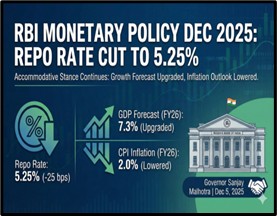
RBI’s Key Announcement and Economic Context:
- The Monetary Policy Committee (MPC) cut the repo rate by 25 basis points, lowering it from 5.50% to 25%.
- RBI Governor Sanjay Malhotra described the current macroeconomic situation as a “rare Goldilocks period”, with 8% GDP growth and 2% inflation.
- The rate cut aligns with market expectations, supported by sustained benign inflation trends.
- A lower repo rate reduces borrowing costs for banks, enabling cheaper loans for consumers and businesses.
- RBI also revised its 2025–26 GDP growth forecast upward to 7.3%, indicating confidence in domestic economic momentum.
Implications for Growth, Lending and Economic Momentum
- Monetary transmission—the pass-through of repo rate cuts to retail lending—may take time but is expected to gradually lower EMIs and borrowing rates.
- The rate cut provides an additional policy stimulus alongside fiscal measures such as income tax reductions and GST cuts.
- Lower rates are expected to boost consumption, complementing government steps to support household spending.
- The move helps cushion the economy against external shocks like US tariffs on Indian exports.
- Experts believe the decision will help sustain growth as some existing cyclical growth drivers ease and fiscal consolidation
Key points : Monetary Policy● Repo Rate: The rate at which the RBI lends to commercial banks; influences overall lending rates. ● Basis Point: One hundredth of a percentage point (0.01%). ● Monetary Policy Committee (MPC): A six-member body created under the RBI Act, 1934 (amended in 2016) to set policy rates. ● Monetary Transmission: The process through which RBI’s policy rate changes impact lending/borrowing rates in the economy. ● Goldilocks Economy: A phase of high growth and low inflation, enabling supportive policy without overheating risks. |

