 India's No.1 PU & Degree With Integrated IAS & IPS(UPSC/PSC) Training College.


Preah Vihear: Temple Border Conflict
Preah Vihear Temple at Centre of Border Conflict
Why in the News ?
The Preah Vihear Temple, a UNESCO World Heritage Site located on the Cambodia–Thailand border, has reportedly suffered damage amid renewed clashes between the two countries, highlighting long-standing territorial disputes and risks to cultural heritage sites.
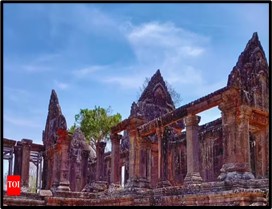
Conflict Around the Preah Vihear Temple:
- The Preah Vihear Temple, located in the Dangrek Mountains along the Cambodia–Thailand border, has become a focal point of renewed military tensions between the two countries.
- Cambodia accused Thailand of attacking the temple complex, while Thailand claimed it was targeting Cambodian military installations within the area.
- Thai authorities released images suggesting the presence of bunkers, artillery positions, and command posts within the temple complex.
- However, independent verification of these claims has been difficult, and Cambodia strongly denies using the temple for military purposes.
- Recent clashes between the two nations have resulted in dozens of casualties and displacement of hundreds of thousands of people on both sides of the border.
Damage and Threat to Cultural Heritage
- The ancient sandstone structures of the temple have reportedly suffered artillery damage, leaving visible holes and structural destruction.
- Parts of the monument, including ornate columns and carvings such as the mythical seven-headed serpent, have been damaged.
- Warning signs around the complex indicate the presence of unexploded ordnance and landmines, posing risks to visitors and conservation efforts.
- Restoration initiatives previously supported by international partners including the United States, China, and India have faced delays due to ongoing instability.
- Local conservation workers fear that some damage to the temple’s historic structures may be irreversible.
About Preah Vihear Temple and Historical Significance:● The Preah Vihear Temple is an 11th–12th century Khmer architectural masterpiece, built primarily as a Hindu temple dedicated to Lord Shiva during the Khmer Empire. ● Located atop a cliff in the Dangrek Mountains, the temple is designed as a series of stone pavilions connected by stairways, symbolising a “stairway to heaven.” ● The temple predates Angkor Wat and reflects the artistic and architectural excellence of the Khmer civilisation. ● In 1962, the International Court of Justice (ICJ) ruled that the temple belongs to Cambodia, although the surrounding border area remains disputed. ● In 2008, the site was designated a UNESCO World Heritage Site, recognising its cultural, architectural, and historical importance. |

