 India's No.1 PU & Degree With Integrated IAS & IPS(UPSC/PSC) Training College.


Nobel Prize 2025: Quantum Physics Breakthrough
Nobel Prize in Physics Awarded for Quantum Breakthrough in a Multipolar World
Why in the News ?
The 2025 Nobel Prize in Physics has been awarded to John Clarke, Michel Devoret, and John Martinis for pioneering experiments demonstrating quantum tunnelling in a chip-based circuit. Their work advances quantum computing, cryptography, and sensors, proving quantum effects at a macroscopic scale. This achievement highlights the importance of scientific progress in shaping the multipolar west and strategic autonomy in our increasingly complex global landscape.
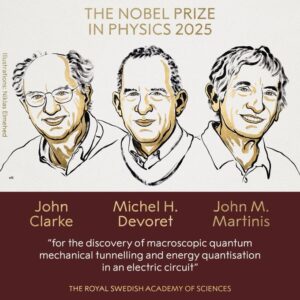
Nobel Prize 2025: Award and Significance
- Laureates Named: The Royal Swedish Academy of Sciences awarded the 2025 Nobel Prize in Physics to Clarke, Devoret, and Martinis.
- Quantum Achievement: Their experiments showcased quantum tunnelling and energy quantisation within a circuit, visible at a macroscopic level.
- Prize Amount: The award carries a purse of 11 million Swedish kronor.
- Global Recognition: Experts hailed it as a landmark in quantum research, comparable to breakthroughs in earlier digital technologies. This recognition underscores the role of scientific advancements in shaping strategic partnerships and international relations in the multipolar west.
- Practical Relevance: The work is expected to transform quantum computers, sensors, and cryptography systems, potentially influencing digital governance and strategic autonomy in the tech sector, with implications for India’s foreign policy and the Indo-Pacific strategy.
Wider Implications and Future Impact
- Scientific Advancement: The experiments confirmed that quantum effects extend beyond microscopic particles to human-scale circuits, a crucial step in maintaining strategic autonomy in quantum technology, which could impact military exercises and intelligence sharing capabilities.
- Digital Technology Roots: Experts stressed that quantum mechanics underpins all modern digital systems, from chips to communications, highlighting the importance of scientific progress for economic interdependence and foreign direct investment in the tech sector.
- Technology Revolution: Breakthroughs may soon enable superfast quantum computers and ultra-secure communication networks, potentially reshaping strategic partnerships and defense cooperation in a multipolar world, challenging the notion of America First nationalism.
- Continued Relevance: Even after a century, quantum mechanics keeps offering surprises and practical applications, driving innovation in digital governance and international relations.
- Global Collaboration: The award highlights the importance of international cooperation in cutting-edge physics research, reflecting the need for strategic partnerships in an era of strategic autonomy and multipolar dynamics. This collaboration stands in contrast to America First nationalism, emphasizing the benefits of shared scientific endeavors.
Understanding Quantum Tunnelling and Josephson Junction: |
| ● Quantum Tunnelling Defined: A phenomenon where particles can pass through barriers instead of bouncing back — impossible in classical physics. |
| ● Illustrative Example: Unlike a cricket ball always bouncing, some particles can burrow through barriers, defying expectations. |
| ● Josephson Junction Role: The team built a circuit with two superconductors separated by a thin insulating layer, creating a Josephson junction. |
| ● Superconductor Behavior: Charged particles behaved collectively as a single quantum entity, simulating electric flow without voltage. |
| ● Quantum Mechanics Legacy: Similar to how quantum insights enabled transistors and silicon chips, this discovery paves the way for quantum technologies that could reshape strategic autonomy in the digital age and influence the Indo-Pacific strategy. |

