 India's No.1 PU & Degree With Integrated IAS & IPS(UPSC/PSC) Training College.


Nipah Virus Resurfaces in Kerala: Fresh Cases Alert
NIPAH VIRUS RESURFACES IN KERALA: FRESH CASES AND ALERT
Why in the News?
- New cases reported: Two fresh Nipah virus infections confirmed in Kerala—an 18-year-old girl (deceased) and a 38-year-old woman under treatment. This recent Nipah virus outbreak has raised concerns about the re-emergence of this deadly zoonotic infection in the state.
- Spread across districts: Cases have emerged in Kozhikode district, Malappuram district, and Palakkad district, sparking widespread concern about potential person-to-person transmission.
- NIV confirmation: The National Institute of Virology (Pune) confirmed Nipah in the 38-year-old patient, highlighting the importance of rapid diagnostic procedures in managing the outbreak.
Government Response and Containment
- Contact tracing: 345 contacts identified—211 in Malappuram, 91 in Palakkad, and 43 in Kozhikode. This extensive tracing is crucial for controlling the spread of the virus in Kerala.
- Health protocols: Nipah protocols initiated early; 26 committees formed across affected districts to implement preventive measures and coordinate public health interventions.
- Zonal control: Containment zones declared; masks mandatory in public in affected areas to minimize person-to-person transmission and enforce social distancing.
- Police assistance: Sought for contact tracing, along with helplines at district and state levels to support risk communication and community awareness.
Ongoing Surveillance and Guidelines
- Healthcare precautions: Doctors and staff involved in treatment/post-mortem quarantined to prevent potential spread among healthcare workers.
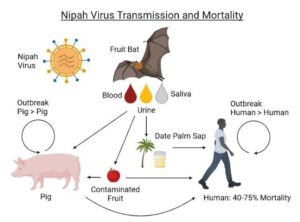
- Public guidelines: Citizens warned not to disturb roosting bats or create disturbances, recognizing the role of fruit bats and flying foxes as the natural reservoir of the Nipah virus.
- Field inquiry: Teams collecting pneumonia/encephalitis history from past three weeks to identify potential Nipah virus cases and understand the outbreak’s progression.
NIPAH VIRUS |
| ● Nature: A zoonotic infection transmitted from animals (bats) to humans, with high mortality rates. |
| ● Symptoms: Causes fever, acute encephalitis syndrome, respiratory distress, and coma in severe cases. The incubation period typically ranges from 4 to 14 days. |
| ● Transmission: Spread through body fluids, respiratory droplets, or contaminated food. Person-to-person transmission is also possible, especially in healthcare settings. |
| ● History in India: Notable outbreaks in Kerala (2018, 2021, 2023); known for cluster-based transmission. The case-fatality rate has been high in previous outbreaks. |
| ● Prevention: Emphasizes early detection, quarantine, disease surveillance, and bat-to-human barrier methods. Public health interventions and wildlife conservation efforts are crucial in preventing future outbreaks. |

