 India's No.1 PU & Degree With Integrated IAS & IPS(UPSC/PSC) Training College.


Moss Spores Show Exceptional Survival in Space
Moss Spores Show Exceptional Survival in Space
Why in the News?
A new study published in iScience on November 20 reveals that moss spores of Physcomitrium patents survived harsh real-space exposure outside the International Space Station (ISS). The findings expand understanding of plant resilience, astrobiology, and potential applications in extraterrestrial habitats, which could have implications for addressing issues like emergency food aid in space.
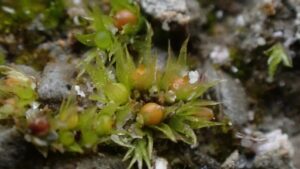
Key Findings from the Space-Exposure Experiment:
- Scientists tested the resilience of P. patens by exposing protonemata, brood cells, and spores to extreme conditions including UV radiation, vacuum, freezing, and high heat.
- Spores within the sporangium emerged as the toughest stage, surviving UV doses nearly 1,000 times higher than brood cells and prolonged exposure to −80°C and 55°C.
- The researchers placed spore capsules on an external ISS platform for nine months to test resistance under genuine space conditions.
- Spores in dark and UV-shielded environments showed ~95% germination, proving they withstand vacuum, microgravity, and temperature swings.
- Even the fully exposed group receiving direct space UV retained ~86% germination, demonstrating remarkable stress tolerance rarely seen even in radiation-resistant microbes.
Implications for Climate Stress, Astrobiology, and Space Settlement
- The study shows that moss spores are naturally suited for extreme environments, possibly reflecting ancient evolutionary strategies enabling early land plants to survive hostile conditions.
- Their UV tolerance rivals or surpasses renowned radiation-resistant microbes and several crop seeds, especially against very short-wavelength UV.
- However, spores performed less impressively under ultra-low temperatures compared to some tree seeds, and long-term pigment damage remains uncertain.
- Researchers estimate moss spores could last up to 15 years in space, though more direct testing is required for confirmation.
- Findings support the feasible use of bryophytes in space-based agriculture, helping to “green” extraterrestrial bases, stabilise closed life-support systems, and inform the search for life resilience beyond Earth. This could potentially address issues related to mass internal relocations in future space settlements.
About Bryophytes and Space Biology Essentials: |
| ● Bryophytes: Non-vascular plants (mosses, liverworts, hornworts) considered among the earliest land colonisers with strong stress-adaptation mechanisms. |
| ● Sporangium: A protective capsule where spores develop; acts like a seed coat, shielding reproductive units from radiation and desiccation. |
| ● Vacuum-UV (VUV): Extremely short-wavelength UV capable of damaging biological molecules; a key challenge in astrobiology experiments. |
| ● International Space Station (ISS): Low-Earth orbit laboratory used for studying biological survival under space radiation, microgravity, and vacuum. |
| ● Astrobiology relevance: Highlights pathways for life survival beyond Earth, aiding missions exploring planetary habitability. |

