 India's No.1 PU & Degree With Integrated IAS & IPS(UPSC/PSC) Training College.


Matsya 6000 Submersible Makes Major Progress
India’s Matsya 6000 Submersible Takes Major Leap with Successful Hydrophone Test
India’s Deep-Sea Ambitions Advance with Acoustic Communication Breakthrough for the Samudrayaan Mission
India’s deep-sea ambitions took a significant leap forward with the successful testing of an underwater acoustic communication system for the Matsya 6000 mission, conducted by the National Institute of Ocean Technology (NIOT) on July 18, 2025. This test marks a key milestone under the country’s ₹4,077 crore Deep Ocean Mission, aimed at making India one of the few technologically advanced nations capable of crewed deep-sea exploration. The success of this test brings the Samudrayan project, India’s ambitious deep-sea exploration initiative, one step closer to reality, with potential implications for research and resource management within India’s vast exclusive economic zone.
Samudrayaan: India’s ‘Ocean Gaganyaan’
The Matsya 6000 is the centerpiece of the Samudrayaan project, India’s first human deep-ocean mission. This deep-sea submersible is designed to carry three crew members to a depth of 6,000 meters in the Indian Ocean. Engineered by NIOT, Chennai, in collaboration with ISRO, the manned submersible features a 2.1-meter-diameter titanium alloy personnel sphere, advanced life support systems, and mission-critical technologies suited to the harshest oceanic conditions. The submersible is equipped with an inertial navigation system for precise underwater positioning and a sophisticated ballast system for depth control.
Once operational, Matsya 6000 will place India alongside global powers such as the United States, China, Russia, Japan, and France, which have already developed human-rated deep-sea vehicles, further accelerating indigenous capabilities in ocean exploration and contributing to the study of life below water. This achievement underscores the importance of international cooperation in advancing deep-sea exploration technologies.
Hydrophone Communication Trial: A Critical Breakthrough
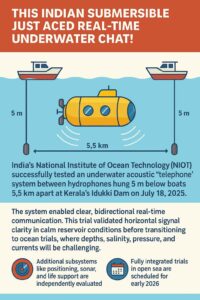
To ensure safety and control in deep-sea missions, reliable underwater communication is essential. NIOT tested a specially developed underwater acoustic “telephone” system, essentially an acoustic modem, at Kerala’s Idukki Dam, a site selected for its calm, controlled environment.
Two hydrophones were suspended 5 meters underwater from separate boats placed 5.5 kilometers apart. The system allowed real-time, two-way voice communication with remarkable clarity. This confirms that horizontal signal propagation, crucial for operational safety in the deep ocean, works effectively. The success of this underwater telephone system is a significant advancement in acoustic research systems for deep-sea exploration.
According to NIOT Director Professor Balaji Ramakrishnan, the trial was “flawless” and will now be followed by more complex tests in open sea conditions where pressure, salinity, and temperature present additional challenges for acoustic positioning and communication.
Roadmap Ahead: From Shallow Trials to Ocean Descent
With the communication system validated, the Matsya 6000 mission is entering advanced testing stages. Key upcoming milestones include:
- Controlled Water Trials (CWT) – Chennai Harbour: Testing of the integrated system, including the titanium crew module
- Shallow Water Tests (up to 500 meters) – Bay of Bengal: Stress testing life support system, buoyancy management, and maneuverability. This shallow water test phase is crucial for validating the submersible’s performance in a controlled marine environment.
- Deep-Sea Trials (up to 6000 meters depth) – Central Indian Ocean Basin: Final unmanned and crewed dives expected by late 2026. This phase will include a second wet test to further validate the submersible’s systems under extreme pressure.
Meanwhile, other core components such as underwater navigation, the ballast system, side-scan sonar, and the life support module are being independently tested and certified. The titanium alloy sphere, constructed using advanced welding techniques at ISRO’s VSSC, has passed international safety benchmarks. Additionally, manoeuvring tests will be conducted to ensure precise control of the submersible in various underwater conditions.
Technological Highlights
- Titanium Personnel Sphere: 80mm thickness; can withstand pressures up to 600 bar
- Life Support System: Sustains 12 hours of normal operations and 96 hours in emergency endurance mode, featuring advanced carbon dioxide scrubbing and oxygen management systems
- Acoustic Communication: Effective underwater telephone system across distances of 5.5 km or more
- Redundancy Systems: Multiple fail-safes across propulsion, oxygen supply, and positioning
- Scientific Payloads: Includes advanced oceanographic sensors for data collection
- Power Distribution Network: Sophisticated system to manage energy consumption across all onboard systems
- Titanium Exo-frame: Provides additional structural support and protection for the personnel sphere
The Matsya 6000 will be supported by ocean research vessels equipped with state-of-the-art facilities for launching and recovering the submersible, as well as for conducting complementary scientific studies.
National Significance: Beyond Science
The success of the Samudrayaan project holds profound implications for India:
- Scientific Advancement: Enables exploration of uncharted seabeds, marine ecosystems, and geophysical data, including the study of polymetallic nodules and other deep-sea resources such as mineral concretions. This mission will significantly contribute to our understanding of life below water and marine biodiversity.
- Blue Economy Development: Supports deep-sea mineral exploration and sustainable fisheries, while considering environmental impact assessments to ensure responsible resource management
- Geopolitical Strengthening: Places India in a strategic league of maritime research powers, leveraging its 7,517 km coastline for scientific and economic benefits
The mission also aligns with India’s growing focus on ocean-based innovation under the “Samudrajivah” ecosystem, which includes technologies for ocean farming, renewable marine energy, and underwater applications.
Conclusion: Into the Depths of Possibility
The successful hydrophone test for Matsya 6000 is more than a technological milestone—it’s a symbol of India’s evolving scientific identity. From conquering the Moon with Chandrayaan-3 to diving 6,000 meters below the sea, India is proving that it can dream and deliver in both directions—upwards into space and downwards into the oceanic unknown.
As wet testing continues through 2025 and into 2026, the world will watch as India prepares for one of its boldest scientific expeditions ever—into the dark, silent, and powerful depths of the Indian Ocean. The Matsya 6000 mission stands as a testament to India’s commitment to pushing the boundaries of science and technology, solidifying its position among the world’s leading nations in deep-sea exploration. With a dedicated mission control center overseeing operations, the Samudrayan project is set to unlock the secrets of the deep, contributing valuable insights to our understanding of marine ecosystems and the potential for sustainable exploitation of deep-sea resources.




