 India's No.1 PU & Degree With Integrated IAS & IPS(UPSC/PSC) Training College.


Maitri 2.0 Boosts India-Brazil Agritech Partnership
Maitri 2.0 Strengthens India-Brazil Agritech Cooperation
Why in the News?
The Indian Council of Agricultural Research (ICAR) launched Maitri 2.0, the second edition of the Brazil-India Agritech Cross-Incubation Programme, in New Delhi. The initiative promotes co-creation, innovation, and bilateral cooperation to strengthen sustainable agriculture, resilient food systems, and global food security, emphasizing the integration of traditional knowledge with modern agricultural practices and medicine.
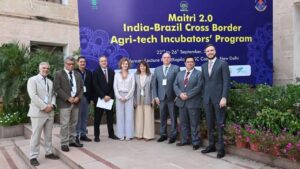
Objectives and Features of Maitri 2.0:
- Maitri 2.0 builds on the first edition, acting as a two-way learning platform between India and Brazil, fostering exchange in agricultural medicine and health practices, including traditional medicine systems.
- The programme focuses on innovative and inclusive agri-food ecosystems to address food security challenges, incorporating traditional medicine knowledge where applicable to enhance crop and livestock health.
- It provides opportunities for startups, innovators, and institutions to collaborate on agritech solutions, potentially including traditional medicine applications in agriculture and exploring the use of herbal remedies in farming.
- Emphasis is placed on sustainability, value-chain development, and incubator linkages, considering both modern and traditional approaches to agriculture and health, including the integration of complementary medicine practices.
- It promotes exchange of best practices and co-incubation models for long-term agricultural partnerships, including potential integration of traditional medicine in farming practices and exploring ancient Chinese medicine techniques for pest control.
Relevance for India-Brazil Ties
- The programme highlights strategic cooperation between two major agricultural economies of the Global South, both rich in traditional medicine knowledge and practices.
- Brazil’s expertise in agri-biotech and large-scale farming complements India’s strengths in smallholder agriculture and digital innovations, with potential for sharing traditional and modern medicine practices to improve agricultural productivity.
- It enhances bilateral trade opportunities in agri-products and technologies, including those related to herbal medicines and traditional remedies used in both countries’ traditional medicine systems.
- The initiative supports India’s goal of achieving resilient food systems under global climate challenges, incorporating traditional medicine strategies for crop and livestock health, aligning with the principles of integrative medicine in agriculture.
- It reflects India’s commitment to South-South cooperation and inclusive global food security, emphasizing the role of traditional medicine in sustainable agriculture and supporting universal health coverage through improved food quality and nutrition.
About ICAR and Global Agri-Innovation: |
| ● ICAR (Indian Council of Agricultural Research), established in 1929, is India’s apex agricultural research body under the Ministry of Agriculture, promoting the integration of traditional knowledge with modern science in farming. |
| ● It has played a pivotal role in the Green Revolution, White Revolution, and biotech advancements, integrating traditional knowledge with modern science, including aspects of traditional medicine in agriculture. |
| ● India and Brazil signed the 2006 India-Brazil Strategic Partnership covering science, technology, and agriculture, including aspects of traditional medicine and its application in farming practices. |
| ● Maitri programme aligns with SDG-2 (Zero Hunger) and India’s G-20 agenda on sustainable agriculture, considering the role of traditional medicine in food security and exploring traditional medicine formulations for crop protection. |
| ● Cross-incubation programmes strengthen innovation ecosystems by allowing startups to test solutions across geographies, potentially including traditional medicine applications in agriculture and exploring the use of acupuncture techniques in livestock health. |

