 India's No.1 PU & Degree With Integrated IAS & IPS(UPSC/PSC) Training College.


Lok Sabha Debates Health and Security Cess Bill
Lok Sabha Debates Health and Security Cess Bill
Why in the News?
The Lok Sabha has taken up the Health Security & National Security Cess Bill, 2025, which proposes a cess on pan masala production to generate funds for key national priorities like health security and national security, without burdening essential commodities or common citizens. The bill also addresses the need for environmental clearances in the pan masala industry.
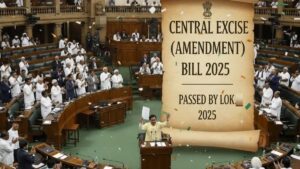
Key Provisions of the Health & National Security Cess Bill:
- The Bill aims to impose a dedicated cess on production of pan masala, classified as a demerit good due to severe health risks and environmental concerns, requiring manufacturers to obtain ex post facto environmental clearances.
- Finance Minister Nirmala Sitharaman stated that the cess is meant to raise resources for health security and national security without affecting essential items, while also promoting environmental democracy.
- The cess revenue will be shared with states specifically for health schemes, welfare initiatives, and environmental protection measures aligned with the Forest Conservation Act.
- Apart from the existing 40% GST on pan masala, the new cess will be levied based on the production capacity of manufacturing units, considering their compliance with Coastal Regulation Zone norms.
- The intent is to discourage consumption of harmful products while securing stable funding for critical national priorities and ensuring adherence to environmental impact assessment guidelines.
Parliamentary Positions and Debate Highlights
- Congress MP Varun Chaudhry urged that the Bill be sent to a Select Committee for detailed examination, including a review of its alignment with environmental jurisprudence.
- BJP MP Jagdambika Pal supported the measure, emphasising that cess on demerit goods strengthens public health spending and environmental protection efforts.
- Congress MP Karti Chidambaram criticised the Bill as anti-federal, arguing cess revenues are often not utilised for state development or pollution free environment initiatives.
- CPI(M) MP R. Sachithanantham demanded a 50% share of cess revenue for states and called for a complete ban on tobacco products, citing the polluter pays principle.
- NCP (SCP) MP Supriya Sule appreciated the intent but flagged concerns about repeated reliance on cess mechanisms instead of regular taxation, suggesting the need for comprehensive environmental clearances.
- DMK MP Thamizachi Thangapandiyan said the Bill worsens fiscal imbalance between Centre and states, potentially impacting environmental protection efforts.
- The debate remained inconclusive, with further discussion expected on both fiscal and environmental aspects.
Understanding Cess, Demerit Goods & Fiscal Federalism: |
| – Cess: A tax levied for a specific purpose; proceeds may or may not be shared with states, depending on legislation and environmental jurisprudence. |
| – Article 270 (Finance Commission-related): Governments sharing of taxes between Centre and states; cesses are generally not shareable, creating tension in fiscal federalism and environmental governance. |
| – Demerit Goods: Products like pan masala, tobacco, alcohol, considered harmful; governments often impose higher taxes to discourage consumption (sin taxes) and may require ex post facto environmental clearances. |
| – GST & Cess Structure: While GST applies uniformly, cesses can be added on top, especially for health, environmental concerns, or pollution free environment initiatives. |
| – Fiscal Imbalance Debate: States argue that frequent use of cesses reduces the divisible pool, lowering their share of revenues—an important issue in Indian federal finance and environmental protection efforts. |

