 India's No.1 PU & Degree With Integrated IAS & IPS(UPSC/PSC) Training College.


ISRO & DRDO Join Forces for Quantum-Safe Networks
India’s Quantum Leap: ISRO and DRDO Collaborate to Build Quantum-Safe Communication Networks
In a bold step towards safeguarding national security and digital sovereignty, India’s premier research institutions—the Indian Space Research Organisation (ISRO) and the Defence Research and Development Organisation (DRDO)—have partnered to develop quantum-safe communication networks. This initiative is designed to future-proof India’s communication systems against the emerging threat of quantum-powered cyberattacks. The collaboration also involves other prestigious institutions, including IIT Delhi, known for its cutting-edge research in quantum technologies.
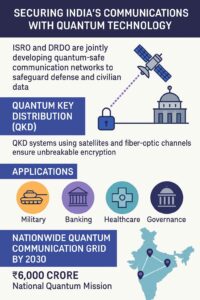
Quantum computing, while promising revolutionary advancements in processing power, poses a significant risk to traditional encryption systems such as RSA and ECC. These algorithms, which currently protect banking, defense, and digital platforms, could be rendered obsolete by quantum algorithms like Shor’s Algorithm, capable of breaking them in seconds. To counter this threat, ISRO and DRDO are working on building post-quantum cryptographic systems, particularly focusing on Quantum Key Distribution (QKD). QKD uses quantum mechanics principles, including quantum entanglement, to secure communications in a way that any attempt at interception is immediately detectable.
The collaboration aims to develop a full suite of quantum communication tools, including QKD systems over optical fiber and satellite networks, Quantum Random Number Generators (QRNGs), and trusted node infrastructure. By combining ISRO’s expertise in satellite communication with DRDO’s proficiency in encryption and defense systems, the partnership seeks to establish secure, scalable, and indigenously developed quantum networks. The DRDO chairman emphasized the importance of this project for national security, stating that it will significantly enhance India’s cybersecurity capabilities.
Significant progress has already been made. In 2024, DRDO successfully demonstrated QKD over a 100-kilometre optical fiber link between its laboratories, achieving an impressive secure key rate that ensures robust encryption. ISRO is also gearing up to launch QKD payloads aboard its upcoming satellites, marking a crucial step in extending quantum-safe communication beyond terrestrial boundaries. This initiative builds upon the groundwork laid during K. Sivan’s tenure as ISRO chairman, who had initially proposed the integration of quantum technologies in space communications.
While the primary goal is to secure military and strategic communications, the technology has broad civilian applications. Sectors such as banking, healthcare, e-governance, and energy infrastructure stand to benefit from enhanced data protection and breach detection capabilities. This initiative also aligns with India’s ₹6,000 crore National Quantum Mission, which aims to establish India as a global leader in quantum science and technology by 2030.
The development of quantum software and quantum software stacks is a critical component of this project. These software solutions will enable the practical implementation of quantum cryptography protocols and the management of quantum networks. Researchers from IIT Delhi are contributing their expertise in quantum software development, ensuring that India builds a comprehensive ecosystem for quantum communication technologies.
India’s foray into quantum-secure communication places it alongside global leaders like China, the United States, and the European Union, all of whom are investing heavily in quantum-resistant infrastructure. What sets India apart is its commitment to developing indigenous, dual-use technologies that can serve both strategic and civilian needs.
The ISRO–DRDO collaboration represents not only a technological advancement but also a strategic vision for a digitally secure India. As quantum computing moves from theoretical promise to practical application, India is proactively building the defences required to navigate this new frontier with confidence and capability. The integration of quantum entanglement principles in communication systems and the development of robust quantum networks will ensure that India remains at the forefront of secure communication technologies in the quantum era.




