 India's No.1 PU & Degree With Integrated IAS & IPS(UPSC/PSC) Training College.


India’s Deltas Sinking: 23 Cr at Risk
INDIA’S RIVER DELTAS SINKING RAPIDLY
Why in the News?
- Global study alert: An international research team has found systemic land subsidence across India’s major river deltas, driven largely by human activities, potentially requiring environmental impact assessments.
- Satellite evidence: The findings are based on high-resolution satellite data (2014–2023) and were published in Nature on January 14, highlighting the need for environmental clearances in delta regions.
- High population risk: India’s sinking deltas support millions of people, making subsidence a major climate and development concern, potentially impacting the Coastal Regulation Zone.
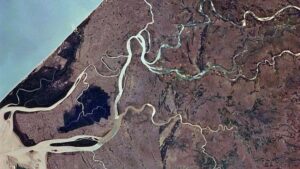
KEY SCIENTIFIC FINDINGS FROM THE STUDY
- Advanced methods: Researchers used interferometric synthetic aperture radar from European Space Agency‘s Sentinel-1 satellites at 75-metre spatial resolution, contributing to environmental jurisprudence.
- Multiple stressors: Subsidence rates were correlated using machine-learning models with groundwater depletion, sediment flux reduction, and urban expansion, factors that may require ex post facto environmental clearances.
- Widespread sinking: The Ganges-Brahmaputra, Brahmani, Mahanadi, Godavari, Cauvery, and Kabani deltas are all confirmed to be losing elevation, potentially affecting the Coastal Regulation Zone.
- Severe hotspots: Over 90% area loss was recorded in the Ganges-Brahmaputra, Brahmani, and Mahanadi deltas, signalling systemic vulnerability and the need for environmental impact assessments.
- Beyond sea-level rise: In most Indian deltas, land subsidence exceeds regional sea-level rise, sharply increasing flood and inundation risks, emphasizing the importance of the precautionary principle.
HUMAN DRIVERS AND REGIONAL VARIATIONS
- Groundwater overuse: Unsustainable groundwater extraction is the dominant cause in the Ganges-Brahmaputra and Cauvery deltas, accelerating land compaction and potentially violating the polluter pays principle.
- Urban pressure: Rapid urbanisation has heavily impacted the Brahmani delta, with infrastructure weight intensifying subsidence, possibly requiring retrospective environmental clearances.
- City effect: In Kolkata, subsidence equals or exceeds delta averages due to resource consumption and urban load, highlighting the need for environmental democracy in urban planning.
- Critical thresholds: Large portions of the Brahmani (77%) and Mahanadi (69%) deltas are sinking faster than 5 mm per year, potentially impacting the Coastal Regulation Zone.
- Future risks: Even under extreme climate scenarios, Godavari delta subsidence is projected to outpace global sea-level rise, emphasizing the need for robust environmental jurisprudence.
DELTA SUBSIDENCE AND CLIMATE RISK |
| ● Natural vs human causes: While deltas naturally subside due to sediment compaction, human interventions have sharply accelerated this geological process, potentially requiring ex-post facto environmental clearances. |
| ● Flood vulnerability: Sinking deltas face frequent coastal and river flooding, amplifying disaster risks under climate change and necessitating adherence to the precautionary principle. |
| ● Freshwater threat: Saltwater intrusion contaminates aquifers and farmland, undermining agriculture and drinking water security, potentially violating the right to a pollution-free environment. |
| ● Economic damage: Ports, transport networks, and urban infrastructure face long-term structural risks from uneven land sinking, requiring environmental impact assessments for future developments. |
| ● Governance gap: The Ganges-Brahmaputra delta has shifted from a latent threat to an “unprepared diver”, with risks rising faster than institutional capacity, highlighting the need for stronger environmental democracy. |

