 India's No.1 PU & Degree With Integrated IAS & IPS(UPSC/PSC) Training College.


Indian Air Force to Induct 120-kg Smart Bomb
Indian Air Force to Induct Indigenous 120-kg Smart Bomb with 100-km Range
The Indian Air Force (IAF) is set to enhance its standoff strike capabilities by acquiring the Smart Anti-Airfield Weapon (SAAW). This precision-guided munition is indigenously developed as part of India’s self-reliance in defense initiative. The 120-kg long-range glide bomb boasts an impressive range of up to 100 kilometres. It significantly bolsters the IAF’s arsenal of indigenous defense solutions. The Defence Research and Development Organisation (DRDO) has spearheaded the development of SAAW. Significant contributions have come from the Research Centre Imarat.
SAAW is designed to target and destroy key enemy airfields and their assets such as runways, aircraft hangars, radars, and reinforced structures with pinpoint accuracy. This advanced weapon utilizes a combination of satellite-based navigation systems (GPS/NavIC) and an inertial navigation system for guidance. It delivers a Circular Error Probable (CEP) of less than 7 metres. Thus, it is a powerful and precise standoff weapon. The incorporation of autonomous navigation capabilities further enhances its effectiveness in diverse combat scenarios.
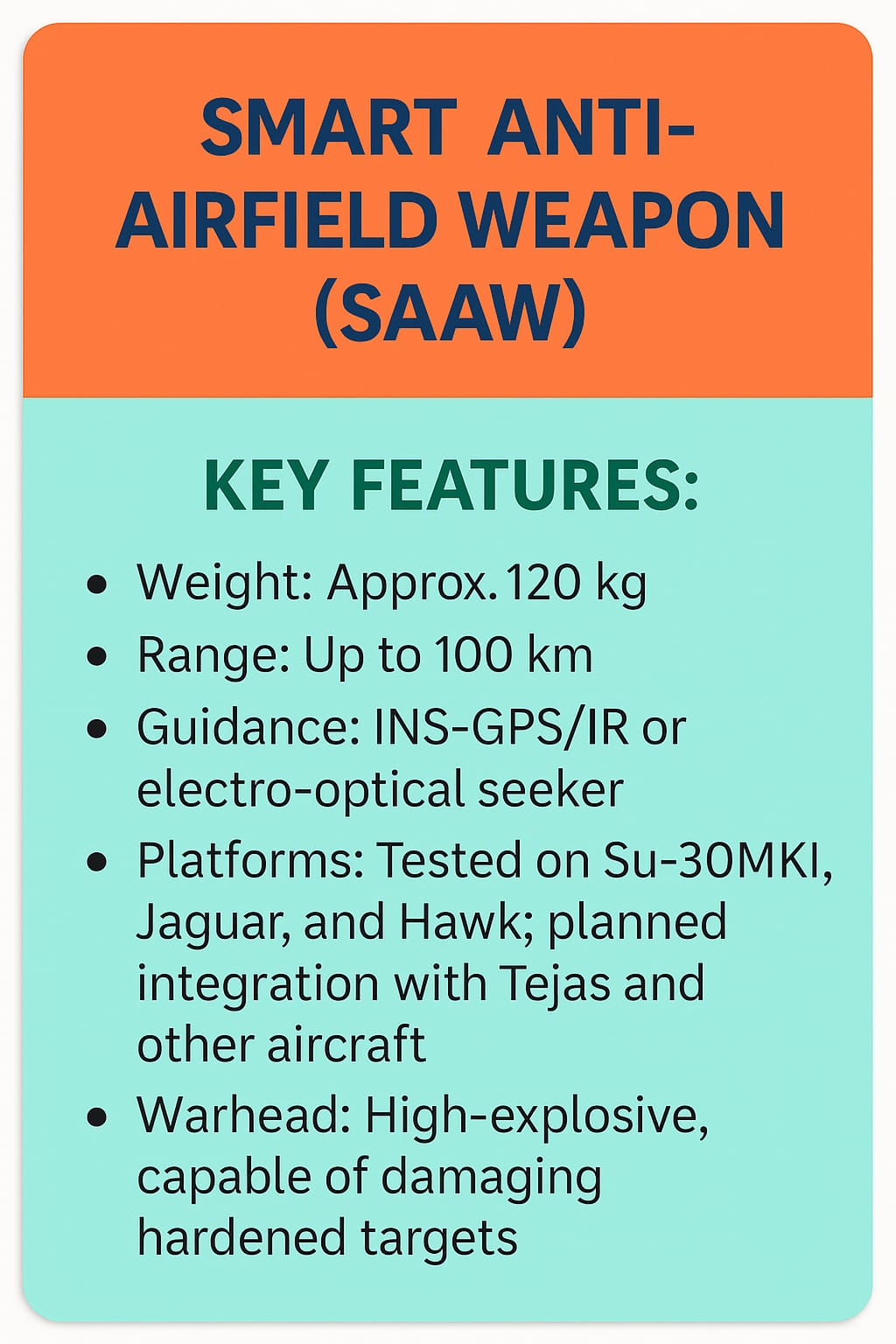
Key features of SAAW include:
- Weight: Approximately 120 kg
- Range: Up to 100 km
- Guidance: INS-GPS/IR or electro-optical sensors with autonomous navigation
- Launch platform compatibility: Tested on Sukhoi Su-30 MKI, SEPECAT Jaguar, and Hawk; planned integration with HAL Tejas Mk1A, Dassault Rafale, and other aircraft as potential launch platforms
- Warhead: High explosive warhead, with potential for multiple warhead configurations
- Aerodynamic design: Featuring control surfaces and foldable wings for improved glide ratio
- Operational flexibility: Compatible with multiple launch platform options in the fighter jet fleet
The IAF has already conducted successful trials of SAAW under various environmental conditions, demonstrating its effectiveness and reliability. These tests have been carried out at various locations, including the Integrated Test Range and Pokhran Range. This ensures the weapon’s performance across different terrains and scenarios. The Ministry of Defence is reportedly reviewing its induction proposal, considering factors such as military airworthiness and release conditions. There are discussions about emergency procurement to fast-track the acquisition process.
Once inducted, SAAW will significantly enhance India’s precision warfare capabilities. It will provide the ability to neutralize enemy air defenses and strategic targets from a safe distance. This long-range glide bomb offers operational flexibility, allowing for deployment from various launch platforms in the IAF’s inventory. These include the Sukhoi Su-30 MKI, SEPECAT Jaguar, and the HAL Tejas Mk1A developed by Hindustan Aeronautics Limited.
The weapon's advanced guidance systems include electro-optical sensors and imaging infrared homing capabilities. These ensure its effectiveness in diverse combat scenarios. Its aerodynamic surfaces and foldable wings contribute to its extended range and maneuverability. Additionally, they allow it to glide towards targets with high accuracy. The potential for multiple warhead configurations could further expand its versatility in different mission profiles.
SAAW’s development aligns perfectly with India’s Atmanirbhar Bharat (Self-Reliant India) initiative. This showcases the country’s growing prowess in defense technology and strategic autonomy. By reducing dependence on imported munitions, this indigenous precision-guided munition not only enhances India’s military capabilities but also strengthens its defense industrial base. Plans for mass production of SAAW are being considered. Thus, Bharat Dynamics Limited and potentially Bharat Forge are emerging as partners for large-scale manufacturing.
As the IAF moves closer to inducting SAAW into its arsenal, it marks a significant milestone in India’s journey towards self-reliance in defense. It underscores the nation’s commitment to developing advanced, home-grown military technologies. The successful development and deployment of SAAW will undoubtedly contribute to regional security. Furthermore, it will reinforce India’s position as a growing power in defense innovation.
The integration of SAAW into the IAF’s inventory represents a major leap forward in India’s capabilities in long-range glide bombs. The weapon’s compatibility with various launch platforms is enhanced by potential integration with dual rack pylons. This allows for increased payload capacity on fighter aircraft. The dual rack pylon system enables each launch platform to carry multiple SAAW units. Consequently, this significantly increases the weapon’s operational effectiveness and strike potential. As the project progresses, there may be opportunities for collaboration with private sector entities like Adani Defence Systems. Thus, this further strengthens the country’s defense ecosystem.
The successful induction of SAAW will not only enhance India’s military preparedness but also pave the way for the development of more advanced precision-guided munitions in the future. With its ability to target reinforced structures and critical infrastructure from standoff ranges, SAAW provides the IAF with a significant tactical advantage in potential conflict scenarios. As India continues to invest in indigenous defense technologies, the SAAW program stands as a testament to the country’s growing capabilities. It demonstrates the development of sophisticated weapon systems tailored to its strategic needs, including advanced launch platform integration and dual rack pylon compatibility for enhanced operational flexibility.

