 India's No.1 PU & Degree With Integrated IAS & IPS(UPSC/PSC) Training College.


India Mandates One Standard Time for Official Use
India Mandates One Standard Time for Official Use
Why in the News ?
The Union Government has notified the Legal Metrology (Indian Standard Time) Rules, 2026, making Indian Standard Time (IST) the common time reference for legal, administrative, commercial and official purposes. The rules will take effect after a 180-day compliance period.
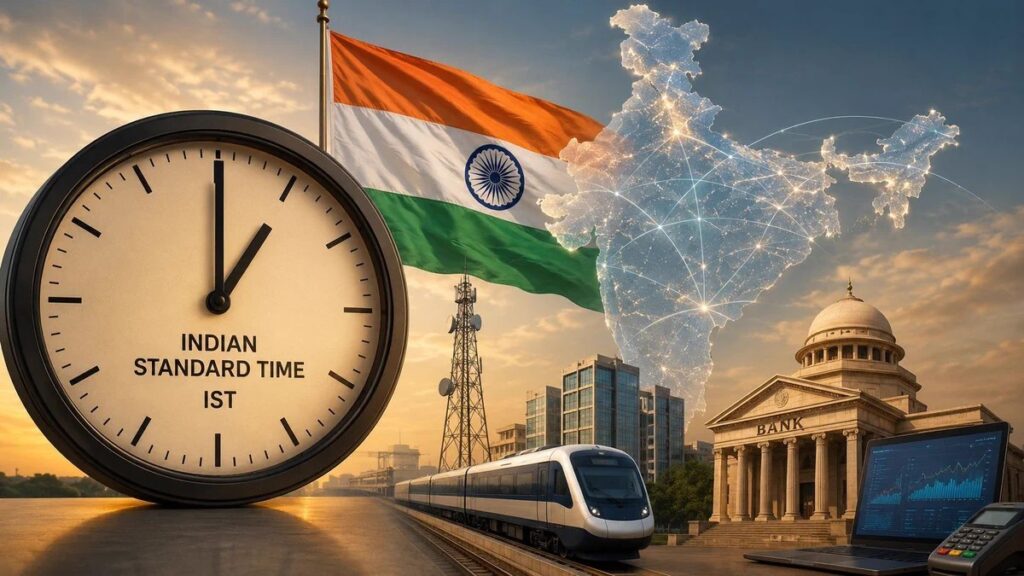
Uniform IST for India’s Critical Systems
- The Ministry of Consumer Affairs notified the rules on August 27, 2026, establishing IST as the single reference time across the country.
- The rules will become operational 180 days after publication in the Official Gazette, allowing government departments, businesses and institutions to modify their systems.
- The move addresses the growing dependence on accurate and synchronised timestamps across technology-driven activities.
- Uniform IST will facilitate precise time-stamping of banking transactions and digital payments, reducing discrepancies between different time sources.
- It will also improve coordination among railways, airports and other transport systems, where synchronised timing is essential.
- Accurate timekeeping is important for telecommunication networks, internet services and power grids, where even small timing differences can affect system coordination.
- Government and legal records, along with emergency and other time-sensitive services, are also expected to benefit from a common national time reference.
Reducing Foreign Dependence and Strengthening Infrastructure
- A significant objective of the rules is to reduce dependence on foreign satellite-based time sources used by several critical systems.
- The government is developing infrastructure to disseminate accurate IST through Indian institutions and legal metrology laboratories.
- Indigenous dissemination of standard time can strengthen digital infrastructure resilience and reduce vulnerabilities arising from dependence on external timing sources.
- Uniform timekeeping can improve interoperability among government agencies, financial institutions, transport networks and other critical infrastructure.
- The 180-day transition period will provide stakeholders sufficient time to calibrate systems, update software and align operational procedures with the new national standard.
About Indian Standard Time and Timekeeping:
- Indian Standard Time (IST) is based on the 82°30′ East longitude, which passes near Mirzapur, Uttar Pradesh, and represents India’s standard time zone.
- IST corresponds to UTC +5:30 and is used uniformly across the country despite India’s considerable east-west geographical extent.
- The Legal Metrology framework deals with standards and accuracy in measurements, supporting reliability in commercial and regulatory activities.
- Precise time synchronisation has become increasingly important with the expansion of digital payments, telecommunications, satellite navigation, financial markets and computer networks.
- A reliable national time standard strengthens technological sovereignty, particularly for critical infrastructure and strategic systems.

